
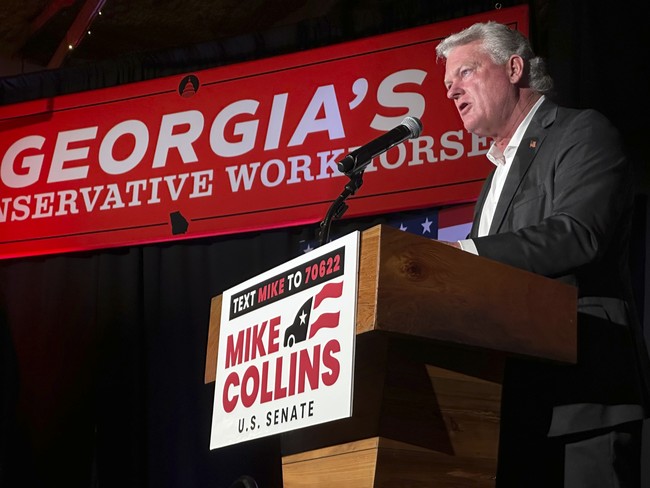
This article breaks down the latest polling and political dynamics in the Georgia Republican Senate runoff, focusing on Rep. Mike Collins’ growing advantage over Derek Dooley, the campaigns’ messaging contrasts, and the stakes for Republicans ahead of the June 16, 2026 election.
The May 19 primary left Georgia Republicans heading to a runoff after no candidate reached 50 plus 1. Rep. Mike Collins finished first with 40.5 percent while Derek Dooley took 30.9 percent, producing a runoff that will decide who faces Sen. Jon Ossoff in November. That spacing set up a high-stakes contest where turnouts and undecided voters will be decisive two weeks out from the runoff.
A fresh JMC Analytics and Polling survey released in late May shows Collins widening his lead to 16 points over Dooley. The same poll found undecided voters leaning toward Collins at 39 percent compared with 27 percent for Dooley, signaling momentum for the congressman as the runoff approaches.
https://x.com/OpenSourceZone/status/2060158147101114443
Favorability dynamics matter here: the poll reported 25 percent of voters view Collins as “very favorable,” while Dooley registers 16 percent in that category. Those perception gaps track with the messaging differences each campaign is running and could influence soft voters who decide late. With such margins, the campaign playbook will prioritize shoring up base turnout and converting the soft undecideds.
Collins has built a profile as a two-term congressman focused on fiscal discipline, small business support, and policies aimed at working families. He authored the Laken Riley Act and worked to move it through the House, positioning himself as a lawmaker who gets things done on serious issues. His platform emphasizes strong border security, firm immigration enforcement including mass deportations, robust support for veterans and the military, and alignment with the broader MAGA policy agenda.
Despite Collins’ alignment with the priorities that energized the 2016 and 2020 Republican electorate, former President Donald Trump has not made a public endorsement in this race. That absence leaves room for local endorsements and grassroots mobilization to play out as Collins seeks to convert poll numbers into votes. The campaign’s immediate task is turning favorable views into actual ballots at the polls on June 16, 2026.
Derek Dooley, better known to many as a former University of Tennessee football coach, is pitching a different, more centrist message under the banner of “Georgia First.” He emphasizes safer communities, investments in education and skills training aimed at higher-paying jobs, and economic affordability for families across the state. Dooley’s approach seeks to appeal to suburban and moderate Republican voters by stressing state-focused solutions rather than national culture-war fights.
Dooley has secured the endorsement of Georgia Governor Brian Kemp, which gives his campaign an institutional boost inside the state GOP. Kemp’s backing signals establishment support that could help with fundraising and outreach to certain voter blocs. Still, endorsements alone rarely close double-digit polling gaps without a sustained ground game and compelling persuasion operations.
Turnout will be the ultimate decider in a runoff scheduled for June 16, 2026, where both campaigns must motivate their supporters and neutralize apathy. Runoffs are timing contests where organization and discipline frequently outpace short-term messaging wins. For Republicans, holding this seat matters for defending the broader congressional agenda and maintaining leverage over national policy debates.
Campaign narratives are already shaping the closing days: Collins leaning into conservative policy wins and law-and-order themes, Dooley blending public safety and workforce development as his path to victory. Each side will press hard to make the choice crystal clear for voters who skipped the primary or stayed uncommitted. The coming weeks will show which message resonates more effectively with Georgia’s Republican electorate.


Add comment