
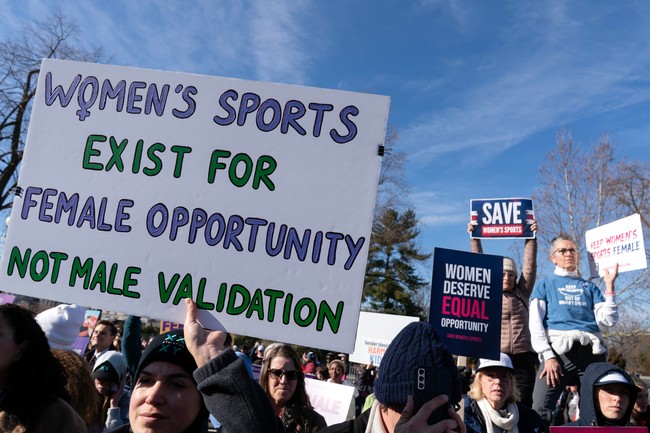
The debate over transgender athletes in women’s sports has boiled down to a simple claim: biology matters. This article examines Caitlyn Jenner’s blunt position on WNBA eligibility, the league’s unclear rules, the examples used to test those rules, and why many conservatives say women’s sports deserve protection based on biological differences.
Human sex is binary for the vast majority of people: genetically determined at conception as XX or XY. That biological reality matters deeply in competitive athletics because male puberty and biology typically confer measurable advantages in strength, speed, and endurance. When a league meant for women becomes ambiguous about who qualifies, it invites controversy and challenges that threaten competitive fairness.
Caitlyn Jenner reacted to how the WNBA has navigated its latest controversy over whether transgender athletes would be eligible to play in the league.
The WNBA has lacked clarity on whether a transgender athlete would be able to play in the league. In the midst of it all, former NBA players Enes Kanter Freedom and Royce White each launched bids to get into the WNBA.
Jenner appeared on “Fox News @ Night” with Trace Gallagher and said there was a “simple” conclusion to the ordeal.
“They’re showing the hypocrisy of what’s going on out there in the WNBA,” Jenner said of Kanter and White. “The WNBA had their meetings on this issue and Cathy (Engelbert), the head, says, ‘We talked about the trans issue but we just haven’t come up with a conclusion at this point. We will continue the conversation.’ Cathy, XX, you’re in. XY you’re out. It’s that simple.”
Jenner’s line is straightforward and unapologetic: categorize by chromosomes and protect women’s sports. From a conservative standpoint that insists on objective standards, that answer stops ideological hand-waving and restores a clear rule for competition. The WNBA’s current collective bargaining agreement says only players who are women are eligible, but it never defined “woman” in biological terms, and that ambiguity is the core of the mess.
Critics argue nuance is necessary and that gender identity deserves respect, while defenders of sex-based rules point to objective performance gaps. Those gaps are real in elite athletics, where small differences in speed or power can decide games and careers. When leagues ignore these biological realities, female athletes who have trained and sacrificed for professional careers can lose fairness and opportunities they earned.
Two former NBA players, Enes Kanter Freedom and Royce White, publicly declared themselves eligible for the WNBA draft as a stunt to expose the league’s fuzziness. Their move highlighted how the absence of a clear biological definition creates openings for political theater. The WNBA ultimately rejected those attempts, but the decision felt inconsistent to many observers because the league’s policy language left room for subjective interpretation rather than an objective standard.
That inconsistency matters beyond headlines. Women’s sports programs at every level rely on predictable rules to manage rosters, scholarships, and competition brackets. Coaches recruit and train athletes based on expectations about physiology and fairness. When governing bodies waver, they force administrators and athletes into reactive policy fights instead of letting sport operate on consistent, science-aligned principles.
From the Republican viewpoint, protecting women’s sports is not about denying anyone dignity in life, but about preserving fair competition where sex-based advantages would otherwise distort outcomes. Establishing a clear, biology-based eligibility rule is a policy that can be applied uniformly and defended logically. It avoids ad hoc decisions that swing with public pressure or media cycles and respects the sacrifices women have made in the athletic arena.
The WNBA can choose clarity: explicitly define eligibility based on biological markers tied to sex, and implement rules that reflect physiological realities of competition. Critics will claim exclusion, but the point of sport rules is to make contests fair by separating categories that matter. Allowing political or cultural pressure to overwrite biological distinctions creates confusion and undermines the leagues women rely on.
Ultimately, this fight is about standards. Either a women’s league is reserved for those who meet biological criteria, or it becomes a different kind of entity altogether. Jenner’s blunt prescription—XX in, XY out—resonates with conservatives because it favors clear rules over shifting definitions, and it centers fairness for female athletes who expect to compete on a level playing field.


Add comment