
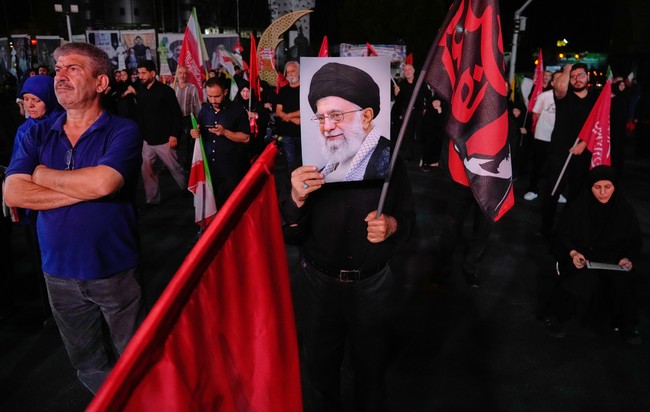
This article explains Iran’s announced bounty for killing or capturing U.S. military personnel, examines practical and financial problems with the offer, notes where the claim originated and who announced it, and highlights implications for U.S. security and border concerns.
Iran’s leadership has been under intense pressure from sustained strikes and economic strain, and recent reports say military figures are stepping into the spotlight. The announcement that the Iranian Army has put a price on the death or capture of an American service member reads like an act born of pain rather than confidence. The stated reward is 5 billion tomans, roughly $30,000, and officials reportedly said the amount is doubled if the act is carried out by a woman.
The officer credited with making the statement is Army chief Amir Hatami, and that attribution has been widely repeated in international reporting. Hatami’s words were carried by state outlets and then relayed by foreign press, which supplied the details about the amount and the gender-based doubling. In the original notice, Hatami described the plan as responding to “the large number of requests” to participate in what the regime framed as support for the war effort.
The economics of the bounty make it a strange play. A toman is an informal unit equal to 10,000 rials, and the Iranian currency has been heavily devalued by inflation and sanctions. Even if Iran declares a payoff, the regime’s frozen assets and sanctions-heavy environment raise real questions about how any outsider would collect the money. The announcement reads more like a symbolic provocation than a viable recruitment incentive.
https://x.com/IrnaEnglish/status/2089003747443655152
There is also a glaring operational mismatch: there are no known U.S. ground forces deployed inside Iran, so the reward would not apply to an action on Iranian soil. Anyone hoping to claim the bounty would likely have to strike U.S. forces or facilities located outside Iran, in other parts of the Middle East, which presents substantial challenges. That mismatch reduces the announcement to rhetoric unless Iran or its proxies change tactics or expand operations in ways they have not to date.
IRAN’S MILITARY HAS announced that it is offering a bounty equivalent to $30,000 (€26,000) for killing or capturing US soldiers, with the reward doubled if carried out by a woman.
Army chief Amir Hatami said the plan had been drawn up following “the large number of requests” to participate in the financial support, according to the IRNA state news agency.
There has been no known deployment of US ground forces in Iran during the Middle East war, with the exception of a rescue mission in April for a downed American pilot.
Hatami did not provide any details on where or when the killing or capturing of US soldiers was expected to take place.
“Anyone who kills or captures and hands over an invading American military personnel will receive a reward equivalent to $30,000 or 5 billion tomans from the Islamic Republic of Iran’s Army,” Hatami said, using an informal unit equivalent to 10,000 Iranian rials.
“Courageous Iranian women who carry out such an action will receive double the reward,” he added.
Beyond feasibility, the announcement carries political theater value: it lets Tehran portray itself as defiant while signaling to domestic audiences that leaders are trying to mobilize support. For adversaries and partners alike, the move is a reminder that Iranian hardliners will use inflammatory language to rally factions and obscure internal weakness. Words like this also test the reactions of regional governments and U.S. forces without forcing Tehran into immediate, irrevocable military escalation.
From a security perspective, the bounty narrative forces uncomfortable questions about how threats might migrate. Attacks aimed at U.S. personnel are more likely to be launched by proxy groups or separatist elements with local access rather than by operatives traveling directly from Iran. That means U.S. forces and regional partners need to remain vigilant about indirect threats, basing protection on hardened posture and intelligence rather than on Tehran’s propagandistic proclamations alone.
There is also a domestic angle that cannot be ignored. Inflammatory foreign statements feed into debates about border control and vetting, especially when officials question who among noncitizens in the country might harbor hostile intentions. Those concerns are politically potent for conservatives who argue that effective immigration enforcement is essential to national security, and such episodes tend to strengthen calls for stricter controls and better tracking of foreign nationals.
Ultimately, the bounty claim functions as a propaganda tool with limited practical value unless Iran can move money and people in ways it currently cannot. The announcement will be parsed by allies and adversaries, gauging whether it signals a real change in Iranian strategy or simply another attempt to shift attention away from internal failures. For policymakers, the sensible response is to treat the claim seriously in planning but skeptically in expectation.


Add comment