
The Michigan governor’s race this November is shaping up as a true toss-up, and this piece lays out why that matters, who the main Democratic contenders are, and how past decisions and recent moves could influence the outcome for Republicans and the state at large.
The Michigan Governor’s Race Happens This November and I Feel Sick About It Because It Truly Is a Toss Up
I dislike toss-up elections — particularly in statewide contests where a single result can tilt policy and spending for years. The last time a GOP candidate won Michigan’s governor’s race was in 2014, and that memory feels both distant and urgent for any conservative watching the map. This year’s dynamics make flipping the state a steep uphill climb unless Republicans get disciplined about message and turnout.
We are now officially in 2026 and Governor Gretchen Whitmer’s term ends at year’s close, which means voters will pick a new chief executive in November after primaries in August. The environment is messy: economic complaints, pandemic-era decisions still debated, and a political class that talks a lot about unity but rarely delivers it. For Republicans, the central task is to convert frustration into votes and to present a candidate who looks like government reform, not more of the same.
Michigan’s gubernatorial race is a virtual tie between Democrat Jocelyn Benson and Republican John James, with independent Mike Duggan close behind, according to a new poll from the Detroit News.
Benson and James lead their primaries by a significant margin.
When Duggan is excluded from the poll, the race between Benson and James is within the margin of error, indicating no clear leader.
That poll line is the problem: a true toss-up with an independent in striking distance guarantees chaos and unpredictable turnout. Republicans cannot afford to treat this as an afterthought; John James or any GOP nominee must own law and order, fiscal restraint, and clear contrasts with the outgoing administration. Michigan voters deserve a clear alternative to eight years of policies that, in many conservative eyes, have underperformed.
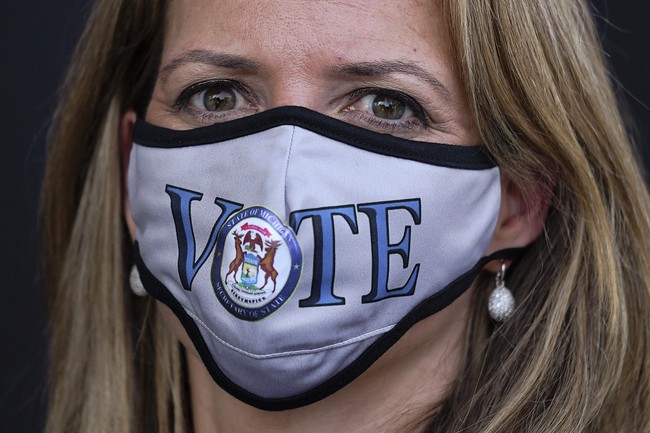
On the Democratic side, Secretary of State Jocelyn Benson is the marquee name and carries both the power of incumbency and the baggage of controversial election guidance. Benson announced a run for governor after two terms overseeing motor vehicle services and election processes, touting administrative achievements like shorter appointment wait times and self-service kiosks. Those operational wins look great in press releases, but political scrutiny follows every decision from the secretary of state’s office.
Michigan Secretary of State Jocelyn Benson announced in January that she would run for governor. Benson, elected in 2018, serves her second term overseeing the state’s election processes and the motor vehicle department. She cited her achievements in that role, including decreasing wait times for in-person appointments and installing self-service motor vehicle stations across the state.
That brings us to a legal snag that could haunt Benson’s run if conservatives press it hard and the media actually covers it beyond soundbites. A court ruled against part of her guidance on mail-in ballots, a decision that raises questions about how she interpreted election law while running the office. For Republicans, that court finding is not just a policy footnote; it’s a rallying point to cast doubt on administrative competence and judgment.
A Michigan Court of Claims judge has ruled against Secretary of State Jocelyn Benson in a lawsuit challenging a portion of her election guidance on mail-in ballots.
Benson had said that ballots returned with mismatched numbers between the ballot stub and the envelope should be counted as a “challenged ballot,” but Judge Brock A. Swartzle ruled Wednesday that if the numbers do not match, the vote cannot be counted.
Beyond Benson, the Democratic field shifted when the former lieutenant governor exited the gubernatorial race to pursue the secretary of state position instead. That move narrowed the primary and reshuffled the map, leaving room for other names to try to claim the center-left lane. Democrats like Sheriff Chris Swanson emerged with law-and-order messaging that complicates easy caricatures of the party.
In January 2026, Gilchrist dropped out of the gubernatorial race and announced he was running for Secretary of State.
Chris Swanson, Genesee County’s sheriff, launched a Democratic bid and emphasizes his law enforcement background as a credential for statewide leadership. He drew attention for marching with protesters in 2020 and speaking at the Democratic National Convention, which gives him name recognition outside traditional party circles. For Republicans, a law-and-order Democrat is not a gift, but it does force a campaign to sharpen policy contrasts rather than rely on caricature.
Genesee County Sheriff Chris Swanson launched his Democratic bid for governor in February. Swanson was elected sheriff of Michigan’s fifth-largest county, Genesee County, in 2020. The announcement marked his full leap into politics after gaining national attention for marching with protesters in 2020 and speaking at the Democratic National Convention last August.
So far, those are the headline Democrats likely to compete for the nomination and possibly face a Republican in November. After nearly eight years of what conservatives call a train wreck under the current administration, the expectation might be that any GOP candidate should start ahead. Michigan is not predictable, though, and nationalizing the race without a concrete local pitch is a recipe for disappointment.
In the coming days this campaign turns to Republican contenders and independents who may siphon votes in competitive precincts. For GOP operatives and voters worried about this toss-up, the focus should be on disciplined messaging, targeted turnout, and pressing the legal and administrative records of Democratic leaders where they are weakest. Michigan can be won, but it will require a campaign that looks and sounds like change, not more of the status quo.


Add comment