
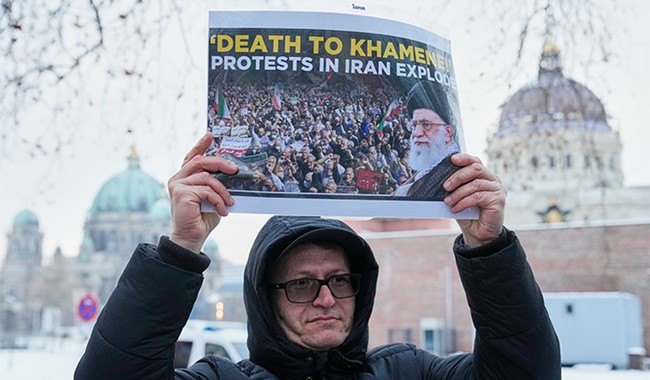
The state-run television network in Iran was disrupted for roughly ten minutes as hackers aired footage urging security forces to side with protesters, a dramatic moment in weeks of nationwide unrest that has intensified global attention and prompted assertive U.S. responses.
For three weeks, mass protests have swept Iran, touching every province and challenging the regime’s authority in a way many did not expect. Security forces have pushed back hard, and estimates of deaths during the crackdown vary widely, adding urgency and international scrutiny to the unrest. The silence and confusion inside Iran during near-total internet shutdowns made the broadcast interruption even more striking.
On one night, hackers replaced state programming across multiple channels with clips of exiled Crown Prince Reza Pahlavi, son of the last Shah, and imagery meant to encourage security personnel to refuse orders. The footage included explicit calls for soldiers and police to “join the nation for the freedom of Iran,” a direct challenge to the clerical regime’s hold on power. For ordinary Iranians glued to their screens, it was a surreal break from the usual stream of state messaging.
Multiple Iranian state TV channels were hacked on Sunday amid a near-total internet shutdown to air footage of exiled Crown Prince Reza Pahlavi and images of anti-government protests that have rocked Tehran in recent weeks.
Two clips of Pahlavi were shown as well as a graphic calling on Iranian security forces to side with the public, The Associated Press reported.
“Don’t point your weapons at the people. Join the nation for the freedom of Iran,” one graphic read, according to a translation from the outlet.
Pahlavi himself called on Iran’s military to break with the Islamic Republic and side with the people.
The interruption reportedly lasted about ten minutes, long enough for millions of viewers to see images and messages that contradicted years of relentless state propaganda. State TV has long been a central pillar of the regime’s control, the single legal broadcaster used to set the narrative and dampen dissent. When that pillar cracked, even briefly, it exposed a vulnerability many in the opposition and abroad saw as significant.
A contemporary social-media post captured the mood that night: it called the broadcaster “the only legal broadcaster in the country, used solely to brainwash the public and spread lies,” and declared that “TONIGHT, that pillar cracked.” The post described a massive cyber operation and framed the hack as proof the regime had lost control of its voice. For Republicans watching from outside Iran, the event underscored the importance of firm U.S. posture to support freedom and deter further brutality.
The above tweet continues:
It is the only legal broadcaster in the country, used solely to brainwash the public and spread lies. It is the main pillar of their control.
BUT TONIGHT, that pillar cracked. 📉
In a massive cyber-attack, all major state TV channels were hacked for 10 full minutes. Instead of the usual propaganda, millions of Iranians saw a message of freedom from Prince Reza Pahlavi, calling on the Army to join the people.
The regime has lost control of its own voice. History is happening. 🔥
The hacked segments included footage of Pahlavi and scenes showing security forces and personnel in uniform, along with claims that some had laid down their weapons and pledged allegiance to the people. Those claims were presented without independent verification, but the images and words themselves were powerful symbols for a population already enraged. The broadcast fed a sense among protesters and observers that cracks were appearing inside establishments once presumed loyal to the state.
The footage aired Sunday night across multiple channels broadcast by satellite from Islamic Republic of Iran Broadcasting, the country’s state broadcaster. The video aired two clips of exiled Crown Prince Reza Pahlavi, then included footage of security forces and others in what appeared to be Iranian police uniforms. It claimed without offering evidence others had “laid down their weapons and swore an oath of allegiance to the people.”
Video of a viewer flipping through channels and finding the same message on every station circulated quickly, showing how pervasive the interruption felt to people in Iran. These images circulated despite heavy internet restrictions, which only amplified their impact and the regime’s sense of vulnerability. The hack became both a tactical blow to state information control and a symbolic victory for those pushing for change.
Washington responded with visible moves, including repositioning naval assets, and President Trump pledged support for demonstrators; that posture reflects a belief that strength and clarity from the United States can protect dissidents and deter further violence. Republicans who favor firm foreign-policy measures see these actions as necessary to back the cause of freedom and to signal consequences for brutal crackdowns. The broadcast hack and the U.S. posture together highlighted a moment where technology and geopolitics intersected sharply.
Iran remains a brutal theocracy that will likely resist change violently, and there are no guarantees about the outcome or the timeline for any political shift. But the ability of outside actors to penetrate the regime’s most guarded communications for even a short time fed hopes among protesters and observers that the regime’s monopoly on information is not absolute. For many watching from afar, that fragile breach suggested possibilities that did not exist before.



Add comment