
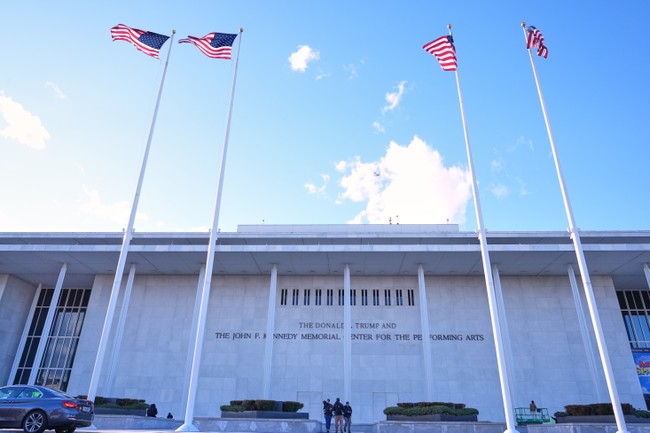
Musician Who Cancelled Kennedy Center Performance Over Trump Name Finds Out Actions Have Consequences
This piece lays out what happened when a longtime holiday performer pulled his show from the newly renamed Trump Kennedy Center, how the Center’s leadership responded, and why the dispute escalated into a potential $1 million damages claim. It covers the artist’s stated reason for cancelling, the Center president’s letter and public comments, and the broader arguments about art, politics, and accountability. The reporting sticks to the facts, direct quotes remain unchanged, and the embed is preserved in its original spot.
Musician Chuck Redd announced he had canceled his annual Christmas Eve jazz concert after seeing the Trump name added to the Kennedy Center building. Redd said the name change prompted his last-minute withdrawal, which left the Center scrambling to replace a show that had been on the calendar for years. That single decision set off a chain reaction between an artist and the institution that hosts him.
Richard Grenell, the Center’s president, did not take the cancellation lightly and formally notified Redd that the Center intends to pursue damages. Grenell framed the withdrawal as a partisan choice that hurt a nonprofit arts organization and said the timing was particularly damaging given ticket sales and donor expectations. The Center announced it will seek $1 million in damages for what it called an eleventh-hour political stunt.
“Your decision to withdraw at the last moment — explicitly in response to the Center’s recent renaming, which honors President Trump’s extraordinary efforts to save this national treasure — is classic intolerance and very costly to a non-profit Arts institution,” Grenell wrote.
“Regrettably, your action surrenders to the sad bullying tactics employed by certain elements on the left, who have sought to intimidate artists into boycotting performances at our national cultural center,” he added.
Grenell went further, pointing to box office performance and donor interest as part of his rationale for seeking recompense. He noted the event had been “lagging considerably behind our other Christmas and holiday offerings” and said that contrast with other sold-out acts made the cancellation especially painful. That critique moved the dispute out of abstract culture-war language and into measurable business terms.
“The most avant-garde and well-regarded performers in your genre will still perform regularly, and unlike you, they’ll do it to sold out crowds regardless of their political leanings,” Grenell continued.
The Trump-Kennedy Center president further claimed that Redd’s “dismal ticket sales and lack of donor support” combined with the eleventh-hour cancellation “has cost us considerably.”
“This is your official notice that we will seek $1 million in damages from you for this political stunt.”
Another Center official echoed that sentiment in sharper terms, condemning the cancellation as selfish and intolerant rather than principled. The Vice President of Public Relations told the press that an artist who refuses to perform because of the building’s name is failing the basic duty of public artists to serve all people. Those comments frame this as an ethical failure, not just a contractual dispute.
“Any artist cancelling their show at the Trump Kennedy Center over political differences isn’t courageous or principled — they are selfish, intolerant, and have failed to meet the basic duty of a public artist: to perform for all people,” Trump-Kennedy Center Vice President of Public Relations Roma Daravi told The Post.
Grenell also posted on X that he would not let the matter pass quietly: “The Arts are for everyone – and the Left is mad about it.” That public line underscores the political dimension, making the reaction both an institutional and a rhetorical move meant to signal firmness to donors and the public. The statement is short and pointed, designed to show resolve rather than invite back-and-forth concessions.
The Center stresses it will continue producing crowded, high-profile events, including its holiday programming and the Kennedy Center Honors, while also fundraising to restore and maintain the facility. Officials emphasize that the renaming has encouraged new donations and renewed interest in preserving the venue, which they say had been in decline before recent efforts to stabilize funding. That claim turns the question away from the canceling artist and toward institutional survival and public support.
Observers on the right will see this as a test of consequences for mixing politics and performance in a public cultural space. If artists choose public boycotts tied to partisan views, institutions may treat those actions as breaches that harm operations and supporters. The looming legal claim puts a price tag on that choice and forces a conversation about where professional responsibility and political expression intersect.
Redd’s cancellation lit a fuse that moved quickly from a personal stance to a formal dispute with monetary demands attached. The coming weeks will determine whether the parties settle, go to court, or quietly resolve the matter behind closed doors. Either way, the episode has crystallized how cultural decisions now carry immediate institutional and financial consequences.


As any responsible parent tells their children, actions have consequences. Apparently Redd missed that lesson.
We Americans want a better performer than this guy find him a get a performer who loves America.