
The article examines a violent stabbing in London that left two Jewish men hurt, the dramatic police takedown of the suspect, and the broader security and political questions it raises for Britain and allies. It describes the incident, the officers’ response, public reaction to the video of the arrest, and ongoing counterterror inquiries, while noting concerns about recent attacks on Jewish sites and possible foreign involvement.
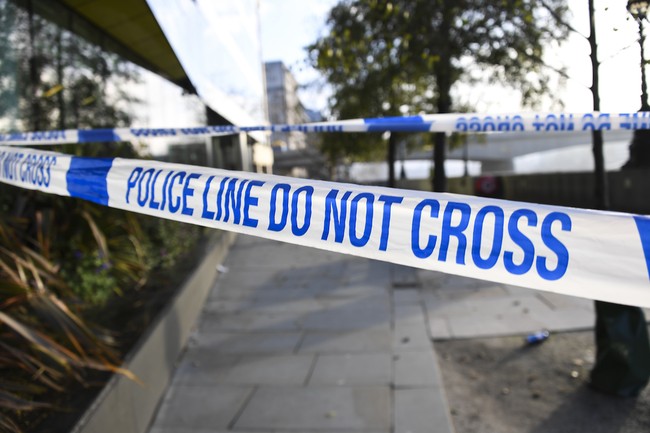
The attack happened on a London street and resulted in two men being hospitalized with knife wounds, prompting police to treat the incident as a terrorist matter. From a law-and-order perspective, the footage of officers confronting and subduing the suspect shows both the danger on the ground and the limits of policing in an environment where most officers are unarmed. Police moved quickly to arrest a 45-year-old man on suspicion of attempted murder, and they had to use force to disarm him after tasers proved insufficient.
Police arrested a 45-year-old man on suspicion of attempted murder in the city’s latest antisemitic attack.
The Metropolitan Police said the attack in the Golders Green area left two men, aged 34 and 76, hospitalized with knife wounds.
Counterterror police are investigating whether the stabbings are linked to recent arson attacks on synagogues and other Jewish sites in the British capital.
The video of the takedown is wild and shows officers deliberately engaging the suspect to protect bystanders, drawing attention away from those nearby. You can see an attempt to control space and movement while trying to avoid escalating to lethal force in a crowded area. It’s important to understand how that choice affects outcomes when officers lack firearms as a routine option.
Warning for graphic language:
London policing relies heavily on unarmed officers and specialized armed units rather than routinely armed patrols, which changes the dynamics of how threats are handled. In this case, officers deployed tasers to try to stop the suspect, and when that failed they physically struggled to remove the knife. The footage includes kicking and forceful restraint, actions the police say were necessary because the suspect kept his weapon and refused to comply.
Public reaction on social platforms was mixed, with some viewers criticizing the officers for the level of force used. That criticism ignores the immediate risk: a knife still in a suspect’s hand, in close quarters, represents an ongoing lethal threat to officers and civilians alike. From a conservative law-and-order viewpoint, the priority has to be stopping the attacker as quickly as possible while minimizing further casualties.
Fortunately, none of the officers were injured during the takedown, but the video makes clear how easily that situation could have ended differently. The suspect allegedly attacked at least one man after the victim put on a kippah, which has led investigators to consider antisemitic motive as part of the inquiry. Counterterror units are now involved because the incident fits a pattern that includes recent arson attacks against Jewish institutions in the city.
They are working to establish the suspect’s nationality and background, and Detective Chief Superintendent Luke Williams said “investigators are considering all possible motives.”
Arson attacks in recent weeks targeted Jewish sites in London, including a charity’s ambulances in Golders Green and a synagogue a few miles (kilometers) away.
Officials are also exploring whether those arson attacks and this stabbing are part of a connected campaign, which raises the specter of organized or externally influenced violence. Intelligence services in the region have publicly warned about overseas actors using proxies to carry out attacks, and counterterror investigators are treating that possibility seriously. If foreign proxies are involved, it forces a hard look at how the U.K. and its allies respond to threats that cross borders.
Counterterror officers are investigating whether the arson attacks were the work of Iranian proxies. The U.K. has accused Iran of using criminal proxies to conduct attacks on European soil targeting opposition media outlets and the Jewish community. Britain’s MI5 domestic intelligence service says more than 20 “potentially lethal” Iran-backed plots were disrupted in the year ending in October.
There is also a political angle to the story, because national leaders shape how security operations and foreign threats are prioritized. Recent comments by Prime Minister Keir Starmer about military actions and international engagements have sparked debate over Britain’s posture abroad and at home. Incidents like this one highlight the consequences of underestimating transnational threats and the need for clear policy on confronting state-backed proxies.
For communities under threat, the immediate concern is protection and swift justice for victims, not political hedging or equivocation. Authorities must pursue the investigation quickly, clarify motive, and ensure robust policing measures to prevent copycat incidents. In the meantime, the video will keep the story in the public eye and push leaders to answer tough questions about security and accountability.


Add comment