
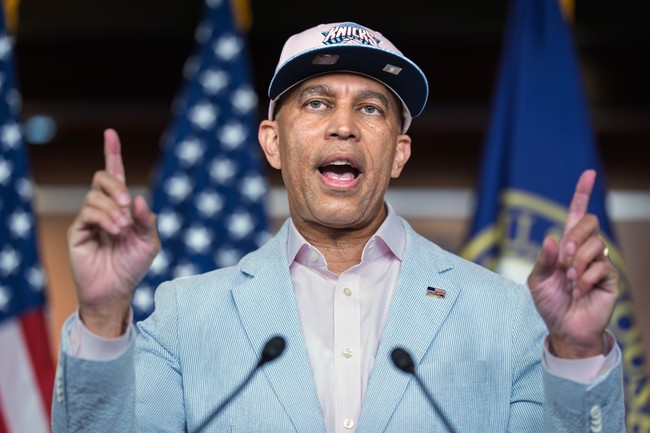
This article examines how House Minority Leader Hakeem Jeffries reacted to recent primary wins by socialist-leaning candidates in New York City, details his public response and subsequent campaign post, notes reactions from local progressives, and critiques what this shift means for Democratic priorities and party unity from a conservative perspective.
The surprise primary victories by socialist-backed candidates in New York City triggered a clear test for Democratic leadership, and Hakeem Jeffries’ response has become a focal point. Rather than confront the rhetoric and positions coming from those winners, Jeffries chose a conciliatory tone that many conservatives see as capitulation. This matters because party leaders signal what behavior and ideology will be tolerated and rewarded inside the Democratic coalition. In a city where general elections lean blue, primary winners set the tone for national debates.
On television at a watch party, socialist supporters openly chanted, “You’re next!” at an image of Jeffries, a remark that should have demanded a strong rebuke. When pressed after that episode about extreme statements from one of the candidates, Jeffries pivoted immediately to attacking Donald Trump instead of addressing the core concerns. That deflection frustrated observers who wanted to hear him acknowledge the dangers of far-left extremes rather than downplay them. For Republicans and many independents, silence or normalization looks like complicity.
Jeffries’ follow-up actions confirmed the initial impression: his campaign account publicly congratulated the newly nominated New York congressional hopefuls, signaling acceptance. The post listed several names and praised a mixed group of public servants, union organizers and community activists without distinguishing ideology or addressing controversial remarks. Among the listed were Darializa Avila Chevalier and Claire Valdez, identified elsewhere as socialists, and Brad Lander, a progressive. That kind of blanket praise feels like a strategic decision to keep party unity at the cost of confronting radical elements.
The campaign message included a line that reads exactly as quoted: “Congratulations to our newest members of the NYC congressional delegation. From public servants to union organizers to community activists, the path is different but the work is the same. We must decisively address the affordability crisis and crush far-right extremism!” That quote is retained verbatim because it frames Jeffries’ priorities. Noticeably absent from the statement is any mention of the growing influence of far-left extremism or any explicit rebuke of inflammatory comments aimed at his own position.
From a Republican viewpoint, the priorities Jeffries emphasizes are revealing. He doubles down on the affordability talking point and fixates on “far-right extremism” while ignoring left-wing radicalism that threatens property rights, public safety, and economic stability. The affordability issue is real and deserves attention, but it is disingenuous to avoid discussing policy failures that contributed to it. Failing to hold the left flank accountable leaves voters without clear alternatives and rewards candidates whose programs would worsen the crisis.
Progressive figures tied to those primaries responded in ways that suggest cooperation is already forming inside New York’s Democratic delegation. One prominent progressive, Brad Lander, indicated willingness to work within the party’s framework, which signals to leadership that conciliatory tones will produce loyalty. That dynamic weakens the hand of moderates who might otherwise push back and makes it harder for the party to present a coherent platform to the general electorate. For Republicans, this is an opportunity to highlight inconsistencies and contrast pragmatic governance with ideological posturing.
https://x.com/hakeemjeffries/status/2070854894890692957
Normalizing candidates who have publicly endorsed extreme positions is risky politically and substantively. It undermines the party’s credibility with suburban and swing voters who care about common-sense solutions and public safety. It also invites intra-party tension down the road as ambitious figures jockey for influence and seek to impose ideological litmus tests. If leadership prefers short-term unity over standing for clear principles, the party will find itself increasingly unmoored on policy and tone.
Jeffries may believe that embracing or tolerating these primary winners preserves unity and electoral viability, but that calculation is flawed if it alienates the majority of Americans who reject radical solutions. America needs leaders willing to confront extremism on both sides of the aisle, not selectively. For conservatives watching this play out, the lesson is straightforward: the GOP must continue to offer a contrast built on individual liberty, economic common sense, and firm opposition to any extremism that threatens American institutions.


Ship that DIRTY LOW DOWN NO GOOD COMMUNIST Hakeem To GITMO NOW!!!
He absolutely does not belong in our Country let alone GOVERNMENT; he does deserve a concrete prison cell in GITMO or WORSE!!!
What are all you money grubbing, pencil pushing so called Elected Representatives of the People waiting for; its time to earn your keep and clean up this MESS! Do your damned jobs and protect American’s Constitution, Sovereignty and Citizens; or get the hell out with all these ingrates, traitors and invaders!