
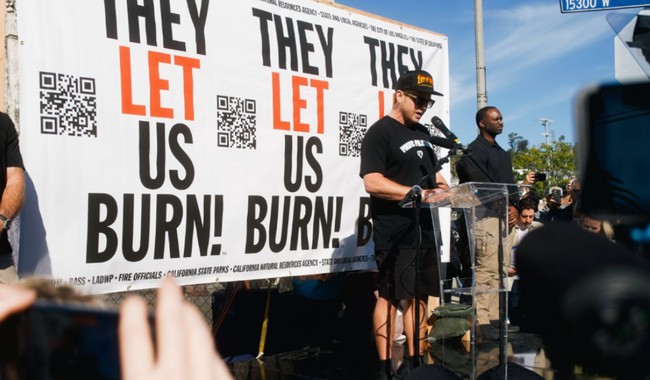
The trial over the alleged arson that sparked the Pacific Palisades fire ended in a hung jury, and now an anonymous veteran firefighter has come forward with sharp accusations that leadership at the Los Angeles Fire Department failed to follow basic safety protocols, potentially allowing a contained blaze to flare back into the devastating Palisades Fire; federal prosecutors say they plan to seek a retrial while no public internal investigation has yet been announced.
The mistrial has reopened questions about what happened in the days after the initial Lockman fire, and a whistleblower claiming long service with the Los Angeles City fire forces says department practices were inadequate. That anonymous account pins blame at the command level, arguing standard post-fire surveillance was skipped and available resources were not used. The claim is stark: a fire that could have been monitored and contained was allowed to rekindle, producing catastrophic consequences.
“An anonymous veteran Los Angeles City firefighter has stepped forward as a whistleblower, leveling damning accusations of negligence against department leadership following a federal mistrial. The insider claims the fire department’s failure to follow standard safety protocols is directly responsible for allowing a contained blaze to reignite into the destructive Palisades Fire.” These are the words attributed to the source, and they succinctly frame the core allegation: negligence at the top enabled a preventable escalation. The allegation echoes concerns some jurors reportedly raised during deliberations about accountability and cause.
The whistleblower provided specific assertions about how the initial Lockman fire was handled, saying that once the scene was left by crews the risk of a holdover fire was not treated with the vigilance it required. “Speaking exclusively to FOX 11 under a guarantee of anonymity, the veteran firefighter revealed that the department failed to properly monitor the initial Lockman fire, allowing it to flare back up seven days later as the devastating Palisades Fire.” That timeline, if accurate, suggests a window where simple, routine steps could have made a difference.
A juror in the original proceeding reportedly found the defense’s “holdover fire” theory unpersuasive, but also indicated the jury could not ignore questions about departmental actions that may have contributed to the disaster. The whistleblower’s account aligns with that juror’s hesitation, claiming that the department’s own procedures — or lack thereof — are central to understanding how a contained incident rebounded into something far worse. Federal prosecutors nonetheless intend to press for a retrial, signaling the case is far from closed.
The whistleblower described missed opportunities to use existing tools and manpower to keep the original fire suppressed and monitored. “The insider claims the fire department’s failure to follow standard safety protocols is directly responsible for allowing a contained blaze to reignite into the destructive Palisades Fire.” According to the account, assets that could have been deployed were not, and critical post-incident watches did not occur as they should have.
According to the whistleblower, the department completely bypassed standard fire watch protocols after the initial blaze. “Our job is to put out fires, not to, you know, douse them and leave. So we feel that our job, when do we take responsibility? We should have had engines sitting there the entire time, on fire watch. They could have called in the hand crews. They could’ve called in infrared drones which are sitting around, which you guys found for a couple of million dollars, but they never used. You could have just had an engine on there, rotating around, every four or five hours, just in case something sparked up. No one did that. They’re 100% to blame.” That passage, quoted exactly from the source, accuses leadership of ignoring basic, cost-effective precautions.
The whistleblower challenged the official explanation that a smaller remaining ember or hotspot reignited after crews left, saying closer, sustained oversight should have been mandatory. If fire watch rotations, supplemental hand crews, or infrared surveillance had been used, the source argues, the later emergency might have been averted. Those are operational failures that, if confirmed, would warrant scrutiny not just of tactics on the ground but of decision-making higher up.
At the moment there is no public sign that the department has launched an internal probe, and no official response has been recorded addressing the whistleblower’s claims. Prosecutors’ announcement of plans for a retrial means the legal phase will continue, but administrative and operational questions remain unresolved. Residents and observers are left waiting to see whether formal internal review or outside oversight will follow these serious allegations.
The situation remains fluid and contentious: the legal process, the whistleblower’s testimony, and the wider public interest all intersect in a case that raises plain questions about fire management and accountability. The core factual claims and the quoted statements from the anonymous veteran stand as the principal elements driving the story forward.


Add comment