
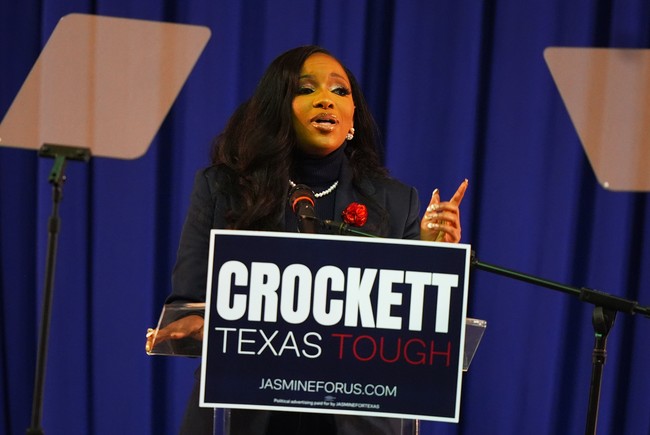
Democrat Rep. Jasmine Crockett has widened her lead in the Texas Democratic U.S. Senate primary while early voting is already underway, with a recent survey showing a notable shift in support that suggests Democratic voters are consolidating behind her campaign.
The fresh statewide survey, conducted Feb. 2 through Feb. 16 among likely Democratic primary voters, shows Crockett pulling away from state Rep. James Talarico. Early voting began Feb. 17 and runs through Feb. 27, so these numbers come as ballots are being cast and voters are making final choices. That timing matters because movement during early voting is less common than last-minute swings before polls open.
The poll puts Crockett ahead by a clear margin, and it isn’t small. “Crockett leads Talarico 56 percent to 44 percent among likely Democratic primary voters statewide.” That twelve-point spread is a meaningful uptick from earlier figures. Late-January polling had her ahead by eight points, so the trajectory is one of growth, not stagnation.
When multiple polls line up, the pattern becomes harder to dismiss as noise. Aggregated polling and averages show the same widening gap, indicating the change is not the result of a single outlier survey. Inside Democratic circles, the chatter has shifted to confidence, not caution, and party operatives are framing the race as if a decisive trend has taken hold. One longtime party strategist even noted that DSCC sources believe Crockett is “likely winning,” adding that an attack line against her opponent “worked.”
That language from party insiders reflects a belief that momentum has consolidated rather than fractured. In contrast, the Republican primary remains closely fought and unsettled, with the contest between Texas Attorney General Ken Paxton and Sen. John Cornyn showing single-digit spreads and frequent shifts. Republicans are still jockeying for position and have not produced a clear consolidation equivalent to what Democrats now appear to be experiencing.
Primary behavior typically sees races tighten as undecided voters make up their minds, so moving from a modest lead to a double-digit advantage during early voting is notable. It signals that Democratic voters are leaning into a choice instead of holding out, which changes the dynamic of late campaigning. For Republicans watching the general landscape, a consolidated Democratic primary opponent presents different strategic considerations.
Crockett’s rise hasn’t been subtle. Over the last year she has embraced high-energy exchanges, viral moments, and sharp soundbites that travel beyond Texas politics. Those tactics have amplified her name recognition and message, and in this primary they appear to be paying off rather than backfiring. Where others might be cautious, her team has pushed bold lines that resonate with a base focused on clear, vivid messaging.
Political moments and hot takes can flip quickly, and there have been instances where early condemnations from lawmakers later proved premature when fuller information emerged. That pattern has not necessarily damaged Crockett in this race; if anything, voters who value a forceful tone seem to be consolidating around her. The campaign that moves the conversation often wins the attention, and attention is translating into measurable support here.
On the Republican side, uncertainty persists and the race between Paxton and Cornyn has not produced the kind of decisive consolidation Democrats are now experiencing. Single-digit differences and fluctuating polls mean Republicans face a more unpredictable primary outcome, which can complicate plans for the general election. Meanwhile, Democrats are moving in the opposite direction, narrowing internal debate as voting proceeds.
Polls are always snapshots, capturing a moment rather than a final outcome. Still, a widening margin during early voting carries weight and reflects a reality beyond random variation. When voters are already casting ballots and a candidate is growing her lead, that suggests a settled preference rather than temporary enthusiasm. For observers who care about how the general election might shape up, seeing one party coalesce while the other remains divided is a signal worth noting.
The implications stretch beyond the immediate primary. A consolidated Democratic nominee alters the playbook for both campaigns and donors, and it forces Republicans to reckon with a unified opponent while they continue to sort out theirs. As ballots continue to be counted and more data comes in, the story will refine, but this moment shows Crockett moving from contender to front-runner in a way that few expected when the cycle began.



Add comment