
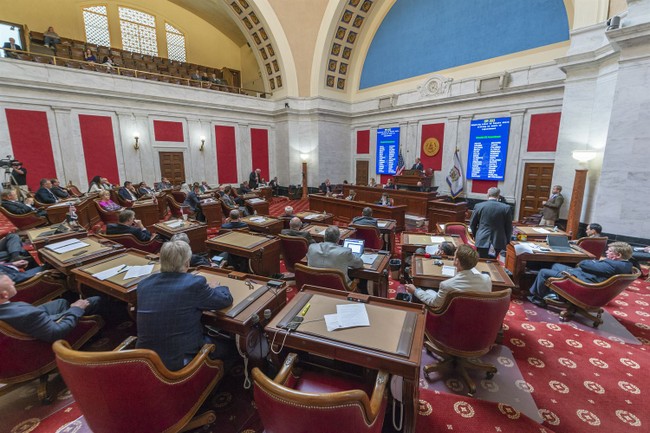
Virginia Democrats moved quickly to change who draws the state’s maps, passing a constitutional amendment through the state Senate that could return redistricting authority to the General Assembly and set up a partisan redraw ahead of the 2026 midterms.
This was a straight party-line push in the state Senate, and the House of Delegates already agreed earlier in the week. The proposed amendment would let the General Assembly — currently led by Democrats — redraw congressional lines between census cycles, which would affect the state’s 11 U.S. House districts. Supporters say it restores legislative control; critics call it a blatant power grab aimed at shrinking Republican representation.
To take effect, the amendment must pass again in the legislature seated in January 2026 and then survive a statewide voter referendum. Five years ago Virginians approved a bipartisan redistricting commission designed to take politics out of drawing maps. This proposal would dismantle that structure if the amendment wins out in the next legislative session and the subsequent public vote.
The timing is unmistakable: a redraw between 2025 and 2030 would let politicians alter districts before the 2026 midterms. Right now Republicans hold five of Virginia’s 11 House seats, and Democratic strategists plainly want to reduce that number substantially. The maneuver sets the stage for a partisan battle over who chooses voters instead of the other way around.
Opponents warn this move flips the promise of nonpartisan reform on its head and undermines voter trust. The effort highlights a larger clash over how stable institutions and election rules should be treated when political advantage is on the line. If lawmakers can change the rules midstream, voters face an uncertain and shifting system that rewards whoever controls the levers of power.
Local Republican leaders issued sharp condemnations, arguing the change is an attempt to rewrite rules while elections loom. They recall the bipartisan commission vote that landed with broad public support and say this climb-down on reform is cynical and undemocratic. For many critics, the coming fights in the legislature and at the ballot box are about preserving a fair process rather than partisan wins alone.
Matthew Hurtt, chairman on the Arlington County Republican Party, told RedState of the Democrat Party’s effort to wrest control of redistricting:
Virginia Democrats’ effort to rewrite our state’s redistricting process is a blatant attempt to change the rules in the middle of the game — and voters should be outraged.
Just five years ago, more than 65% of Virginians—Democrats, Republicans, and Independents alike—voted to create a nonpartisan redistricting commission to take politics out of the process. That reform was a victory for transparency, accountability, and fairness. Now, because the political winds have shifted, Democrats are trying to dismantle it for their own partisan gain.
This proposed constitutional amendment is nothing more than a power grab. It undermines the will of the people and betrays the trust Virginians placed in their elected officials. The redistricting commission was designed precisely to prevent this kind of manipulation — where politicians choose their voters instead of voters choosing their representatives.
Virginians deserve better. We deserve leaders who respect the Constitution, honor the decisions of the voters, and uphold the principles of fair representation.
It’s clear: if Democrats will change the rules to win elections, they can’t be trusted to govern responsibly.
One immediate practical effect of the special session is political: Winsome Earle-Sears, the lieutenant governor and Republican gubernatorial candidate, had been held in the Senate to preside over the redistricting session. With that work done for now, she can return to campaigning and make last pushes with voters. Campaign calendars and strategy meetings will shift quickly as candidates react to the new timetable and stakes.
The proposed amendment would, if ultimately approved by voters, let the General Assembly redraw maps any time between census cycles, essentially enabling mid-decade redistricting. Mid-decade map changes have been controversial in other states where the party in power tuned lines to cement gains or blunt opposition. The risk in Virginia is that voters will feel the rules are flexible tools wielded for advantage instead of fixed guardrails for fairness.
Beyond the procedural fight, there are real stakes for who represents communities in Congress. Alterations to district boundaries can shift the partisan balance and reshape which voices get amplified in Washington. That makes the upcoming legislative fights and the public referendum pivotal moments for Virginia’s political future.
Meanwhile, the public debate will likely focus on trust and institutional stability: whether elected officials should reverse past reforms when convenient or honor reforms that had broad voter backing. Those arguments will be central on the campaign trail and in voter outreach leading up to any referendum. For now, Virginia is in a contentious stretch where mapmaking and politics collide in plain view.
Editor’s Note: The Schumer Shutdown is here. Rather than put the American people first, Chuck Schumer and the radical Democrats forced a government shutdown for healthcare for illegals. They own this.



Add comment