
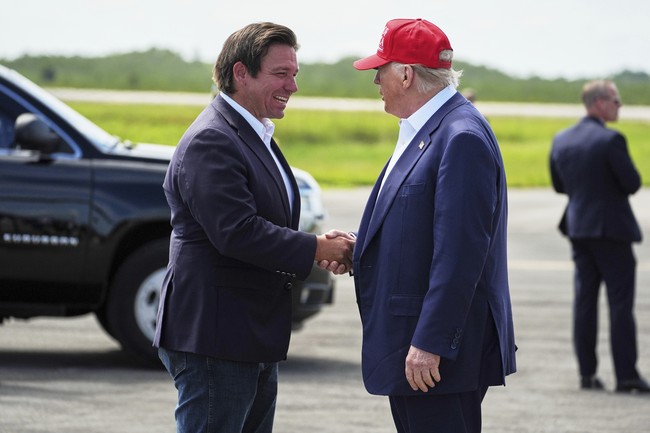
This piece examines President Trump’s recent public nod to Ron DeSantis and what it could mean for the governor’s next move, tracks their thawing relationship since the 2024 primary, highlights DeSantis’s record on COVID and state governance, and lays out why a role in the administration is plausible and politically significant.
Ron DeSantis has been a visible conservative force since taking Florida’s governorship in 2019, and his tenure has been defined by direct confrontation with corporate and cultural overreach. One high-profile clash involved the Walt Disney Co., where DeSantis moved to replace the Reedy Creek Improvement District’s leadership with a board aligned to state priorities. That decision underscored his willingness to push back when he perceives outside entities trying to impose ideological agendas on Floridians.
During the COVID era, DeSantis became a clear alternative to lockdown orthodoxy, rejecting prolonged school closures and heavy-handed mandates that dominated other states. His approach appealed to families who saw normal life disrupted, and people who fled restrictive policies ended up praising Florida’s insistence on keeping public life open. Those choices cemented his reputation among conservatives as someone who defends everyday freedom over bureaucratic control.
The 2024 GOP primary between DeSantis and Donald Trump was bruising, with sharp attacks traded back and forth across the airwaves. Trump coined the nickname “DeSanctimonious,” while DeSantis labeled Trump’s behavior “petty” and “juvenile.” That public spat made a future partnership seem unlikely to some observers, yet political realities often produce rapid reconciliations once broader stakes are in play.
All that friction appears to be in the rearview mirror now, and President Trump’s recent remarks suggested an openness to bringing DeSantis into the fold. Reporters asked the president about a possible cabinet post for DeSantis, and Trump replied directly. The question and response were brief but notable because they signal an interest in leveraging top-performing state leaders to strengthen the federal team.
The exchange captured on camera was simple and to the point. The president answered a reporter outside the White House, and the interaction was printed verbatim in the public record. That kind of off-the-cuff praise from the commander in chief can quickly reshape expectations and open doors for high-profile appointments.
REPORTER: Would you consider Ron DeSantis for a cabinet position?
TRUMP: Well, I like him a lot so… [Crosstalk] I like him lot.
Since the nomination fight, the relationship between Trump and DeSantis has undeniably warmed, and it’s easy to see why both men would find common cause. Trump has publicly praised DeSantis on various occasions, even giving high marks during a tour of state facilities and commending the governor’s handling of immigration detentions. The political chemistry matters because it shapes not only appointments but also the broader conservative agenda heading into future battles.
Florida’s role on the national conservative stage has grown, and DeSantis’s policies have been part of that ascent. The governor signed measures honoring presidential legacy projects and worked with local officials on symbolic gestures, all of which demonstrate a state-level alignment with a national Republican brand. Those moves make him a natural candidate for consideration if the administration seeks seasoned governors to translate state successes into federal policy.
From a personal perspective, many conservatives view DeSantis as someone who led when others hesitated, particularly in resisting sweeping mandates that disrupted children’s schooling and family life. That practical governance record gives him credibility beyond campaign rhetoric and offers a track record that national leaders value. If the administration prioritizes effective, results-driven people, a former or current governor with executive experience is a logical choice.
Bringing DeSantis into a federal role would also create strategic benefits for Republicans looking to solidify wins at multiple levels. It would place a proven manager into a high-stakes environment while signaling to the base that bold state-level policies can scale to the national stage. Such a step would be both a reward for effective leadership and a tactical move to knit together disparate corners of the party.
At the same time, a move to Washington would require DeSantis to weigh the trade-offs between national influence and the on-the-ground authority he wields in Florida. Governors often face a choice between continuing to pilot state experiments and taking on cabinet duties that demand coalition-building across federal agencies. Whatever path he chooses, his decisions will shape conservative momentum and the practical rollout of policy priorities.
For now, the public signal is clear: Trump likes DeSantis and is willing to publicly acknowledge it. That kind of endorsement can spark conversations inside the White House, among senior advisers, and across the Republican ecosystem. The coming weeks and months will reveal whether those conversations turn into a formal offer, a new role, or simply a continued alignment of two major conservative figures.

Add comment