
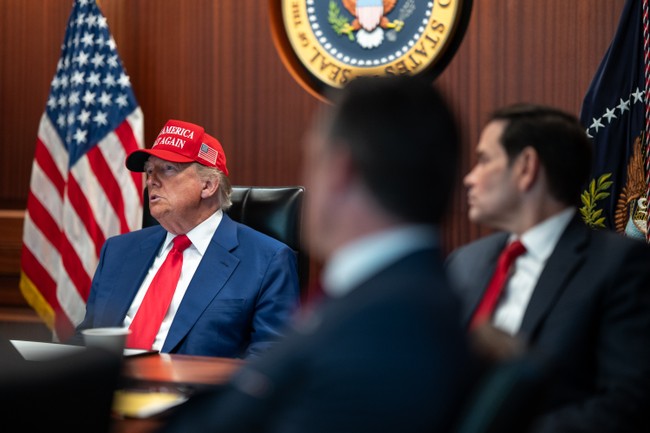
President Trump called an unusual Saturday Situation Room meeting to weigh the next moves as talks with Iran hang by a thread; top aides and national security officials gathered to assess the Strait of Hormuz, Iranian reactions to U.S. proposals, and whether diplomacy can still avert renewed hostilities. The White House signaled a tougher stance, with a Wednesday deadline on the table and plans discussed to interdict Iranian vessels worldwide if needed. The atmosphere mixed grim realism about Iran’s internal chaos with blunt confidence that the United States will not be bullied over freedom of navigation or American lives. This article lays out who showed up, the tone inside the room, and why the White House appears ready to shift from patient negotiation to decisive action.
The meeting drew a who’s who of the administration’s security team: Vice President JD Vance, Secretary of State Marco Rubio, Secretary of War Pete Hegseth, Treasury Secretary Scott Bessent, Chief of Staff Susie Wiles, the Iran negotiator Steve Witkoff, CIA Director John Ratliffe, and Joint Chiefs chairman Dan Caine. One notable absence stood out: Director of National Intelligence Tulsi Gabbard was not present. That lineup signals a mix of political operators and hard-edged security minds, which set the tone for a high-pressure, short-timer approach to diplomacy.
Inside the briefing they focused on the Strait of Hormuz and whether Iran was playing for leverage or willing to deliver on concrete concessions. The White House has been clear that the strait must remain open, and there’s growing impatience with Tehran’s pattern of brinkmanship. At the same time, the administration had been engaged in talks, and officials described “good conversations,” yet those talks appear fragile and subject to the realities of Iran’s fractured power centers.
Publicly, the president cut a direct and blunt figure, reminding Americans why the U.S. has a different posture than past administrations. He framed the problem in stark terms, pointing to decades of Iranian provocations and the human cost tied to Iranian-backed tactics abroad. That history underpins the administration’s argument that it is no longer tolerating a regime that threatens shipping lanes and American personnel without consequences.
The White House made it plain there’s a deadline: if a deal isn’t finalized by Wednesday, the administration has signaled it will end the ceasefire and resume pressure. Military planners reportedly discussed seizing so-called dark fleet vessels and Iranian ships wherever they operate, a global approach intended to remove safe havens for illicit shipping. That operational posture reflects a strategic choice: use American power to control the environment and force Tehran to accept terms or face stepped-up consequences.
Assessments inside the Situation Room were blunt about who actually makes decisions inside Iran and how that complicates talks. Some in the room described Iran’s leadership as fractured and unpredictable, which makes negotiating reliably with Tehran nearly impossible. That uncertainty helps explain the administration’s impatience and the preference for applying pressure on clear objectives like maritime freedom and the curbing of enriched uranium programs.
The public rhetoric after the meeting was as direct as the private conversation: the president left little doubt that the United States would not tolerate attempts to shut the strait or to coerce American policy. At one point the president said Iran can’t ‘blackmail’ the U.S, “They wanted to close up the Strait again, as they’ve been doing for years, but they can’t blackmail us.” That straightforward line reinforced the message—diplomacy remains on the table, but leverage and deterrence will be used if needed.
TRUMP: We have very good conversations going on. It’s working out very well. They got a little cute, as they have been doing for 47 years. Nobody ever took them on. We took them on.
They have no navy, they have no air force, they have no leaders, they have no nothing. Actually, their leaders are… it is regime change. You call that enforced regime change. But we’re talking to them.
They wanted to close up the strait again — as they’ve been doing for years — and again, blackmail us. In fact, a lot of ships are coming up to Texas and Louisiana. I don’t know if you know. The ships are coming up. If they get used to it, maybe they’ll keep doing it. It’s worked out pretty good. But it’s going along, actually, very well, and we’ll see. We’ll have some information by the end of the day. We’re talking to them.
We’ll have some information by the end of the day. We’re talking to them, we’re taking a tough stand. They’ve killed a lot of people. A lot of our people have been killed. A lot of your fellow soldiers have been killed over the years by Iran. The roadside bombs. Soleimani. I killed Solemani.
UNKNOWN: Explosively formed penetrators. They were making them in Iran and bringing them into Iraq and blasting them through vehicles.
He was the father of the roadside bomb, essentially. He killed a lot of people, and when you see soldiers and others, but soldiers generally walking around with no legs, with no arms, with a face that has been smashed, that was Solemani, that was Iran that did that. So we have a much different view on it than other presidents. They’ve gotten away with murder for 47 years; they’re not getting away with it any longer.
Outside observers heard mixed signals from Tehran, with some outlets quoting an ayatollah figure saying Trump “talks too much.” That exchange underscores the communication gap—both sides are trading public messages while power struggles inside Iran complicate any reliable deal. The result is a high-risk, high-stakes environment where American resolve and clarity of purpose matter more than clever diplomatic phrasing.
Short timelines and harder tactics are the administration’s answer to chronic Iranian gamesmanship. The next few days will test whether Tehran will make verifiable concessions or whether the U.S. will move to enforce its red lines. Either way, the White House has signaled it prefers clear results over endless bargaining, and that posture reflects a broader Republican view that power and credibility matter in foreign affairs.
This is not about saber rattling for its own sake; it is about protecting shipping, deterring attacks, and stopping Iran from rebuilding capabilities that threaten the region and American interests. Officials in the room made it plain: diplomacy is still possible, but it will happen on American terms and on a schedule the president deems sufficient to protect U.S. security.

Add comment