
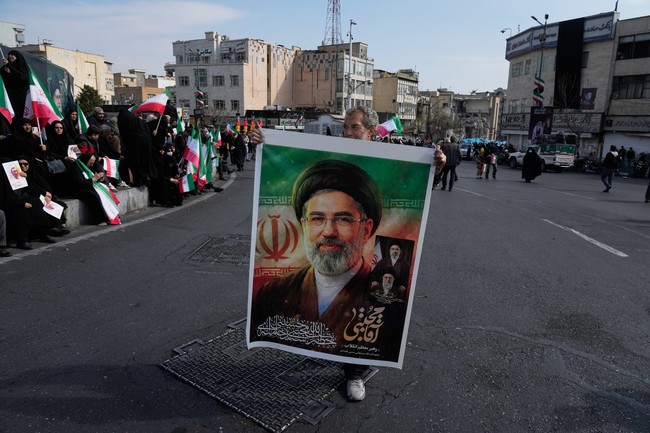
I’ll lay out why the chatter from Iran’s new, unseen supreme leader matters, the weakness behind his online threats, the state of Iran’s military after recent strikes, the real power players likely running the show, and what that means for American policy and deterrence.
There is a blunt, simple reality at play: Tehran’s public bluster is increasingly digital and detached from a functioning chain of command. A Telegram post claimed a new round of naval threats from Mojtaba Khamenei, the son said to have taken the mantle after a devastating strike that killed his father. The post claims Iran’s navy “is ready to inflict new bitter defeats on enemies,” but the context around that claim matters far more than the words themselves.
A gravely injured Iranian Supreme Leader Mojtaba Khamenei issued a chilling message on Saturday amidst an uneasy truce with Israel, threatening that “Iran’s navy is ready to inflict new bitter defeats on enemies.”
The Iranian Armed Forces Day message comes from the newly minted Ayatollah who has not been seen since he took control of the regime after being maimed and losing a leg in the Feb. 28 US-Israeli airstrike that killed his father, Ali Khamenei.
Now, despite Iran negotiating a truce with Israel, the absentee Ayatollah is threatening to flex Iran’s heavily depleted military.
“Just as Iran’s drones strike like lightning against the US and Zionist criminals, Israel, the brave navy is also prepared to inflict new bitter defeat on enemies,” a post from Khamanei’s Telegram account read.
Claims of leadership, made through an encrypted messaging app, raise a straightforward question: who is actually in charge in Tehran? Reports circulate that Mojtaba Khamenei may be incapacitated and that he has not been seen publicly since the operation that killed his father. When a leader is absent, authoritarian regimes rarely stop issuing directives, but those directives can become performative rather than operational.
Another document circulated to Western partners reportedly states, “Mojtaba Khamenei is being treated in [the Iranian city of] Qom in a severe condition, unable to be involved in any decision-making by the regime.” If true, that would leave a vacuum that the Islamic Revolutionary Guard Corps is more than prepared to fill. The IRGC has the organization, the motive, and the hardened leadership willing to carry out asymmetric actions without the need for pompous public speeches.
“Mojtaba Khamenei is being treated in [the Iranian city of] Qom in a severe condition, unable to be involved in any decision-making by the regime,” read a diplomatic memo, which The Times said is based on US-Israeli intelligence and shared with their Gulf allies.
From a hard-nosed perspective, Tehran’s threats are only as credible as the forces behind them, and many of those forces have been degraded. Recent precision strikes have reportedly taken apart air assets, targeted command nodes, and seized or disabled maritime capabilities. Military pride matters less when the logistical backbone and senior leadership have been attrited.
Rhetoric of revenge or maritime prowess plays well for domestic audiences and propaganda channels, but it does little to change strategic realities. Iran’s navy, already suffering attrition, now faces not just technological and logistical setbacks but also the loss of experienced officers and centralized coordination. Empty slogans about bitter defeats do not rebuild aircraft, replace seasoned ship crews, or restore lost missile stockpiles.
From an American conservative view, this is the time to keep pressure on the regime while avoiding the trap of being baited by theatrical online statements. Strong deterrence requires clarity: degrade hostile capabilities, support regional partners, and make sure Tehran understands that hollow boasts will not deter decisive responses. This is not saber-rattling; it is practical insistence that threats have consequences.
Internally, the IRGC’s increased influence means that decisions will skew toward asymmetric and proxy tactics rather than conventional confrontations. That favors cyberattacks, missile strikes by clandestine units, and maritime harassment designed to complicate shipping lanes without inviting full-scale retribution. These are dangerous moves, but they are not the same as an organized, conventional campaign launched by a functioning national navy and air force.
For policymakers, the takeaway is straightforward: treat the Telegram posts as indicators of intent from elements inside Iran, not as proof of centralized command. Continue to prioritize intelligence, maintain naval superiority in key chokepoints, and work with allies to isolate the IRGC financially and operationally. When Tehran’s public posture is disconnected from its military reality, the best response is measured, forceful, and strategic, not performative.
As Tehran juggles internal chaos and external pressure, observers should watch who issues and enforces orders more than who posts them online. The regime survives on coercion and messaging, but its ability to translate words into effective military action has been sharply reduced. That gap is the vulnerable spot that effective policy and deterrence should exploit while preventing escalation into unwanted wider conflict.

Home-based job that pays more than 12,000 Dollar per month by doing simple tasks on a laptop or mobile device part-time. Last month, I earned 24,863 Dollar from this job by working 4 hours per day online. Very simple jobs to do, and the earnings are insane. Everyone can now make more money online by joining the website listed below…..
𝒋𝒖𝒔𝒕 𝒖𝒔𝒊𝒏𝒈 𝒕𝒉𝒊𝒔 𝒔𝒊𝒕𝒆.. Www.FindJobs1.Site