
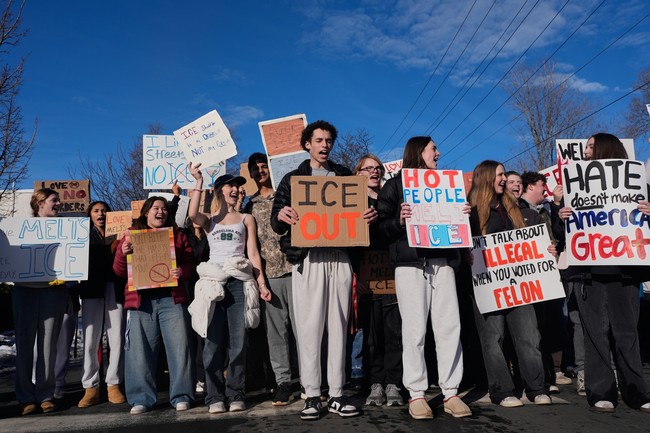
An anti-ICE activist running for Congress in Tennessee publicly criticized a high school student who objected to classmates leaving class for an “ICE OUT” protest, prompting debate about protest disruption, classroom priorities, and political ambitions in a deeply red district.
Local students at Science Hill High School in Johnson City staged an “ICE OUT” protest during school hours, with reports of more than 150 students leaving classes and using airhorns in hallways. Several classmates chose to stay put because they had tests and quizzes, and those trying to concentrate say the noise and commotion made it impossible to focus. That clash set the stage for a public clash online when a student posted their frustration on social media and drew attention from a congressional hopeful.
The student wrote that participants should face consequences for disrupting instructional time, explaining that many students “come to school for our futures as an education too and we don’t do nothing crazy during education.” They emphasized that supporting a cause does not require making learning impossible for peers who are trying to complete assessments. Their tone pushed back against what they called “unacceptable” behavior and urged protesters to consider their classmates’ right to learn.
Instead of backing the students who stayed to take tests, Kristi Burke, a Democratic candidate in Tennessee’s 1st District, left a comment that escalated the controversy. Burke has been vocal in her opposition to ICE and the current federal approach to immigration enforcement, and she used the student’s post to criticize the broader administration. Her reply framed the protest within a national political fight and urged solidarity with the demonstrators rather than with quiet students.
Burke’s response included the exact lines: “I can promise you that fascism will disrupt your life significantly more than a protest will. All students deserve to learn in peace. But there is no peace under this regime. I hope you will show some support to your classmates, who risked a lot to stand up for what is right.” Those words brought national attention to a local school dispute and turned a student complaint into a partisan flashpoint. The exchange highlights how political campaigns can insert themselves into everyday school conflicts.
From a Republican perspective, the priority should be clear: classrooms exist primarily for education, not as stages for political theater during mandated school hours. When students leave class en masse and create loud disturbances, they deny peers the quiet needed for tests and instruction. Advocates for preserving school time argue that there are appropriate ways to demonstrate civic engagement without undermining educational responsibilities.
This episode also raises questions about the role of teachers unions and outside organizers in pushing protest agendas during the school day. Critics point to nationwide efforts labeled as “Shutdown Days” and similar campaigns, suggesting they are coordinated by large organizations rather than emerging organically from students. That coordination can put pressure on school communities and force students and staff into political positions during class time.
At the same time, supporters of the protests argue that some causes demand public attention and civil disobedience to drive change. They maintain that students exercising free speech and standing up for what they believe is important, even if it disrupts normal routines. But many parents and educators worry those tactics cross a line when they interfere with required learning and testing schedules.
Tennessee’s 1st District is famously one of the most reliably Republican districts in the nation, a reality that shapes how campaign moves like Burke’s are perceived locally. Voters here have a lengthy history of electing conservatives, and challengers from the left face an uphill climb. Still, nationalized encounters like this one can serve campaign narratives, energizing both supporters and opponents depending on how the story is told.
For students caught in the middle, the incident is a reminder that school is where academic priorities should come first, and that activism can be effective without disrupting the education of others. The debate continues over how to balance civic engagement with classroom duties, especially when outside political actors and candidates weigh in. Meanwhile, parents and educators are left sorting out policy and discipline decisions at the school level.
As the controversy plays out online and in the community, it underscores the tension between public protest and the sanctity of instructional time, especially in contested districts where political posturing can amplify local disputes. The core issue remains plain: students deserve uninterrupted time to learn, and political actors should think twice before inserting themselves into school conflicts in ways that escalate rather than resolve tensions.

Add comment