
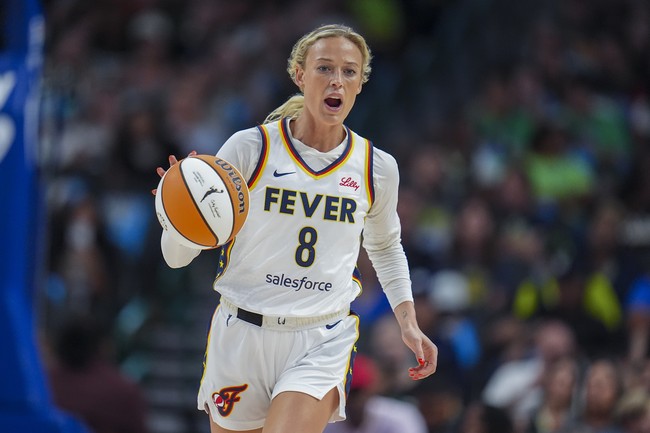
Sophie Cunningham has become a flashpoint this summer — a WNBA guard who went viral for a pointed moment on the court and who has since stood firm on protecting women’s sports, drawing fierce praise and louder criticism. This piece looks at her blunt public replies, the market reaction to a limited sneaker release tied to her name, and interest from a niche athletics brand that champions female-only competition. It highlights how authenticity, controversy, and commerce collided around one athlete and examines what that says about culture and consumer demand right now.
Sophie Cunningham is an Indiana Fever guard who broke through the noise after a viral on-court finger point. Reporters asked how people typically reacted to her, and she answered in a way that left no room for spin. “People love me or they really frickin’ hate me,” she says. “I just don’t care.”
That line reads as brash if you want it to, but it also reads as simple honesty. Cunningham is choosing clarity over carefully worded appeasement, and that posture connects with a lot of fans who are tired of performative language from public figures. In her world — professional women’s sports — she says her priorities are straightforward and personal.
The same bluntness showed up around the debate over transgender athletes in women’s sports. Cunningham explained her perspective without adopting the loaded language some critics expected. “I got a lot of negative feedback about me hating trans. And I’m like, ‘I never once said that,'” she says. “I think that I am here to extend love. But I also think with that love is truth, being honest. And I want to protect young girls in a locker room, or young girls in sport who shouldn’t have to go against biological men.”
That response set off predictable outrage from those who equate any defense of sex-separated sports with bigotry. Observers on the left pushed back loudly, while others pointed out that Cunningham was defending clear, longstanding distinctions in competitive categories. The cultural clash is less about a single athlete and more about how institutions, brands, and fans decide what counts as fairness and safety for women.
Some media commentaries framed Cunningham as a convenient target for broader ideological battles, but the market reaction offered a different kind of data point. When Adidas released a limited “Crazy Energy” Sophie Cunningham shoe at $120 a pair, critics predicted slow uptake and public blowback. The actual result was a sellout inside 24 hours, a quick, concrete signal that a significant segment of consumers will back athletes who speak plainly about their priorities.
The sneaker sellout undermined the idea that the loudest critics set purchasing trends. Instead, a quieter majority of customers—especially women—showed they would put their money where their values are. That dynamic matters to corporations and sponsorship teams deciding which athletes to back and how much political risk they’re willing to take.
That kind of market validation also drew attention from XX-XY Athletics, a brand that has built its identity explicitly around defending women’s sports and women’s spaces. The company’s founder and CEO has publicly signaled interest in partnering with Cunningham, even creating mock-ups of merchandise that riff on her famous on-court gesture. That outreach reveals the commercial niche for brands willing to stake out this position.
Brand-founder outreach is more than PR theater; it’s a strategic bet. XX-XY has positioned itself as one of the few companies openly supporting female-only competition, and a partnership with a high-profile player would boost both visibility and credibility. For Cunningham, the choice to align with a brand like that would be consistent with her public statements and with the audience that already moved to buy her shoes.
Critics will keep calling out athletes who weigh in on social issues, and some sponsors will shy away to avoid backlash. But the Cunningham example shows a countervailing force: consumers who reward clarity and conviction. Companies that listen to that market signal could find growth by appealing to mainstream women who want fair competition and aren’t represented by the loudest voices online.
There’s a practical side to this, too. Teams, leagues, and apparel makers have to decide how to navigate an increasingly polarized landscape without alienating core customers. Cunningham’s case is a reminder that athletes who speak their minds can become cultural touchstones—and that brands are making fast calculations about whether to mute those voices or amplify them.
https://x.com/RomeovilleKid/status/2080069445364433144
What’s happening around Sophie Cunningham is a small-scale example of a larger trend: authenticity sells, controversy attracts attention, and the market often resolves disputes faster than pundits do. The combination of a viral moment, direct quotes, a sold-out shoe, and targeted brand interest creates a clear narrative about demand and identity in women’s sports right now.



Add comment