
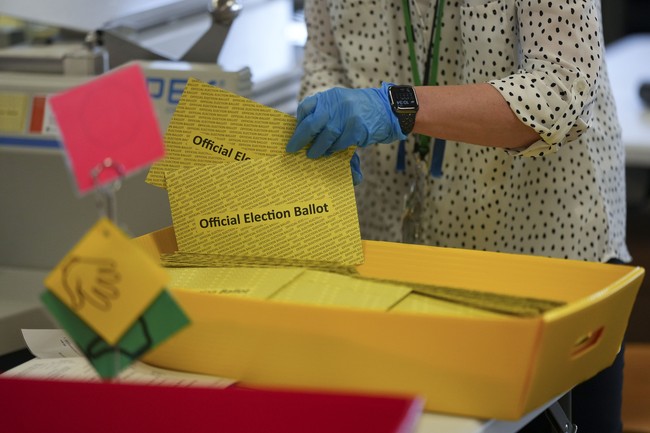
The First Circuit refused the Justice Department’s request to lift a lower court injunction tied to new mail-in ballot rules, issuing a 2-1 decision that found states are already facing concrete harms preparing for the 2026 elections and that DOJ directives create a credible enforcement threat; the split opinion and a partial dissent raise the real possibility this dispute heads to the Supreme Court.
The appeals court’s majority said states can’t be put in limbo when they must plan staffing, compliance, and ballot logistics months ahead of an election. That reasoning pushes back on the administration’s argument that the case is premature while USPS rules remain in flux. Officials on the ground, the majority noted, are facing immediate costs and operational changes if the injunction is lifted now.
SCOTUS Wire reported in an X thread on the details of the 2-1 ruling:
https://x.com/scotus_wire/status/2081120355855593895
Here’s what the majority – Circuit Court Judges Gelpi and Ricklman – in its opinion:
The panel wrote that the plaintiff states are already suffering concrete injuries because they must prepare now for the 2026 elections. The court pointed to diverted election staff, compliance planning, and imminent costs from redesigning mail-ballot systems and envelopes.
It rejected the administration’s argument that the challenge is premature because USPS hasn’t finalized its rules. Election officials cannot “wait and see,” the court said, because administering statewide elections requires months of advance planning.
The panel also found a credible threat of enforcement. Reading the executive order as a whole, it said DOJ’s directives to prioritize investigations and prosecutions of election officials created an imminent enough risk to support standing before the 2026 elections.
The panel’s fractured outcome underscores how high the stakes are for election administration. One judge saw the states’ harms as tangible and immediate, and he signed onto the stay of the lower court’s order for those reasons. That creates a clear legal pathway for further review, because a divided appeals court frequently sends a case to the Supreme Court when national election rules are at issue.
The third member of the panel, Judge Dunlap, a partial dissent:
Judge Dunlap dissented in part. He argued the states likely lack standing to challenge the DHS citizenship-list provision because it merely provides information to states and does not itself require them to take any action. He would have allowed that part of the order to move forward.
Dunlap’s narrower view centered on whether mere information-sharing can create the kind of injury that federal courts will resolve. He thought the DHS provision mainly supplies data and does not compel states to change how they run elections, so that portion should not be blocked. That split over standing is the heart of the disagreement and a classic issue the Supreme Court likes to weigh in on.
The lower court order that triggered the appeal came from U.S. District Judge Indira Talwani and put parts of the administration’s approach to mail ballots on hold. The appeals court ruling now keeps that injunction in place, at least for the moment, and the litigation will determine how far the executive branch can push directives that affect state-run elections. The procedural posture makes an eventual petition for certiorari likely, given the national implications and the divided appellate ruling.
Practical concerns are the immediate drivers here: election officials need lead time to redesign ballots, prepare envelopes, and train staff, and any hint of federal enforcement activity aimed at state election administrators creates a chilling effect. The majority noted these concrete operational burdens as enough to establish standing and justify continued relief. That approach treats election administration as a real-world logistical enterprise, not an abstract legal question.
In turn, the administration has argued the case is premature because USPS rules and other implementing steps are not finalized, but the court pushed back. The majority said waiting for every agency action to become final would let sweeping policy changes undercut states’ ability to prepare. When nationwide election mechanics are at stake, courts will sometimes intervene early to prevent disruption to state-run processes.
Because the panel split, the possibility of Supreme Court review is now real. The DOJ signaled previously it would seek Supreme Court review if its appeal failed, and a divided circuit opinion makes that path more likely. If the high court takes the case, it will confront questions about standing, separation of powers, and the balance between federal directives and state control of elections.
Observers on both sides should expect further filings and a potential certiorari petition in short order. With 2026 planning already underway in many states, the legal fight will continue to move fast, and the next procedural steps will shape how mail ballots are handled nationwide in the run-up to the midterms.

Add comment