
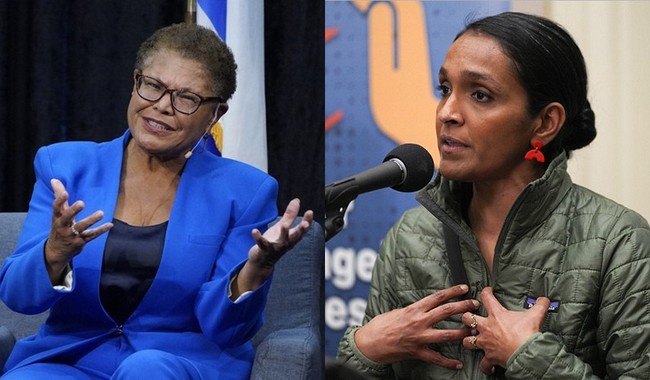
The Los Angeles mayoral race just hit a weird snag: a widely shared poll showing Mayor Karen Bass up by nearly 12 points over Nithya Raman turned out to be an intentional social experiment, not a legitimate survey, and the fallout is already prompting calls for investigations and plenty of political chest-thumping.
Viral polling can move campaigns, shape headlines, and send teams into celebration or crisis mode overnight. In this case, a poll attributed to a group called Median Strategies showed Bass leading Raman by nearly 12 percentage points in a runoff, citing a survey of 560 Los Angeles voters with a stated 4.1% margin of error. The Bass campaign briefly celebrated the numbers before the shock set in: the poll wasn’t real in the traditional sense.
A poll claiming Los Angeles Mayor Karen Bass was leading Council member Nithya Raman by a wide margin — and picking up support from most voters who supported Spencer Pratt in the mayoral primary — was bogus, the company behind the poll acknowledged Monday.
The fake poll by Median Strategies showed Bass leading Raman by nearly 12 percentage points ahead of the Nov. 3 mayoral runoff, and said the results were based on a survey of 560 Los Angeles voters between July 30 and Aug. 5. It said it had a 4.1% margin of error.
Median Strategies later admitted the whole thing was a short-term social experiment meant to test how unverified polling info spreads through political media. They said they weren’t looking for publicity or interviews and framed the project as designed to expose how quickly claims can be amplified. That explanation does not exactly comfort campaigns or voters who rely on polling to gauge momentum and turnout.
But Monday, in response to repeated inquiries from The Times, the company said the purported “poll” was nothing of the kind.
“Median Strategies was created as a short term social experiment to examine how purported polling information could enter and spread through the political information ecosystem without independent verification,” the company said in an email to The Times. “We are not seeking publicity or attribution for the individuals involved and are declining interviews.”
Naturally, the Bass campaign responded with fury and called for legal action, arguing that any bad-faith attempts to influence elections should be investigated and prosecuted. Their statement demanded that outlets and actors who reported the bogus poll be held accountable. Whether that will yield anything more than headlines is another matter; intentional information experiments occupy a gray area between provocation and illegality.
“This poll was reported on by multiple news outlets. Any bad faith attempts to influence elections should be investigated and prosecuted to the fullest extent of the law,” according to a statement from Bass’ campaign.
From a practical standpoint, this episode shows how fragile public trust in polling has become. The most recent legitimate polls were conducted before the primary, where Bass finished ahead by about five points, and a lot of the runoff math depends on where the roughly 25.5% of primary voters who supported Spencer Pratt end up. That makes the electorate dynamic and unpredictable, and a fake poll can distort perceptions even if it doesn’t change votes directly.
Political operatives on both sides know that perception matters; a headline about a double-digit lead can shift donors, volunteers, and media coverage. That power is exactly why creating phony or experimental polling results is reckless. It weaponizes trust and information channels for a social experiment, and the immediate winners are the outlets and campaigns that get a moment in the spotlight, even if the underlying data are worthless.
Polls are tools, not gospel, and bad actors can abuse them to manufacture momentum or panic. Observers who follow elections professionally rely on trends, aggregates, and methodology—things a single fabricated release can’t replicate. Still, the damage from one viral poll can linger: campaign strategies change, messaging shifts, and the public absorbs a version of events that might never have been true.
For voters, the lesson is straightforward: treat any single survey with skepticism, especially when its provenance is unclear. Look for consistent trends across multiple, transparent firms rather than dramatic one-off claims. Elections are decided at the ballot box, and while polls can inform, they should not be treated as substitutes for actual voting behavior.

“This poll was reported on by multiple news outlets. Any bad faith attempts to influence elections should be investigated and prosecuted to the fullest extent of the law,” according to a statement from Bass’ campaign.
Hey Bass affirmative, it’s now time to investigate yourself and for the DOJ to nab you as described in the US Constitution, an Enemy Within!
Enjoy the Cell-block at your new headquarters in GITMO, SNAKE!