
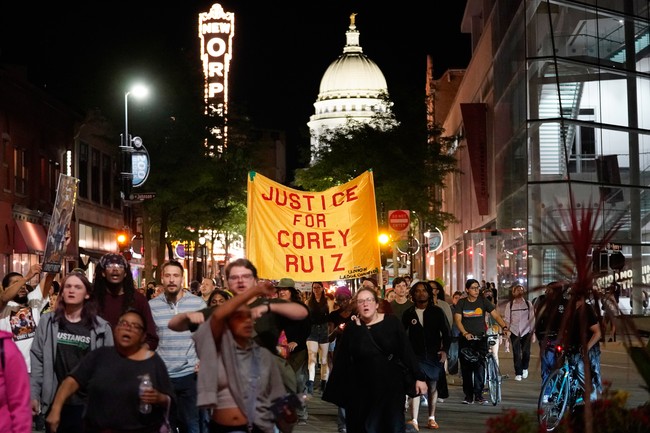
The occupation outside the Baldwin and Williamson intersection in Madison, labeled by some as the “Corey Ruiz Autonomous Zone,” has grown into a multi-day encampment that the mayor now says must end for safety, sanitation, and community stability reasons.
The shooting death of Corey Ruiz on July 22 sparked protests that quickly evolved into an encampment near the scene. What started as a reaction to a police shooting became a street takeover with tents, mattresses, grills, and porta-potties occupying public space. Neighbors and businesses report disruption, and city services have been strained as the presence has persisted for more than a week.
The occupation spread beyond the intersection, with barricades and makeshift installations creating obstacles in the neighborhood. Residents describe blocked sidewalks, interrupted bus routes, and limited access to workplaces and services. That sustained blockage has real consequences for daily life and local commerce, especially in a busy urban area.
https://x.com/SchulteLaura/status/2083196716069609728
The city initially responded in puzzling ways, even providing trucks to help block streets used by the encampment. That public support for an unlawful occupation raised alarms among citizens who expect elected officials to enforce the law fairly and consistently. The optics of city trucks assisting a protest zone only deepened concerns that public resources are being used to sustain a disruption.
There are also practical public health worries tied to the encampment’s long-term presence. When large-scale food preparation happens without refrigeration, sinks, or proper sanitation, the risk of illness rises for everyone nearby. Those conditions create hazards not just for protesters but for children, elderly neighbors, and emergency responders who may need to access the area.
Mayor Satya Rhodes-Conway has called the encampment “not sustainable” and highlighted several specific impacts the occupation is causing. She warned that blocked streets can impede fire and EMS response, and she described ongoing food preparation without basic sanitary infrastructure. The mayor says multiple complaints have come in from neighbors who feel unsafe and unable to sleep, and businesses report financial harm from closures and reduced foot traffic.
“There is all-day food preparation taking place without refrigeration, sinks, and other basics.” Rhodes-Conway said “Any time a street is blocked, it can impede fire and EMS response to our community.”
Beyond sanitation and emergency access, there are reports of people being threatened at the site, both toward neighbors and among protesters themselves. That kind of intimidation undermines any claim that the occupation is solely about peaceful protest. Muscling through a neighborhood with menacing behavior is not a sustainable or lawful tactic for seeking justice or reform.
“We are also hearing from Marquette neighborhood residents that they can’t sleep, can’t conduct business, are experiencing financial hardships, and can’t safely move around the neighborhood.” Rhodes-Conway said. “Those who also want real change after the police shooting of Corey Ruiz are increasingly failing to understand and losing patience with a protest tactic that seems misaligned with bringing the community together.”
There are also homeless individuals sheltering in the encampment, which complicates the scene and raises humanitarian concerns. When encampments mix protest objectives with housing and survival needs, city officials face a dual challenge: protecting public safety while addressing housing and social service gaps. That mix cannot become an excuse for allowing streets to be occupied indefinitely.
The mayor has pointed to costs tied to city resources deployed at the site, including salt trucks used to block passages, and suggested those expenses are substantial. Sustaining an occupation with municipal equipment and personnel runs up taxpayer bills and diverts resources from other essential services. Citizens deserve transparency about the financial toll of tolerating such an encampment.
So far the mayor has asked the occupiers to leave voluntarily rather than ordering a forceful removal, which frustrates many residents who want a quicker resolution. Asking for voluntary compliance is reasonable, but it must be paired with accountability and a plan to restore public order. Allowing the situation to fester risks creating a pattern where future occupations assume immunity from enforcement.
Whatever views people hold about the police shooting, activists do not have a right to close public streets and jeopardize safety and local livelihoods. History shows that when authorities permit prolonged occupations, problems escalate and neighborhoods pay the price. The city needs to balance compassion and due process with a firm commitment to public safety and the rule of law.

Add comment