
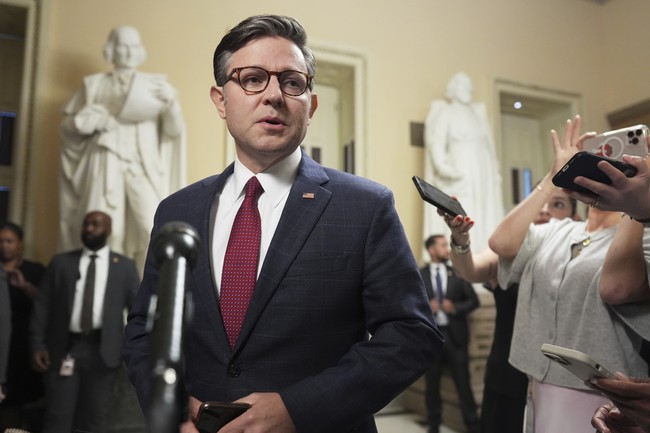
The House speaker backed the administration’s decision to strike Iran, calling the move a defensive necessity to stop an imminent missile threat and protect American forces and regional allies. He argued waiting would have led to heavy casualties, echoed that Israel would have acted regardless, and framed the operation as targeted disarmament rather than regime change—though some see the effects as encouraging internal Iranian opposition.
After a classified briefing for the Gang of Eight, Speaker Mike Johnson publicly endorsed the administration’s actions in Operation Epic Fury, saying the strikes were aimed at immediate defense. He framed the choice as one between acting now to blunt an enemy arsenal or suffering preventable losses later. That stance places the blame squarely on Tehran’s missile buildup and presents the U.S. response as measured and necessary.
House Speaker Mike Johnson said the U.S. strike on Iran was a defensive operation designed to prevent “staggering losses” to American troops and assets, arguing that waiting for Iran to strike first would have resulted in devastating casualties.
Johnson spoke to reporters at the Capitol on Monday, where he emphasized that the most critical point of the operation was that it was defensive in nature.
“Israel was determined to act in their own defense here, with or without American support,” he said. “Israel faced what they deemed to be an existential threat. Iran was building missiles at a radical, and at a rapid clip, to the point where our allies in the region could not keep up, as you know, Iran, has, long vowed to take out Israel, wipe it off the map.”
Johnson made clear he sees the strikes as preemptive protection, not warmongering. He argued that the intelligence pointing to an imminent missile campaign against U.S. troops and regional partners forced a hard choice. From his view, waiting for the first Iranian salvo would have been negligence, not prudence.
He told reporters the administration and military had to weigh risks to American personnel, bases, and assets spread across the Middle East. If Iran had launched short- and medium-range missiles at those targets, Johnson said, the damage could have been catastrophic. Acting first, the speaker asserted, reduced those potential losses and denied the enemy the initiative.
“Because Israel was determined to act with or without the US, our commander in chief and the administration and the officials…had to evaluate the threats to the US, to our troops, to our installations, to our assets in the region and beyond,” Johnson continued. “If Iran had begun to fire all of their missile arsenal – short and mid-range missiles – at our personnel and our assets and our installations, we would have suffered staggering losses, and if we had waited to respond before acting first, then those losses would have been far greater than if we had done what we did. That was their decision.”
Johnson said he guarantees that if the U.S. had not acted, the Trump administration would have been hauled in by Congress and asked why they waited if they had “existential intelligence, knowing that that would happen.”
“I am convinced that they did the right thing,” he said.
Secretary of State Marco Rubio made similar comments, emphasizing that Israel would have moved with or without American backing. That point matters for lawmakers who question U.S. involvement or fear entanglement; it reframes American strikes as both supportive and preventive. Republicans in Congress are leaning into that frame: supporting decisive action while highlighting the administration’s obligation to protect troops.
The speaker emphasized that the primary aim of the campaign is disarmament, not a wholesale attempt at regime change. That line helps present the strikes as surgical, focused on degrading missile capabilities and other immediate threats. Yet for many on the ground inside Iran, dismantling the regime’s tools of repression will also have political consequences.
The aftermath of targeted strikes often accelerates internal dynamics, and it’s clear some Republicans view those consequences as acceptable collateral to remove existential threats to allies. The Iranian people have protested for years against their ruling theocracy, and removing the regime’s ability to project force changes the balance of power inside the country. From this perspective, disarmament and the erosion of the regime’s control can be a step toward a freer Iran.
Critics will say that military action risks escalation or unwanted blowback, but supporters point to the clarity of intent here: protect American lives and blunt an imminent missile threat. The speaker’s message is straightforward and unapologetic—protect our people and our partners, deny the enemy the chance to strike first, and carry out targeted strikes that reduce future risks. That posture reflects a conservative view of strength and deterrence in a dangerous neighborhood.
Public rhetoric aside, the larger debate now shifts to oversight, strategy, and exit conditions. Lawmakers will press for details about how long the U.S. intends to maintain pressure, what measures are in place to prevent escalation, and how the region’s security architecture will be reinforced. Those questions will shape the next congressional hearings and votes as Republicans insist on clear objectives tied to protecting Americans.



Add comment