
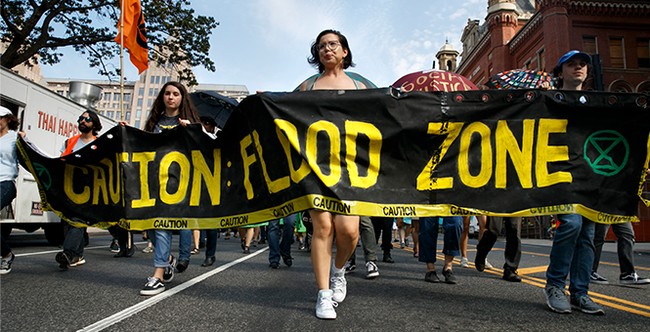
The writer recounts an episode at a climate event in Hampton, U.K., where a man who agreed with the urgency of climate concerns but criticized Extinction Rebellion’s tactics was forcibly removed and injured, raising questions about the group’s claims of nonviolence and how protesters treat dissent from inside their own movement.
At a local talk titled “Climate Reality – What’s causing climate change and what can we do about it,” an attendee stood and challenged not the science but the methods used by activists. He argued that aggressive tactics push people away instead of persuading them, and he tried to make that point calmly. What followed was a vivid example of how a movement that preaches peace can handle internal criticism with surprising hostility.
As the man spoke a speaker interrupted and the room turned impatient, which escalated when his microphone was threatened. To underline his point about annoyance, he blew a small horn and said, “See? This is annoying. This is my point.” That action did not lead to a civil exchange; instead, a few large men moved to remove him, and the situation turned physical.
After the usual cycle of ‘doom, death’ and despair’ followed by the standard ‘if we just spend a lot of money on renewable energy, we’ll save the planet’ narrative the floor was opened for questions.
A few questions in, a gentleman stood up and said that while he agreed with the urgency of the message, the tactics of Extinction Rebellion alienate people rather than persuading them. The panel began interrupting him, urging him to “ask his question or stop” in a rather patronising tone. He calmly continued, explaining how such tactics damage public support. This clearly irritated one of the speakers, a schoolteacher-turned-activist who had moments earlier described how “exciting and fun” activism could be.
Before long, the man was told his microphone would be taken away. In response, he pulled out a small horn and blew into it, saying, “See? This is annoying. This is my point.” The audience began shouting at him to stop. Moments later, a couple of large men approached, grabbed him and started dragging him across the room. He resisted, but not violently, he simply tried not to be hauled out by his neck whilst continuing to shout his message.
Witnesses heard a loud bang as he was shoved toward the exit and reportedly hit his head on the door frame. Some in the audience cheered while the panel maintained that climate protesters are peaceful. That contradiction — claiming peace while watching someone manhandled — is what sticks in the mind of anyone assessing the movement’s credibility.
Three men eventually forced him towards the exit. I heard a loud bang as he was pushed out, apparently hitting his head on the door frame. Some in the audience even cheered.
The panel’s next line, without a hint of irony, was: “We climate change protestors are peaceful.”
A man had just been manhandled out of the room for holding up a mirror to their behaviour, and not one of them intervened or even suggested a calmer approach. It was hypocritical and frankly disgraceful.
A few moments later, the same man crawled back into the room, asking for help. He requested that the police be called, which they were. When things calmed down, I learned that he had indeed struck his head during the scuffle, and a lump was forming. He was unsteady on his feet and shaken by the physical altercation, but also by the realisation that he could not safely stand among people who claim to be fighting for a better world and suggest, politely, that their tactics might need to change.
The injured man’s lump and unsteady gait are worrying signs, and they raise a real safety issue. A head injury can be more serious than it looks, and what began as a verbal disagreement could have led to lasting harm. For people who worry about preserving civil society, seeing force used against a nonviolent critic inside a supposed peaceful movement should be alarming.
Beyond the immediate incident, the episode highlights a larger problem with theatrical protest tactics that disrupt everyday life. Road blockages and attention-grabbing stunts may make headlines, but they also anger commuters, force idling engines, and alienate potential supporters. If the objective is persuasion, those costs should be counted honestly.
Critics feel that tactics matter as much as the message, and this case offers a blunt example of why. When activists cross into coercion, they lose the moral leverage needed to build broad coalitions. That trade-off matters for public policy debates, especially when proposals involve big economic and social changes.
Claims of nonviolence do not automatically absolve a movement of responsibility when its events devolve into rough handling and injury. Observers who care about free speech and civil discourse will want clearer standards and accountability from any group that seeks to shape national policy. The incident in Hampton shows that self-reflection is overdue for groups that call themselves peaceful while treating dissent as a threat.


Add comment