
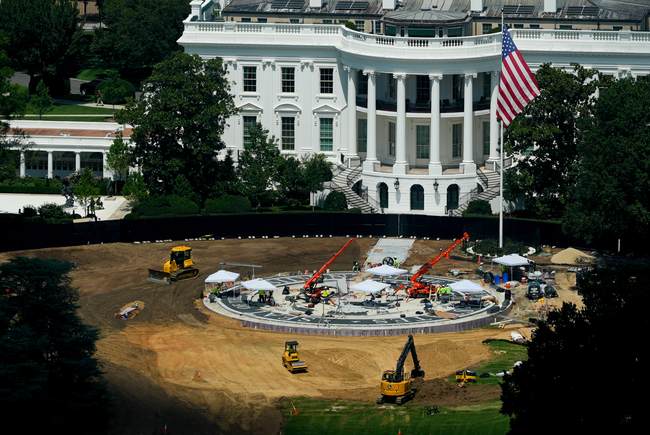
President Trump unveiled a new, oversized White House helipad made of black granite, arguing it will modernize presidential transport, host outdoor events, and accommodate the latest Sikorsky helicopters; the project, funded by the manufacturer, faced slope concerns that were addressed, drew predictable media ire, and will be operational in mid-September.
Donald Trump has a habit of doing things on a big scale, and the helipad is no exception. He championed a 100-foot granite landing zone able to handle larger, more powerful helicopters that previous administrations avoided. At an impromptu press moment he walked reporters through the reasoning and the finished look, clearly pleased with the result.
https://x.com/WhiteHouse/status/2090108210308931992
Trump:
This is going to look incredible from the air and from every place else. And again, this is going to be used for a lot of different celebrations, a lot of different big meetings where, as an example, [Chinese] President X is coming in a little while, a couple of weeks…
President Xi’s coming, other heads of state will come, and we can do this all outside. Nice weather like today.
And this was not a scheduled press conference, but I thought it was so, it’s so good what we’re doing, people should see.
The helipad is poured as a single slab of black granite that engineers say has very high compressive strength. Reports put that strength in a range suitable for heavy rotorwash and repeated touchdowns by modern machines. The work carried an estimated price tag in the low millions, with Sikorsky stepping forward to fund the construction.
The move is squarely about capability and optics: allowing Marine One to use the latest Sikorsky models without tearing up the South Lawn. For years administrations avoided such changes because of the damage stronger helicopters could cause when landing on softer turf. The new pad is meant to eliminate that problem and add a clean, permanent surface for landing and for outdoor functions.
The helipad would allow Mr. Trump to use the latest generation of Sikorsky helicopters as Marine One on White House grounds — a move multiple administrations had avoided because the new, more powerful helicopters were likely to damage the South Lawn during landing.
The Navy began the search in 2010 for helicopters to replace the two models that have been used to transport the president and vice president for more than four decades — the VH-3D and the VH-60N. It purchased 23 VH-92A helicopters, including two test aircraft, at about $215 million apiece, with a total cost estimated at $5 billion, according to the Government Accountability Office.
There was a snag around the slope of the pad that attracted attention, but the issue was resolved by adjusting the grade and reinforcement. Engineers were able to change plans without delaying the overall timeline significantly. Project managers now expect the pad to be fully operational by mid-September, ready for both routine flights and special events.
The financing angle drew commentary because Sikorsky picked up the main tab, which administration spokespeople framed as sensible: the manufacturer benefits directly from a landing zone designed for its machines. The company’s investment also removed a political fight over using taxpayer dollars for a modernization tied to safety and logistics. Critics will still call it unusual, but officials argued it was practical and targeted.
Trump used the unscheduled appearance to criticize the prior condition of the White House grounds and facades, noting repairs and restorations his team commissioned. He described visible chips and broken stone that, in his view, needed professional attention and quick action. That line of argument fit with his longtime focus on property maintenance and presentation.
People should see, because the White House was in terrible condition. Some of these men worked on the facade of the White House, along with the Department of the Interior, Doug Burgum, who’s been fantastic.
But they worked on the facade of the White House. And if you look at it now, if you would have looked at it six, seven months ago, you would have been embarrassed…
It used to make me sick. And look at how horrible the condition was, where the stone was broken, the columns had big chips in them, a foot long, and it was terrible. And now it’s perfect, it’s perfection, and I think you can see that pretty much right here, even from this distance you can see it.
Unsurprisingly, media outlets and political opponents reacted quickly, framing the helipad in familiar ways and questioning approvals. That predictable backlash did not stop the project. While other White House projects face legal hurdles and delays, this landing pad pushed forward and reached completion stages thanks to private funding and finalized engineering fixes.
For now, the helipad will be a visible, functional addition to the White House grounds, used for presidential travel and public events when weather allows. Officials say it solves a real problem for heavier helicopters while adding a neat surface for aerial approaches. Critics will keep raising questions, but the structure itself is now in place and awaiting regular use.



Add comment