
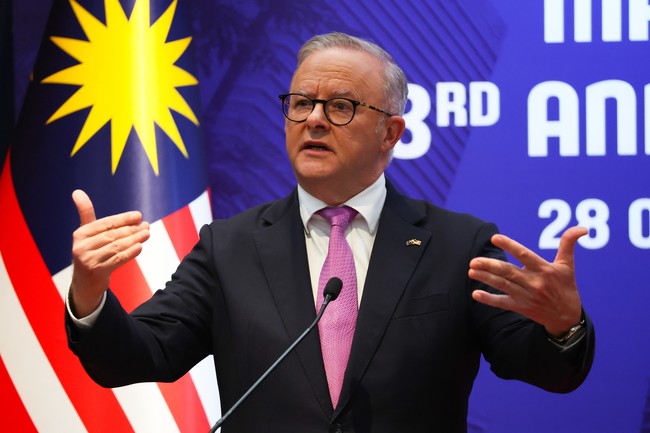
The Australian prime minister’s recent visit to a Sydney mosque turned into a chaotic scene that underscores the risks of political gestures meant to appease hostile elements; this piece examines what happened, how it unfolded, and the broader questions it raises about leadership, security, and national identity.
Anthony Albanese went into that mosque hoping to show contrition and bridge gaps after his public criticism of the Iranian regime, but the optics backfired badly. What was intended as a symbolic act of outreach instead exposed a serious breakdown in message discipline and situational control. Political theater can’t replace clear policy or secure, principled engagement with groups that reject core national values.
Video from the event shows moments of confusion and alarm that no leader should have to endure while under protection. At least one person appears to lunge toward the prime minister, forcing security to act and the entourage to make an abrupt exit. The chanting of “Allahu Akbar” by members of the crowd added to the sense that this was not a calm, reconciliatory meeting but a volatile scene that could have sparked violence.
As Albanese and Minister Tony Burke fled the mosque and moved down a side street, they were pursued by an angry crowd shouting denunciations and accusations. The footage includes a voice asserting that Albanese had “killed our brothers and sisters,” a claim that makes little sense given Australia’s lack of direct involvement in recent Middle East conflicts. The accusation highlights how charged narratives can be weaponized on the spot, regardless of facts.
Leaders owe it to their citizens to assess who they are engaging with and why, not simply to perform for optics. When politicians bend over backward to placate ideologues who openly oppose the liberal democratic order, they risk normalizing aggression and undermining public trust. A government that cannot keep a prime minister safe during a staged outreach has questions to answer about judgment and preparedness.
This episode also surfaces deeper tensions around immigration, assimilation, and national cohesion. The question many Australians will ask is simple: do the communities we welcome embrace the values that sustain free societies, or do they import illiberal attitudes that sow division? Those are hard questions that deserve honest debate, not slogan-driven concessions.
Political leaders have an obligation to protect citizens and preserve the institutions that make society prosperous and free. That includes enforcing law and order and making clear that no group gets a pass for behavior that threatens public safety or expresses hostility toward the nation. Appeasing problematic actors through symbolic gestures leaves ordinary citizens exposed to the consequences of weakened standards.
Security professionals watching the footage would flag multiple tactical concerns: the crowd control plan, the exit routes, and the decision to allow close exposure to a volatile audience. Those are not minor details; they are basic responsibilities of any administration that values the safety of its leaders and the public. Poor execution here is a reflection of priorities, not merely an operational hiccup.
Beyond tactics, there’s a political cost to be paid when leaders repeatedly signal weakness in the face of hostility. Citizens expect representatives to defend national interests and cultural continuity. When those expectations are replaced with performative humility in situations that invite confrontation, trust erodes and political capital drains away.
There is also the matter of narrative control. Erroneous or inflammatory claims shouted by a crowd can take on a life of their own in social feeds and partisan media. A strong government needs to respond quickly with facts and clarity, not limp denials or apologetic posture. Failure to do so lets falsehoods circulate unchecked and fuels further radicalization.
Australia, like any Western nation, faces a choice about social integration and the limits of toleration. Tolerance does not mean tolerating open antagonism toward democratic norms or the use of public gatherings to stage intimidation. Leaders must draw bright lines while remaining fair and law-abiding; that balance requires courage, not capitulation.
Events like the mosque visit should prompt a sober reassessment of public engagement strategies and the principles that guide them. Policymakers should ask whether symbolic gestures are worth the risks when they expose leaders to danger and send confusing signals to the electorate. Politics isn’t theater; it’s the stewardship of a nation’s security and values.
If political outreach is going to be meaningful, it must be paired with clear expectations and consequences. Inviting a faction into the public square does not mean abandoning the standards that make Western societies thrive. When outreach collapses into chaos, it reveals not only operational failure but also a failure of judgment about who deserves the trust and respect of a country’s leaders.

Add comment