
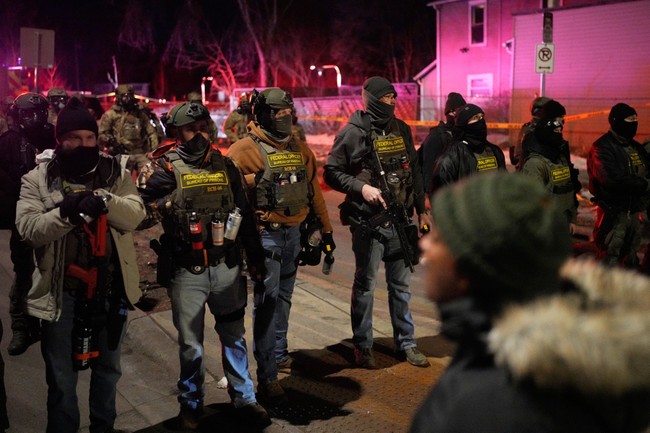
The 8th Circuit Court of Appeals has temporarily halted a federal district court’s preliminary injunction that restricted immigration enforcement actions in Minneapolis during Operation Metro Surge, putting the injunction on hold while the appeals court reviews the case in Tincher v. Noem.
The pause came after U.S. District Judge Kate Menendez issued an order on January 16 that limited federal agents’ responses to protesters, including prohibitions on retaliatory use of pepper spray and on detaining drivers who were not overtly obstructing operations. The Department of Justice sought a stay and appealed, arguing the injunction was unworkable and overbroad. The 8th Circuit first issued an administrative stay and then followed with a formal stay pending appeal, effectively restoring federal enforcement flexibility for now.
The appellate court’s written decision runs only six pages but is pointed about the practical problems the injunction creates. The 8th Circuit found the district court’s broad class-wide remedy could not neatly fit the facts and behaviors shown in videos of different incidents. The appeals court emphasized that the incidents involved “different conduct, by different officers, at different times, in different places, in response to different behavior,” which undercuts the idea that a single, sweeping injunction could resolve everything in one stroke.
We accessed and viewed the same videos the district court did. What they show is observers and protestors engaging in a wide range of conduct, some of it peaceful but much of it not. They also show federal agents responding in various ways. Even the named plaintiffs’ claims involve different conduct, by different officers, at different times, in different places, in response to different behavior. These differences mean that there are no “questions of law or fact common to the class,” that would allow the court to decide all their claims in “one stroke.”
Beyond the class-certification problem, the 8th Circuit called the injunction vague and essentially a directive to follow the law without giving clear operational guidance. The appeals court criticized commands that forbid retaliation against persons “engaging in peaceful and unobstructive protest activity” and that bar stopping or detaining drivers “where there is no reasonable articulable suspicion,” calling them insufficiently specific. That vagueness, the court warned, could put federal agents in a position where any misjudgment risks contempt, while offering little constraint on the district court’s power to enforce the order.
Second, in addition to being too broad, the injunction is too vague. Directions not to “[r]etaliat[e] against persons who are engaging in peaceful and unobstructive protest activity” or “[s]top[] or detain[] drivers . . . where there is no reasonable articulable suspicion” are simply commands to “obey the law,” which are “not specific enough.”
Even the provision that singles out the use of “pepper-spray or similar nonlethal munitions and crowd dispersal tools” requires federal agents to predict what the district court would consider “peaceful and unobstructive protest activity.” The videos underscore how difficult it would be for them to decide who has crossed the line: they show a fast-changing mix of peaceful and obstructive conduct, with many protestors getting in officers’ faces and blocking their vehicles as they conduct their activities, only for some of them to then rejoin the crowd and intermix with others who were merely recording and observing the scene. A wrong call could end in contempt, yet there is little in the order that constrains the district court’s power to impose it. “[F]ederal courts do not exercise general oversight of the Executive Branch,” and the structural injunction imposed here, given its breadth and vagueness, is too big a step in that direction.
From a Republican perspective, the appeals court decision underscores a key point: national law enforcement must be able to carry out federal immigration operations without being hamstrung by broad judicial micromanagement. Enforcement operations like Operation Metro Surge involve shifting, sometimes dangerous conditions where agents must make split-second decisions to protect public safety and carry out their duties. The injunction’s blanket prohibitions risk handicapping those agents and creating inconsistent outcomes across cases.
The stay does not decide the merits, it only preserves the status quo while the appeal proceeds, which means the legal battle will continue. Expect the parties to brief the core constitutional and procedural issues, including whether a classwide structural injunction is appropriate and how detailed any court-imposed restrictions must be to survive appellate scrutiny. The appeals court’s focus on class commonality and clarity signals the analytical path it finds most problematic in the district court’s approach.
Practically, federal agents in Minnesota now have the ability to resume certain enforcement actions that the district court’s injunction would have restrained, at least until the 8th Circuit reaches a final decision. That restores operational discretion absent a narrower, more precisely tailored order from the district court or an adverse ruling from the appeals court. The case will test how courts balance protest rights, public safety, and the executive branch’s authority to enforce federal immigration law under challenging circumstances.



Add comment