
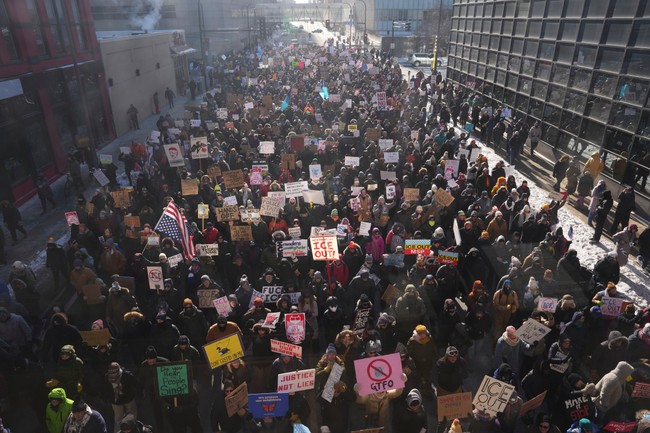
The Minneapolis shooting that killed anti-ICE protester Alex Pretti has sparked nightly demonstrations and sharp political rhetoric, and federal officials say Border Patrol agents involved were wearing body-worn cameras that the Department of Homeland Security is now reviewing.
The city remains tense after the Saturday incident, with crowds showing up in freezing conditions and emotions running high. Officials on both sides are trading accusations as investigators work to piece together exactly what happened. At this stage, many details remain unsettled and the video evidence could be decisive.
President Trump has dispatched Border Czar Tom Homan to the Twin Cities to help manage the situation, signaling a federal response to the unrest. U.S. Border Patrol leadership figures have also been reported to be moving through the area to oversee operations. That federal presence underscores how seriously the administration views the confrontation.
Border Patrol Commander-at-Large Gregory Bovino has been publicly associated with the response, and DHS Assistant Secretary Tricia McLaughlin described him as a valued member of the administration. That statement came as agencies coordinate to stabilize the scene and preserve evidence. The federal posture reflects a priority on protecting agents and completing a disciplined investigation.
One key piece of evidence that could cut through the noise is body camera footage from agents at the scene. DHS officials say agents in the involved unit routinely wear more recording devices than many other teams. If those recordings are intact and admissible, they may offer an objective timeline of events.
Homeland Security has confirmed it is reviewing video captured by cameras worn by multiple agents, according to reporting. The agents involved were part of the Border Patrol Tactical Unit, a unit that typically issues more body-worn cameras than regular patrol teams. That makes the existence of footage more likely than in many other law enforcement encounters.
Homeland Security investigators have videos recorded by cameras worn by multiple agents, department spokeswoman Tricia McLaughlin said.
The agents involved in the Pretti shooting were part of the Border Patrol Tactical Unit, a specialized force, McLaughlin said. Two law enforcement officials told NBC News that unit has more body-worn cameras.
Questions now center on whether the footage will be released and what it will show about how the confrontation unfolded. Early speculation includes suggestions that Pretti’s gun discharged accidentally, but investigators have not verified that scenario. The presence of a firearm in his possession is already a material fact investigators must consider.
Reports indicate Pretti was armed with a Sig Sauer P320 series 9mm semi-automatic pistol and carried two magazines. That model has been noted in past reporting for instances of unintended discharges, though each incident demands its own careful forensic review. Possession of a concealed carry permit also factors into legal and investigative considerations.
The context of the operation matters as well: federal agents were conducting a targeted operation aimed at an Ecuadoran national with an alleged criminal history. That operation provides the backdrop for why heavily armed Border Patrol Tactical Unit personnel were present in greater numbers. When federal officers work a high-risk arrest, the environment can become chaotic quickly if bystanders intervene.
Pretti reportedly joined a crowd confronting the agents, and officials say that interfering with a targeted law enforcement action is dangerous. That danger is amplified when the crowd includes people trying to record or shame officers while the operation is ongoing. From a law-and-order perspective, the risk to both officers and civilians increases sharply under those conditions.
Local leaders have answered with intense rhetoric that federal officials and many conservatives view as reckless. Governor statements and mayoral comments that vilify federal law enforcement only stoke tensions and encourage direct confrontation. For those who value public safety, such language is a serious misstep at a time when calm and careful process should prevail.
Sanctuary policies and lenient local approaches to immigration enforcement are also part of the broader debate in Minnesota. Critics argue that those policies created conditions where federal enforcement became necessary and politically charged. That criticism drives support for a stronger federal role in restoring order and enforcing immigration law.
At the same time, supporters of the protesters say they were exercising free speech and exposing perceived abuses during immigrant-related operations. That clash over motives and methods is at the heart of the political dispute. Each side accuses the other of escalating the situation, and the bodycam footage may help clarify which claims are accurate.
The investigation is ongoing, and DHS has custodial control of the body-worn camera recordings while it reviews them. How and when any footage is released will depend on investigative needs and legal considerations. Transparency advocates will press for public access, while investigators will emphasize the need to protect evidence and witness safety.
Community leaders and federal officials must now balance the demand for answers with the need for a fair, thorough probe. Rush judgments based on partial information will only deepen divisions and possibly jeopardize legal proceedings. The best hope for clarity lies in a careful, evidence-driven process led by investigators with access to the recordings and forensic analysis.
For conservatives focused on enforcing immigration laws and protecting federal agents, the episode reinforces the risks agents face during targeted operations. The presence of bodycams is a positive step toward accountability and clarity in use-of-force incidents. What remains to be seen is whether the footage will settle disputes or fuel further contention.
Add comment