
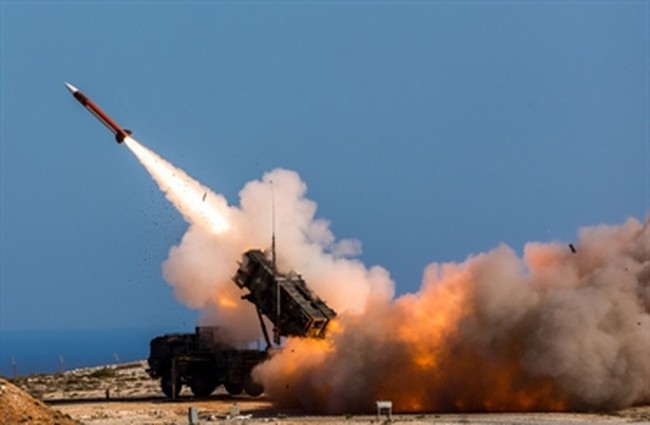
The War Department has struck major framework agreements with Lockheed Martin and Northrop Grumman to surge production of missile interceptors and key components, committing tens of billions to expand output of PAC-3 and THAAD systems and shore up U.S. air and missile defense capability.
These agreements are meant to rapidly scale capacity across the defense industrial base at a time when demand for interceptors has spiked. The deals combine long-term commitments with accelerated production plans so the military can field more interceptors faster than under normal procurement rhythms. Officials frame the effort as a straightforward industrial surge to meet clear national security needs.
The reported dollar figures are substantial and headline-grabbing, with one lock on a multiyear Lockheed modification reaching as high as $53.86 billion for PAC-3 missiles and a separate Northrop framework described at $3 billion. Those sums reflect both immediate ramp-up activities and expanded commitments across multiple years, not single-year spending. Policymakers say this scale is necessary to restore inventory depth and deter adversaries who test our defenses.
Part of the public messaging around these deals stresses supply chain resilience and industrial scale. One Department official put it bluntly: “Building the Arsenal of Freedom requires robust, dynamic supply chains at every level of the industrial base.” That line signals a shift from ad hoc buys to a strategic, layered approach that treats munitions and interceptors as core national infrastructure. It also acknowledges the need for multiple suppliers, manufacturing capacity, and predictable demand signals to justify heavy capital investment.
The War Department also highlighted the specific production goals tied to the framework agreements, describing plans to triple PAC-3 output and quadruple THAAD structural component production. Achieving that will require manufacturers to increase monthly deliveries, hire more workers, and put idle or underused capacity to work. Industry leaders emphasize they already have significant facilities and workforce, which they can redirect toward these urgent priorities.
Northrop Grumman’s work is being framed around two linked efforts: speeding PAC-3 MSE solid rocket motor production under a roughly $2 billion strand, and boosting THAAD component deliveries in a $1 billion strand. Northrop noted its large manufacturing footprint and workforce as key enablers of this push. Northrop’s framework alone is worth $3 billion:
https://x.com/NGCNews/status/2084250991294083229
Lockheed’s modification on the PAC-3 multiyear contract pushes the total multiyear ceiling higher, reflecting a major expansion of an existing program. The company’s seven-year modification reaches up to $53.86 billion for PAC-3 missiles, bringing the collective multiyear contract value to $58.62 billion after earlier actions. Those numbers underscore how a single system family, PAC-3, is now the focal point for rebuilding missile defense inventories.
The agreements were coordinated across several offices inside the Department, including munitions acceleration teams, the Missile Defense Agency, and acquisition leadership. That interagency coordination aims to align budgeting, manufacturing, and program management so output increases translate into usable stockpiles rather than work-in-progress. Officials expect the framework structure to speed contracting, stabilize supplier commitments, and reduce bottlenecks.
Scaling from peacetime production to the targeted levels will not be simple. It requires raw materials, subcontractor performance, workforce retention, and quality assurance at pace—each a potential pressure point. Still, supporters argue that predictable, large-scale contracts are the right tool: they allow suppliers to invest in facilities, hire skilled technicians, and smooth supply chains across years rather than chasing stop-start buys.
There’s a clear political dimension to the timing and tone of these moves. The administration positions this industrial surge as part of a larger posture that prioritizes strength and deterrence. As one famous line put it, “In the real world, peace through strength must be our motto.” That aphorism feeds directly into the case for rebuilding and modernizing missile defense inventories now.
For policymakers who back these steps, the principle is simple: when threats rise, capability must rise faster. These framework agreements are meant to turn a policy choice into production reality, ensuring U.S. forces and allied partners have more interceptors available on shorter timelines. If executed as planned, the industrial surge should leave the nation with deeper stockpiles and a more resilient defense supply chain.



Add comment