
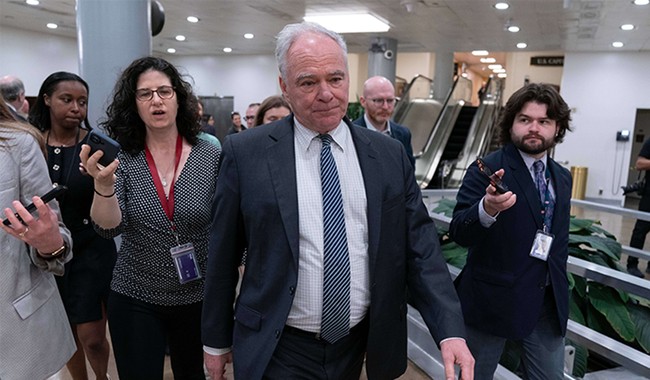
This article examines Sen. Tim Kaine’s candid remarks during a Fox News interview about Virginia’s proposed redistricting amendment, the political math behind the measure, reactions from Republican leaders, and polling that hints at voter skepticism — with embedded media preserved where present.
Sen. Tim Kaine appeared on Fox News and made a line of argument that caught attention because it sounded like a plain admission of motive. The interview focused on a Virginia ballot question that would give the state legislature temporary power to redraw congressional districts. That change could dramatically shift how many seats one party holds in the Commonwealth.
The proposed map at the center of this debate promises to change Virginia’s congressional delegation dramatically, moving from a relatively modest Democratic edge to a much larger one. Projections suggest the map could shift several seats toward Democrats in the next congressional elections, a result that alarms voters who care about fair representation.
With early voting concluded and election day arriving, attention turned to whether voters would accept a temporary constitutional change to let the legislature redraw lines. The timing and the scale of the proposed shift have made this referendum a high-stakes test of whether Virginians prefer maps that reflect statewide votes or maps that lock in partisan advantage. Public interest ran high as the final hours approached.
During the interview, anchor Shannon Bream reminded Kaine that Virginia had been closely contested in the prior presidential race, yet one party could end up with an overwhelming share of seats. Bream pointed to the mismatch between statewide vote totals and the potential seat distribution, then asked Kaine how that squared with fairness in representation. The exchange moved the conversation from abstract policy to the reality of voter power.
Kaine responded by acknowledging the gap between vote share and seat share and then framed the map as a defensive move against future election interference by former President Trump. He said, “90 percent of Virginians aren’t Democrats, that’s true, but about 100 percent of Virginians want election results to be respected. We’re deeply worried that Donald Trump will try to interfere with the election results this November or in 2028, cause we saw him do it before.” That line made critics argue the amendment is less about fairness than about securing partisan control.
The acknowledgment that the map would not reflect proportional statewide preferences left many observers cold, and critics were quick to highlight the contradiction. If the map produces a 10-1 split while statewide voting remains competitive, it raises questions about whether voters are being asked to accept engineered outcomes in the name of security. Those concerns have animated Republican opposition and independent voters wary of manipulative politics.
Former Virginia attorney general Jason Miyares weighed in, summing up the criticism in blunt terms about the mismatch between votes and seats. He argued that calling such a map a defense of democracy rings hollow when it results in overwhelming partisan advantage despite narrow statewide margins. His comments were forceful and aimed squarely at mobilizing voters who favor nonpartisan maps and straightforward representation.
Polling released earlier in April showed signs that the amendment might be more contentious than its backers expected. Some surveys indicated Republican and Republican-leaning voters were more energized to participate, narrowing the advantage Democrats hoped to convert into seats. Those numbers suggested turnout dynamics could matter as much as the map itself, and they fed narratives on both sides about who would show up on election day.
Respondents in that polling also expressed divided views about whether districts should be redrawn to reflect recent shifts in other states or to match the political makeup of Virginia. A notable portion of voters saw a 10-1 map favoring one party as unfair, while another segment thought such a map could be a legitimate reflection of political preference. That split left the outcome of the referendum uncertain as ballots were finalized.
Virginia voters are not new to the redistricting debate; not long ago they approved nonpartisan redistricting reforms that aimed to reduce political gamesmanship. The current amendment seeks to reverse course by temporarily restoring legislative control for the purpose of constructing a new congressional map. That history helps explain why emotions run high and why both sides describe the stakes in existential terms.
As the vote counted down, the central clash boiled down to competing claims: defenders of the amendment frame it as protecting elections, while opponents see it as partisan engineering that undermines representative fairness. The next few days will reveal whether Virginians buy the defensive case or reject what many see as a power play to lock in seats.
“90 percent of Virginians aren’t Democrats, that’s true, but about 100 percent of Virginians want election results to be respected. We’re deeply worried that Donald Trump will try to interfere with the election results this November or in 2028, cause we saw him do it before.”
Nothing says ‘defending democracy’ like rigging the map so 90% of seats go to the party that wins the state with 51% of the vote. Kaine’s logic is insulting to everyone like myself that supported nonpartisan redistricting. I did so even when my party was in power, but for Kaine doing the right thing is just situational ethics. Virginians aren’t stupid — vote NO and tell the Dems to stop [disenfranchising] Virginians.

Add comment