
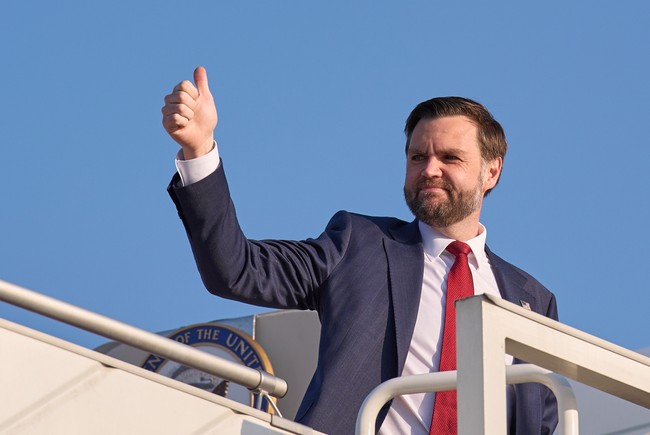
Vice President JD Vance flew to Switzerland to join negotiations aimed at finalizing a Memorandum of Understanding to end the Iran conflict and to reinforce a fragile Israel-Lebanon ceasefire, with U.S. envoys and regional partners already engaged on the ground as talks resumed and military movements around the Strait of Hormuz drew close attention.
Vice President JD Vance departed on Air Force Two for Switzerland to participate in negotiations over a Memorandum of Understanding intended to end the conflict involving Iran and to shore up a tentative ceasefire between Israel and Lebanon. Special envoys and technical teams had been preparing on the ground, and senior U.S. political leadership planned to engage directly to set the structure for talks. The trip was short but focused, centered on two priority items: the nuclear issue and the Lebanon ceasefire. Republican leaders emphasize firm, clear terms rather than vague promises when dealing with hostile states.
https://x.com/VPPressSec/status/2068428832135131460
The vice president spoke briefly to reporters before boarding, laying out the immediate architecture of the talks and who would be involved. He described a multi-party process with both political principals and technical negotiators working in parallel, and made clear the U.S. intended to move swiftly but deliberately. The administration’s aim, from this perspective, is to secure concrete, enforceable commitments rather than open-ended discussions.
VANCE: We’re about to take up talks with the Iranians, the Pakistanis, and the Qataris. Our understanding is that the Iranians just landed. The Qataris and Pakistanis and some of our technical negotiators have been on the ground. So, look, you know, we’ll have a couple of days of talks, we’re gonna get this thing kicked off in the right way. There’s a lot to discuss, but we’re gonna get through it all.
Diplomatic movement was interrupted earlier when exchanges between Israel and Hezbollah threatened the ceasefire and prompted a pause in the schedule. That escalation led to warnings from Tehran and attention to strategic chokepoints in the region, but U.S. military officials reported that commercial traffic continued to flow through the Strait of Hormuz. The presence of U.S. forces monitoring the area underscores the administration’s insistence on maintaining freedom of navigation and deterring unilateral sabotage.
Reporters framed a central question: how the United States plans to prevent localized fighting from undoing the larger diplomatic effort. Officials framed the response as continuous management and engagement, with the goal of creating a stable environment where agreements can take hold. Republicans prioritize clear deterrence measures along with diplomatic pressure, arguing that security underwrites any lasting political settlement. The practical problem is stopping the immediate exchanges of fire long enough for a ceasefire to take root.
REPORTER: The fighting in Lebanon seems to continue to threaten to upend the entire process. What does the U.S. plan to do about that?
VANCE: Well, [Secretary of State] Marco [Rubio] and the entire team have been actively managing what’s going on in Lebanon. Despite the headlines, things are actually getting better there, things have calmed down a little bit. It’s going to be something we’re just going to have to continuously manage, to ensure that, you know, Israel and Lebanon are both safe and secure. That’s fundamentally the goal of this, is to make the whole region safe and secure.
The big problem is that you have, somebody will shoot, and somebody will respond, and you kind of have a chicken-and-egg problem, where you just got to stop the shooting for long enough to get the ceasefire to keep hold. That’s what we’re gonna try to do. We’ll keep on working at it, but things have gotten better.
When pressed on what success would look like for his trip, the vice president emphasized setting up the negotiation framework and making tangible progress on the two main issues at hand. He said principal-level political engagement would be balanced with technical teams remaining in place to hammer out specifics. Vance noted his stay would be brief but strategic, aiming to leave the ground teams in a position to advance the talks. From the Republican viewpoint, short, decisive interventions at the leadership level can create the momentum needed for enforceable agreements.
REPORTER: What would make this a successful trip for you?
VANCE: Well, I think number one, just getting things set up in the right way, and getting the actual structure of negotiation in place. So, the way we’re going to do this is we’re going to have principal level political leadership at the top, and obviously the technical team is going to stay on the ground. As much as I might like to stay, in what appears to be a beautiful place, I can only be there for a day or two. I think we can hopefully make progress on the nuclear issue, make progress on the Lebanon ceasefire issue, those are the two big things that I think we’re going to be focused on. I’m sure the Iranians are going to have issues they’d like to discuss as well.
There was also public reassurance from U.S. Central Command that despite Tehran’s rhetoric, commercial traffic through the Strait of Hormuz remained uninterrupted and was being monitored. Military spokespeople emphasized readiness and vigilance to keep critical waterways open and to deter attempts to disrupt international commerce. That posture reflects a Republican emphasis on maintaining military strength alongside diplomatic negotiations to ensure any agreement is backed by capability. Observers will be watching whether the combined pressure of diplomacy and deterrence produces durable results.
WATCH:


Add comment