
Checklist: Discuss Vance’s pitch to Democrats on voter ID, report his comments on Iran and H1B visas, include his deal offer to end GOP talk of fraud, preserve direct quotes, and keep original embed markers intact.
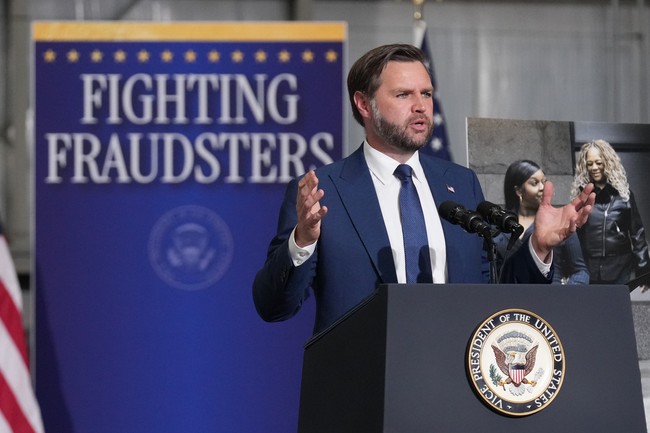
Vice President JD Vance laid out a blunt bargain that put the onus on Democrats: pass strict election integrity measures and Republican complaints about fraud would end. He paired that offer with strong remarks on national security and labor protections, signaling a broader posture that mixes toughness abroad with hardline fixes at home. The argument is straightforward and delivered in plain language — no political fluff, just a demand for laws Republicans have pushed for for years. The administration frames voter ID as a basic reform that would settle a long-running fight if Democrats agreed.
Vance also addressed escalating tensions with Iran and made plain what he says would happen if hostile actions continue. He insisted the United States had made clear terms for engagement and warned that attacks on ships would be met with strong responses. That kind of message is meant to reassure voters who want a decisive foreign policy that protects American interests and commerce. The comments tie into a broader theme: strength, accountability, and consequences.
On the workforce front, Vance announced scrutiny of H1B visa use and emphasized that American jobs should go to American workers. That stance connects to a common Republican concern about labor market fairness and preserving middle-class opportunities. It’s an appeal to blue-collar voters who feel overlooked by policies that favor outsourcing or overreliance on foreign labor. The line is simple: protect U.S. jobs first.
Vance spelled out his deal for Democrats in no uncertain terms, offering a road map to silence the perpetual allegations of election fraud—if Democrats act. He framed Voter I.D. as a minimal, common-sense reform that would bring confidence to elections across the country. The pitch is political strategy as much as policy: force the other side to choose whether they want the debate to end and whether they trust the system enough to impose basic safeguards. The proposal is short and to the point, built to be either accepted or exposed.
He put it this way:
“If Democrats want us to stop talking about election fraud, I make them a simple deal: pass the SAVE America Act and get Voter I.D. and we’ll stop talking about election fraud. We are the only advanced democracy anywhere in the entire world that doesn’t require you to show a voter I.D. to vote. It’s simple—just give us election integrity laws, give us Voter I.D., and then we will have the confidence to say to the American people there’s no cheating.”
The pitch goes beyond rhetoric: Vance tied the demand to legislative action and used the comparison to other democracies to make the point look reasonable, not partisan. Republicans see this as a commonsense fix to restore voter confidence, and Vance’s framing makes Democrats the ones deciding whether to end the controversy. For conservatives, that’s a political win either way — pass the law and quiet the critics, or refuse and reveal their reluctance to secure ballot integrity.
Vance also shared a human moment about missing a time-sensitive call during the 2024 convention, which softened the tone while keeping the conversation grounded. He described juggling a high-pressure political moment and family life in a way many readers will recognize. The anecdote gives a glimpse of the campaign machinery and the personal interruptions that come with public life. It’s a small window into the chaos behind major decisions.
“I get a phone call. Actually, it was a text message from Susie Wiles, who was the campaign manager in 2024. And the text message says, ‘JD, you just missed a very important phone call.’
I’m like, oh, no. So I call the President of the United States and I say, ‘sir, I hear I missed an important phone call.’
And he said, ‘JD, you did miss a very important phone call. And now I’m gonna have to pick somebody else.’
https://x.com/RapidResponse47/status/2074927349611802671
And you know, my entire body clenches up. I’m like, ‘is this, is this real?’
And then at the same time, my 7-year-old, who’s now 9, but at the time, my 7-year-old boy is talking to me about Pokemon cards!
So I’m trying to talk to the President of the United States about becoming the vice presidential nominee. And meanwhile my 7-year-old is talking to me about Charmander cards. And I have no idea what’s going on.
The vice president closed with confidence that things worked out, reinforcing a narrative of competence and personal humility. Republicans will use these moments to humanize leaders while keeping the focus on policy wins like voter ID and job protection. The core message is that firm rules and accountability are the path to public trust, whether on ballots, wages, or national security.
Throughout his remarks, Vance tied together immediate threats with long-term fixes, offering a simple bargaining chip: pass the SAVE America Act and Republicans will concede the issue of fraud. That binary creates political pressure and forces the debate into clear choices for elected officials. It’s a direct approach that reflects a conservative priority — fix the process so citizens can trust the outcomes, and don’t apologize for insisting on American-first policies.
— Rapid Response 47 (@RapidResponse47)


Add comment