
This article reports on a recent confrontation in the Strait of Hormuz where an Iranian-flagged cargo ship attempted to force its way past a U.S. naval blockade, details the response announced by former President Donald Trump, notes other Iranian provocations in the area, and explains the diplomatic fallout and economic pressure on the regime.
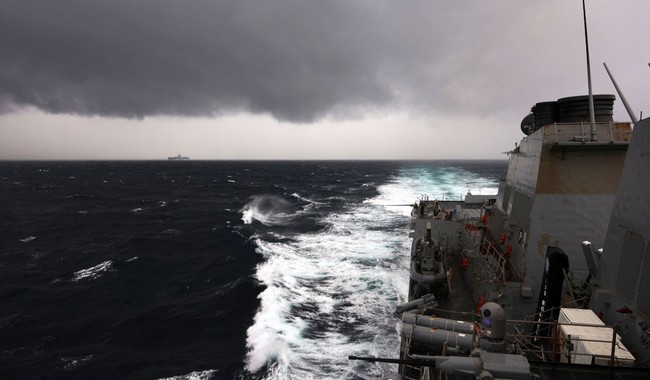
The incident began when a large Iranian-flagged cargo vessel, identified as the TOUSKA, tried to transit the Strait of Hormuz despite a U.S. blockade. The ship, described as nearly 900 feet long and comparable in displacement to an aircraft carrier, was intercepted by U.S. naval forces operating to enforce restrictions in the region.
The U.S. Navy moved to stop the vessel after warning it to halt, and the engagement resulted in direct action against the TOUSKA’s propulsion systems. According to the account released, the U.S. destroyer engaged the ship’s engine room, then boarded parties took control and secured custody of the vessel and its crew.
“The U.S. Navy guided-missile destroyer USS Spruance intercepted the TOUSKA in the Gulf of Oman, and gave them fair warning to stop,” he said.
“The Iranian crew refused to listen, so our Navy ship stopped them right in their tracks by blowing a hole in the engine room. Right now, U.S. Marines have custody of the vessel,” Trump added.
“The TOUSKA is under U.S. Treasury sanctions because of its prior history of illegal activity. We have full custody of the ship, and are seeing what’s on board!” he said.
That message was posted publicly and framed the action as a deliberate, decisive enforcement of U.S. orders in the region. From a Republican perspective, the episode underscores the contrast between administrations that talk and administrations that act, with naval forces executing a clear, ordered response to illegal behavior at sea.
Beyond the TOUSKA, Iranian forces also drew condemnation for separate actions against commercial shipping, including attacks earlier in the weekend on two Indian vessels. Those strikes prompted a diplomatic response from India and escalated tensions between Tehran and other regional maritime powers.
Meanwhile, several commercial cruise ships ignored threats and warnings from Iranian authorities and successfully transited the Strait of Hormuz, demonstrating both the limits of Tehran’s claims of control and the willingness of civilian operators to assert navigation rights. The cruises’ safe passage highlighted how Iran’s attempts to regulate transit routes have not translated into effective enforcement against determined, nonmilitary traffic.
Diplomatically, Tehran was reported to have declined participation in a second round of talks scheduled in Islamabad, citing objections to U.S. demands, shifting stances, and the naval blockade. Tehran framed that absence as a response to what it labeled excessive and contradictory U.S. behavior, while U.S. and allied officials view nonparticipation as a tactic to avoid accountability.
The blockade itself is being felt economically by Iran, with estimates cited that the restrictions cost the regime hundreds of millions of dollars each day in lost revenue. The pressure from seizure and interdiction operations, combined with sanctions on vessels with suspect histories, is meant to degrade the regime’s ability to finance destabilizing activities regionally.
From this vantage point, the U.S. response serves multiple purposes: enforcing maritime law, deterring further provocative actions, and reinforcing the message that attempts to flout international norms will meet a forceful reaction. That posture is intended to raise the political and economic cost for Tehran while protecting commercial shipping lanes and allied interests.
Operationally, the episode underscores the advantages a modern navy brings in a chokepoint environment where a single well-armed surface combatant can control movement and project power. A cargo vessel, even a very large one, has no realistic way to prevail against a guided-missile destroyer backed by boarding teams and coordinated rules of engagement.
The wider pattern of incidents—attacks on merchant ships, threats to control transit routes, and spotlit diplomatic refusals—creates an image of a regime pressing its hand in ways that invite pushback. For observers aligned with a stronger national posture, the response by naval forces and the steps to interdict sanctioned vessels are seen as necessary measures to keep critical sea lanes secure.
As events continue, the region remains tense and closely watched by governments with stakes in unimpeded maritime commerce. The TOUSKA’s capture and the surrounding incidents are likely to factor into ongoing discussions about deterrence, sanctions enforcement, and the diplomatic avenues still open to reduce the risk of wider confrontation.

Add comment