
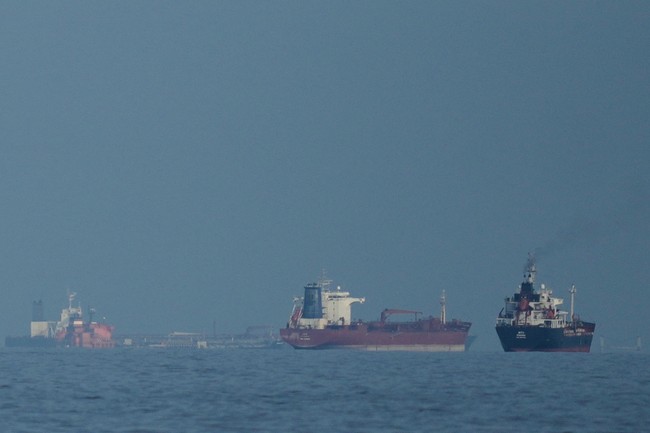
The U.S. Navy disabled and seized an Iranian-flagged container ship after it ignored repeated warnings in the Strait of Hormuz, and the episode raises clear questions about what the vessel might have been carrying and why Tehran risked a confrontation with U.S. forces.
The encounter involved the MV Touska, an Iranian-flagged container ship that ignored roughly six hours of warnings before the guided-missile destroyer USS Spruance fired to disable its engine room. U.S. Central Command released video showing the sequence: warnings, warning shots, and then targeted fire to make the ship stop. After propulsion was disabled, U.S. forces boarded and seized the vessel.
U.S. Marines depart amphibious assault ship USS Tripoli (LHA 7) by helicopter and transit over the Arabian Sea to board and seize M/V Touska. The Marines rappelled onto the Iranian-flagged vessel, April 19, after guided-missile destroyer USS Spruance (DDG 111) disabled Touska’s propulsion when the commercial ship failed to comply with repeated warnings from U.S. forces over a six-hour period.
The Touska’s movements are noteworthy. While her manifest listed a route from Port Klang, Malaysia, to the Strait of Hormuz, AIS records show she recently called at a Chinese port before heading back toward the region. Shipping histories matter here because certain Chinese ports have been linked by analysts to cargo that can support Tehran’s missile and military supply chains.
The ship is large, able to carry thousands of containers, and has previously been implicated in procurement activities tied to Iran’s missile programs. It is part of Iran’s state shipping network and, past reporting has noted, operates in a system of state-backed logistics that the United States and allies have long watched closely. Those facts help explain why U.S. commanders refused to let the vessel proceed without inspection.
The question everyone is asking is simple: why not comply? Most commercial vessels heave to and turn away when faced with a U.S. naval cordon. A six-hour refusal to obey orders suggests the crew or their handlers feared inspection would reveal cargo Tehran does not want inspected. When a ship is linked to sanctioned procurement channels and sails from ports where strategic materials are loaded, you cannot dismiss noncompliance as mere obstinacy.
Iran tried to shape the narrative after the seizure with a flurry of claims. State-affiliated outlets asserted that the Islamic Revolutionary Guard Corps intervened and that Iranian forces struck U.S. ships with drones, but U.S. footage and official accounts show the boarding and seizure by Marines. The discrepancy between Tehran’s claims and the visual record only deepens doubts about the Iranian version.
If Tehran truly repelled a U.S. operation, evidence should be clear and immediate. Instead we have video of the U.S. disabling propulsion and Marines conducting a fast-rope boarding, and no corroborated imagery or independent confirmation of successful Iranian attacks on the U.S. ships involved. That contrast matters—propaganda cannot erase physical evidence captured by U.S. forces.
The broader strategic context matters too. Tehran has long relied on covert procurement and complex logistics to support missile and drone programs. State-owned shipping lines and specific commercial vessels have been flagged in sanctions and enforcement actions for their roles in that network. Stopping and inspecting a suspect vessel in a chokepoint like the Strait of Hormuz is a reasonable enforcement action given that background.
From a policy perspective, decisive enforcement sends a practical message: maritime chokepoints cannot be exploited to move strategic materials with impunity. The U.S. response—warnings, disabling fire to neutralize propulsion, and a boarding by Marines—was calibrated to enforce control without escalating to wider conflict. It also ensured chain-of-custody for any cargo or evidence found aboard.
Public discourse will accelerate now, with Tehran spinning and Western outlets parsing what was on the Touska. But the core facts remain: an Iranian-flagged ship ignored clear orders, U.S. forces disabled its ability to escape, and Marines boarded and seized her. That sequence is the kind of straightforward enforcement that keeps lanes open and prevents the flow of materials that could fuel hostile programs.
Whatever investigators find aboard once the manifest and containers are examined, the incident underscores that sanctions and maritime enforcement matter. When a vessel tied to state shipping networks refuses inspection in a high-stakes corridor, the United States has both the authority and the obligation to act to protect regional security and prevent proliferation.



Add comment