
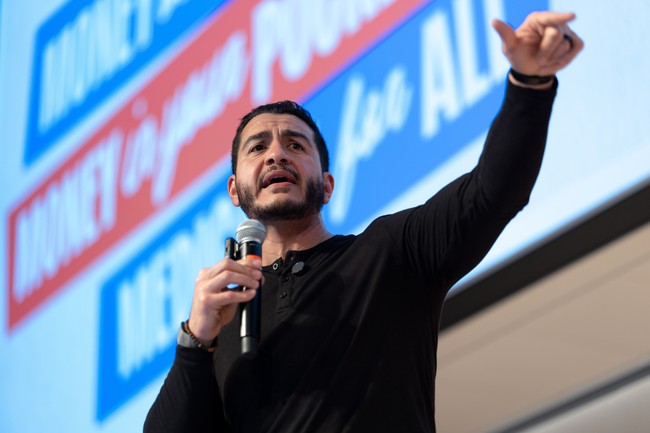
The Democratic Party is facing open dissent from within its own ranks after the primary victory of Abdul El-Sayed for the Michigan Senate seat, with established party insiders publicly rejecting the direction of the party and even endorsing the Republican nominee for November.
Longtime Democratic Hill staffer Julian Epstein has declared he will back Mike Rogers, the GOP Senate nominee, over his own party’s standard-bearer this fall. Epstein, who served as chief counsel for House Judiciary Democrats and staff director for the House Oversight Committee, wrote his thoughts in a prominent opinion piece and has since repeated them to the press. His stance signals a serious split among people who once operated comfortably inside Democratic circles. The break is not just rhetorical; it includes financial support and public campaigning for the opposing candidate.
After decades of giving my all for Democratic House and Senate candidates, this fall I will support — and contribute to — Mike Rogers, Michigan’s GOP Senate nominee, instead.
And I’ll do everything I can to make sure other Democrats follow.
With the exception of Pennsylvania Sen. John Fetterman, my party’s leaders have sought to appease the dangerous faction rising in our midst.
Epstein’s critique lands hardest on what he describes as the far left’s emphasis on identity grievance politics and a victim mindset. He warns this direction damages ambition and practical skills across generations, arguing that policy should focus on building opportunities rather than fueling resentment. His language paints the faction not only as politically misguided but as culturally corrosive to long-term American prosperity.
The politics of identity grievance gives no one greater agency or know-how to succeed; it’s black-pilling an entire generation with a victim mindset that will only hold them back.
Perversely, the Democratic Socialists argue we need more of what’s failing.
But America’s future depends on teaching our people how to build, not how to take from others or peddle whining complaints.
Epstein told media outlets in blunt terms that the party has been hijacked by extremes. He accused current leaders of ceding moral and political responsibility while offering platitudes about inclusion. That sharp rebuke focused on the practical consequences of embracing candidates and ideologies he sees as hostile to core institutions and the rule of law.
“I think the lunatics are in charge of the asylum,” he told Fox News Digital. “I think that there is no room in the tent for people that want to destroy our Constitution. There’s no room in the tent for people that want to align themselves with radical Islam. There’s no room in a tent for people that want to align themselves with antisemitism.”
He doubled down on economic concerns as well, arguing that the leftward tilt includes a hostility to market-based solutions that have historically helped pull people out of poverty. That critique frames the conflict as more than a tactical disagreement about candidates; it’s a fundamental dispute over what governance should prioritize and how to measure success. Epstein expects the fallout to prompt more Democrats to withhold support or switch sides in critical races.
“And there’s no room, in my view, for people who don’t have any interest in building for the next generation but only want to redistribute what others have created and want to basically tear down the free market that has been the most effective anti-poverty liberation machine that human beings have ever invented.”
Epstein names a handful of fellow Democrats he considers reasonable, including Senator John Fetterman, Representative Josh Gottheimer, and consultant James Carville, and warns of an intra-party civil war if the trend continues. He predicts that more members will be forced to distance themselves from El-Sayed on the campaign trail, creating permission slips for defections. Those predictions are already being echoed by others who once worked in the Biden orbit.
Fetterman, and a few other Dems like New Jersey Rep. Josh Gottheimer and consultant James Carville, seem to get that — and they’re warning of a coming intraparty civil war.
Some in Michigan are hinting at mass party defections in November.
And El-Sayed’s new prominence means the bleeding won’t stop.
Democrats in many districts will be forced on the campaign trail to distance themselves from El-Sayed or denounce him — and every one of their comments will write another permission slip for party defections come fall.
To arrest this freefall, Democratic leaders must do more than just tell the extremists to find another party; they must also admit that post-modern liberalism is failing.
Epstein also criticized party leadership directly, calling leaders who proclaim a “big tent” image weak and timid when confronted with extremism. He argues the embrace of radical positions risks aligning the party with movements that reject key institutions like policing, borders, and judicial checks. That language deliberately frames the rift as existential, claiming the party’s future depends on confronting these currents instead of accommodating them.
Weak, timid figures like Senate Minority Leader Chuck Schumer are spouting empty clichés — “We are a big-tent party” — while abdicating their moral and political responsibilities.
Democrats aren’t coddling Scandinavian-style socialists; they’re getting into bed with a nihilistic, deconstructionist brand of third-worldism.
It’s an ideology that seeks the elimination of prisons, policing, borders, the Senate, the presidency, the Supreme Court and democratic free markets.
A worldview that aligns with genocidal jihadist movements like Hamas.
A generation ago, the left would’ve recognized this cadre as Trojan horse doing the bidding of our adversaries.
But not today.
Former White House spokesperson Michael LaRosa publicly echoed Epstein by resharing the op-ed and adding his own emphatic “SAME” on social media. LaRosa later expanded his thoughts in a longer post, where he said he could never support El-Sayed and expressed preference for a candidate he views as reasonable. His commentary included strong language and a colorful recounting of his brief online moment of reaction.
Warning: coarse language
Last night, I literally wrote ONE WORD on X—“SAME”—then closed my laptop, put my phone on my mid-century-modern nightstand, poured half a glass of Whitehaven New Zealand Sauvignon Blanc, watched the first episode of Ted Lasso Season Four, fell asleep—and apparently woke up in Crazy Town.
That said, since everyone suddenly seems so interested in my personal opinion: no, I could never support El-Sayed. Of course, I support a reasonable Republican like Mike Rogers, someone who worked with President Obama and Democrats as Chair of the Intelligence Committee. Of course I would rather see someone like Rogers over a “D” who is too much of a pu**y to stand up to an anti-Semitic goon like Hassan [sic] Piker.
I would never encourage any Democrat to support a candidate too weak to stand up to extremists who believe that those men and women jumping from a burning building 110 stories up because the alternative was worse deserved what they got on September 11th.
If you can’t stand up to amateur DJs or whatever he is spewing hateful and inflammatory rhetoric from behind a microphone, why should voters believe you’ll stand up for an entire state in the United States Senate?
LaRosa clarified that he is not an elected official and has no formal political machinery, but he insists he cares about keeping the party from embracing those he deems unfit for public life. The public resignations of loyalty from familiar Democratic figures underscore a volatile moment ahead of November’s midterms. Whether this dissent becomes a wider trend could shape not just one Senate race but internal dynamics across the party in coming cycles.
https://x.com/MichaelLaRosaDC/status/2086144628621726093

Add comment