
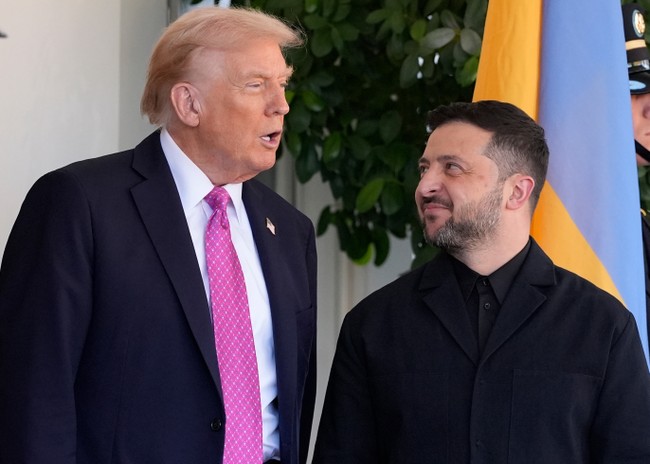
President Trump hosted Ukraine’s Volodymyr Zelensky at Mar-a-Lago and called the meeting a major push toward ending the Russia-Ukraine war, saying “we could be very close” while identifying land disputes as the main obstacle; the two leaders and a small working group are now pressing to finalize a peace framework involving close coordination with European counterparts and direct talks with Vladimir Putin.
The Mar-a-Lago session wrapped up with Trump saying he and Zelensky had “made a lot of progress” and covered about “95 percent” of the issues holding up a peace plan between Russia and Ukraine. He emphasized the human cost, calling the conflict the deadliest war since World War II and stressing urgency: “We’ll see if it gets done, it’s very close certainly,” and “Nobody would have a chance at even getting it to where it is now. Nobody would have thought that was possible.”
Following the meeting, Trump and Zelensky reached out to several European leaders to align on next steps, connecting with officials from France, Finland, Poland, Norway, Italy, the United Kingdom, Germany, NATO, and the European Commission. Trump framed those calls as sensible because these nations sit closer to the conflict zone and face immediate regional consequences, and he presented the outreach as part of a pragmatic push to get a deal over the line.
When pressed about the sticking points, Trump singled out territory as the most difficult issue, saying simply that “land” was probably the thorniest problem holding up a deal. He noted, “Some of that land has been taken. Some of that land may be up for grabs. It may be taken over a period … a number of months,” and urged that “you’re better off making a deal now” to prevent further losses.
A compact working group of advisers is slated to continue negotiations, with Trump naming several trusted figures who will push the process forward alongside Ukrainian representatives. The team reportedly includes close advisers and political allies drawn from business, policy, and military backgrounds, assembled to combine political clout, negotiation experience, and an eye toward fast results.
On timing, Trump said the outcome should become clearer quickly. He stated, “In a few weeks, we will know one way or the other… it’s been a very difficult negotiation,” and suggested he would take extraordinary steps if they would save lives, adding, “I’m not sure that it would be really necessary, but if it would help save 25,000 lives a month… I would certainly be willing to do that.”
Earlier the same day, Trump spoke by phone for nearly two and a half hours with Russian President Vladimir Putin and described that conversation as “excellent.” He made light of the formality around such calls, quipping, “We didn’t talk about the weather,” while underscoring his preference for direct diplomacy when high stakes are on the line.
The president repeatedly framed the effort as driven by a desire to stop the bloodshed, saying plainly, “Everybody wants [the war] ended… I want it ended because I don’t want to see so many people dying.” That humanitarian thrust dovetailed with a strategic pitch: a negotiated halt would spare Europe further instability and reduce the need for prolonged outside intervention.
Coverage of the sit-down included the full post-meeting press conference between the two presidents, which the White House made available after the event and which shows Trump and Zelensky discussing the contours of a potential agreement and the diplomatic steps ahead. Observers will be watching the working group’s next moves closely, as the coming weeks could determine whether momentum translates into a formal ceasefire and framework for lasting peace.

Add comment