
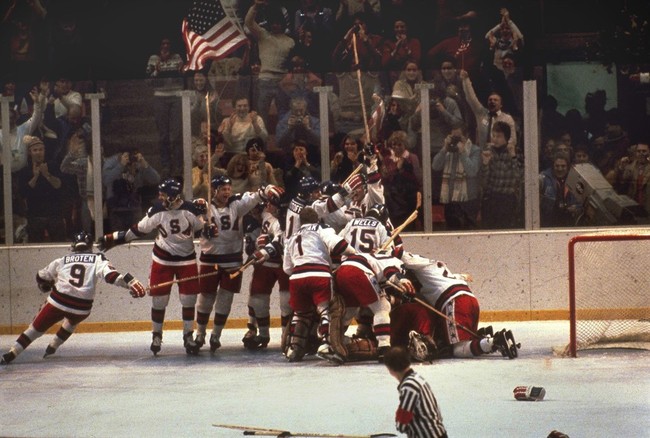
The 1980 U.S. Men’s Hockey team, known for the “Miracle on Ice,” visited the White House where President Donald Trump signed legislation awarding the squad Congressional Gold Medals and received a replica white cowboy hat as a gift from team captain Mike Eruzione. The ceremony celebrated a Cold War era upset that remains a touchstone of American pride, and the bill sets aside three medals to be displayed at national institutions honoring that victory. The event mixed nostalgia, patriotism, and a clear recognition of sports as part of national identity.
The scene in the Oval Office was unmistakably celebratory as members of the 1980 team stood behind the president wearing white cowboy hats, echoing the headwear they famously donned during the Lake Placid opening ceremonies. President Trump signed into law the Congressional Gold Medal Act (H.R. 452) while the veterans looked on, united by that unforgettable winter night when amateurs beat the Soviets. The moment underscored how a single game can resonate far beyond sports and into national memory.
“President Donald Trump honors the 1980 ‘Miracle on Ice’ U.S. Men’s Hockey team,” the post read. “During the height of the Cold War, the Americans fielded a roster with no Olympic or professional experience and defied overwhelming odds by defeating the dominant USSR.”
Trump reflected on the scale of the achievement, calling it “one of the greatest moments in the history of U.S. sports,” and noted the special place that such victories hold for Americans. The White House attorney read the text of the bill aloud, explaining that Congress authorized three medals commemorating the team’s victory at Lake Placid. Those medals are allocated to institutions in Lake Placid, Eveleth, Minnesota, and Colorado Springs to ensure public access and preservation of the legacy.
One of the medals will be placed at the Lake Placid Olympic Center in Lake Placid, New York. Another will go to the U.S. Hockey Hall of Fame Museum in Eveleth, Minnesota. A third will be placed at the U.S. Olympic & Paralympic Museum in Colorado Springs, Colorado.
White House spokesperson Taylor Rogers remarked on the symbolic nature of the triumph and its role in fueling national pride, pointing to the team’s unexpected gold medal as a moment that united Americans. The official statement emphasized honoring American greatness and patriotism, framing the ceremony as an extension of that tradition. The event paired formal recognition with the informal charm of a team reunited decades after their victory.
After the bill was signed, Mike Eruzione, the team captain whose goal sealed the upset, presented President Trump with a replica of the white cowboy hat the players wore in Lake Placid ceremonies. That hat served as a tangible reminder of the era and the cultural moment the win represented. Eruzione framed the gesture as both heartfelt and symbolic, tying the hat to the pride of wearing a USA jersey.
“This is an absolutely incredible honor. I’ve said this before, but when you put a USA jersey on, you’re playing for your country, you’re not playing for your state, your town, or your city. And what an honor it was for us to put that jersey on and accomplish what we accomplished,” Eruzione said. “I’ve always said the gold medal is something that’s incredible, but this is the frosting on the cake.”
Other team members and families joined the event, including Jim Craig, Buzz Schneider, and relatives of the late coach Herb Brooks, whose leadership and coaching style remain central to the Miracle narrative. Jim Craig captured the sentiment well by emphasizing pride in representing the nation and the distinct honor of being recognized many years later. The gathering served both as a reunion and as a public reminder of how sports achievements can echo across generations.
The timing of the bill signing comes just before the 45th anniversary of the Lake Placid game, prompting renewed interest in the story and in the film “Miracle,” which dramatizes Coach Brooks’ preparation and the team’s improbable run. For many Americans, that game represents more than a sporting upset; it’s a story about grit, leadership, and a moment when national optimism surged. The medals and the ceremony ensure the story will remain accessible to future visitors and fans who want to connect with that chapter of history.
The White House ceremony combined official recognition with personal recollection and keepsake symbolism, reinforcing a simple point: moments of national pride matter and deserve to be preserved. By placing medals in public museums and centers, Congress and the administration have made a decision to anchor that memory in institutions where people can see and feel the history firsthand. The 1980 team’s visit illustrated how sport, memory, and patriotism can come together in a short, powerful ceremony that still resonates today.


Add comment