
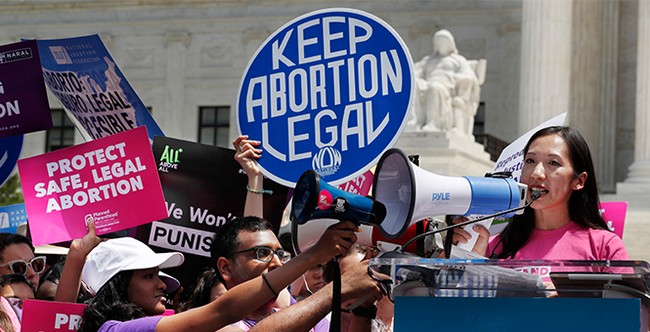
The 1st Circuit Court of Appeals vacated district court injunctions that had blocked enforcement of a provision cutting Medicaid funds to certain abortion providers, reversing a decision that had frozen a law passed by Congress and signed by the president and signaling deference to Congress’s power over federal spending.
Late on a Friday, a three-judge panel in Boston set aside preliminary injunctions issued in July by District Judge Indira Talwani, which had prevented the administration from enforcing Section 71113, the clause that conditions Medicaid funding on abortion-related practices. The panel, composed of judges appointed by President Biden, issued a detailed opinion explaining why the district court’s basis for emergency relief was legally weak. That opinion emphasized the special role of Congress in allocating federal funds and questioned whether a judge should second-guess those budgetary decisions at the preliminary stage.
The dispute began when advocacy groups challenged the statute as unconstitutional, arguing it amounted to a bill of attainder, infringed First Amendment protections, and violated equal protection principles. Judge Talwani granted preliminary injunctive relief, halting enforcement of the funding restriction while litigation moved forward. That decision surprised observers because it effectively blocked a statute enacted through the regular legislative process, raising the question of whether a judge had overreached into Congress’s spending power.
The appeals court disagreed with the district court’s reading of the constitutional claims and explained why the plaintiffs were unlikely to prevail on the merits at this stage. The panel pointed out that Section 71113 uses Congress’s taxing and spending authority to present recipients with a choice: accept federal Medicaid funds without providing abortions or forgo those funds and continue abortion services. The court concluded that presenting a choice tied to the receipt of federal dollars does not automatically amount to punishment in the constitutional sense required for a bill of attainder claim.
The opinion runs to forty-one pages and walks through the procedural history and key legal standards that govern preliminary injunctions and constitutional review. The panel stressed deference to political branches, noting that courts generally should not substitute their judgment for the legislature’s when it comes to fiscal policy. The decision applied rational basis review to the equal protection argument and found plausible governmental interests in treating certain entities differently as major recipients of Medicaid funds.
For all these reasons, Section 71113 does not impose punishment on Appellees. It instead uses Congress’s taxing and spending power to put Appellees to a difficult choice: give up federal Medicaid funds and continue to provide abortion services or continue receiving such funds by abandoning the provision of abortion services. That the law imposes a difficult choice on the recipient of federal funds does not demonstrate that Congress is punishing the recipient for past action — an intrinsic element of a bill of attainder. Appellees therefore likely will not prevail on the merits of their bill of attainder claim.
…
The “Constitution presumes that, absent some reason to infer antipathy, even improvident decisions will eventually be rectified by the democratic process and that judicial intervention is generally unwarranted no matter how unwisely we may think the apolitical branch has acted.” Beach Commc’ns, 508 U.S. at 314 (quoting Vance v. Bradley, 440 U.S. 93, 97 (1979)). Guided by this presumption and given the highly deferential nature of our review, Section 71113 likely survives rational basis review. There are plausible reasons for treating “prohibited entit[ies]”differently from other abortion providers, particularly where Congress viewed these entities as the most significant recipients of Medicaid funds. Preventing these entities from receiving funds if they continue providing abortion services furthers Congress’s interest in reducing abortions. Plaintiffs, therefore, are unlikely to succeed in showing that Section 71113 violates equal protection.
The appeals court’s ruling is limited to the propriety of the preliminary injunctions; it does not resolve the ultimate merits of the constitutional challenges. The plaintiffs still have procedural options, including seeking rehearing en banc or taking the case further, and the district court will continue to decide the underlying claims unless further appellate action intervenes. For now, however, the decision allows the administration to enforce the statutory funding restriction while litigation proceeds.
Beyond the immediate legal outcome, the ruling is notable for its explicit defense of congressional authority over spending and its resistance to broad judicial interference in politically sensitive fiscal choices. The panel invoked Supreme Court precedent emphasizing the presumptive competence of the political branches and the high bar for courts to disrupt enacted budgetary policy. Practically, that means Congress’s decisions about which entities receive federal dollars will generally be given room to operate unless plaintiffs can clear significant constitutional hurdles.
The case remains active, and observers on all sides will watch for further filings, any petition for rehearing, and the district court’s handling of the remaining claims. For now, the 1st Circuit’s opinion represents a meaningful pushback against a district court injunction that stopped enforcement of a law enacted through the ordinary legislative process, reinforcing a separation of powers approach to disputes over federal spending.



Add comment