
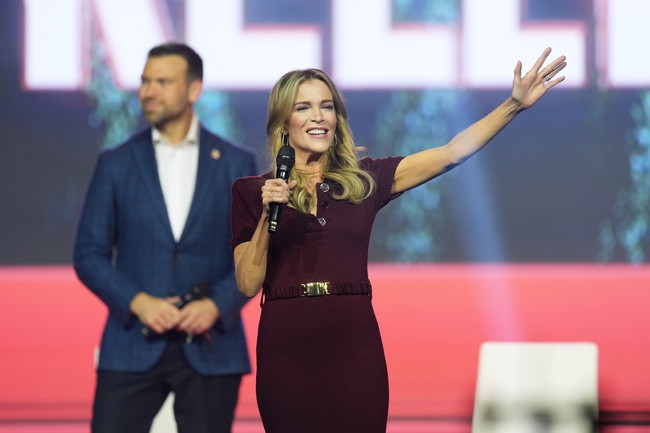
President Trump pushed back forcefully after Megyn Kelly said recent U.S. casualties “did not die for the United States,” sparking debate over Operation Epic Fury, the mission that targeted Iran’s top leadership and aims to stop Tehran from developing nuclear weapons.
The exchange began when Megyn Kelly argued on her radio show that service members killed in the Iran campaign “did not die for the United States” and instead suggested they died for other countries. That comment provoked immediate outrage from many conservatives who see the operation as a necessary defense of America’s national security. The claim hit a raw nerve because it seemed to question the intent and sacrifice of American forces engaged in what the administration describes as preventing a nuclear-armed Iran.
President Trump did not let the remark pass without rebuttal, telling a reporter she should consult history and defending the operation as critical to keeping nuclear weapons out of Iranian hands. He emphasized the decision was taken to protect American lives and interests both at home and abroad, framing the strikes as a direct response to an intolerable threat. In his view, the campaign targets Iran’s ability to threaten the United States and partners, and that priority outweighs partisan criticism.
“My own feeling is no one should have to die for a foreign country,” she said on Monday. “I don’t think those four (updated to six) service members died for the United States. I think they died for Iran or for Israel.”
On the ground, the operation that removed Ayatollah Ali Khamenei and other regime figures has been presented by the White House as decisive and aimed squarely at stopping Tehran from advancing toward nuclear capability. Supporters of the president argue that such direct action was necessary after diplomacy failed repeatedly to curb Iran’s hostile behavior. To them, labeling the mission as anything other than an American security operation is both dangerous and disrespectful to those who served.
Trump made it clear he believes the MAGA movement stands with his choices on national defense and rejects critics who imply weakness or poor judgment. He pushed back against media figures who frame the operation as reckless, insisting the primary mission is preventing a nuclear Iran—a threat he described as predominant. That stance resonates with voters who prioritize strong deterrence and concrete steps to neutralize hostile regimes rather than endless negotiations.
Critics like Tucker Carlson have also voiced harsh objections, calling the campaign morally questionable, but the president dismissed such commentary as irrelevant to his decision-making. He argued that the safety of Americans and allied nations must come first, and that the risks of inaction—allowing Iran to obtain nuclear weapons—were unacceptable. For many conservatives, the calculus is clear: decisive action now prevents a far worse crisis later.
The debate highlights a deeper split about how to honor military sacrifice while pursuing strategic goals. Some voices insist every fallen service member must be framed strictly as defending the United States, while others argue that in a globalized security landscape, protecting allies and stopping existential threats to the free world is inseparable from defending America. Trump’s messaging leaned into the latter, portraying the operation as part of a broader effort to keep America safe by denying adversaries catastrophic capabilities.
Public reaction has been intense and polarized, with supporters praising the administration’s toughness and critics warning about escalation and moral consequences. Within conservative circles, many see the president’s action as the rare fulfillment of campaign promises to be strong on foreign policy and to neutralize adversaries that threaten the homeland. That perspective fuels the view that questioning the motives behind the operation amounts to an attack on patriotism and the troops who served.
Whatever one thinks, the controversy underscores how easily words from media figures can ignite political and cultural backlashes when national security and military sacrifice are involved. The discussion will likely continue as families, veterans, and the broader public process the loss of service members alongside the administration’s claim that bold steps were necessary to prevent a nuclear-armed Iran. The outcome of that debate will shape how future decisions about use of force and alliances are framed in American politics.


Add comment