
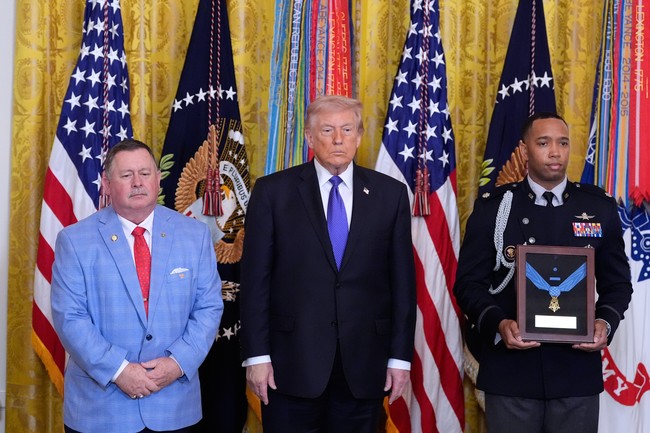
President Trump’s recent Medal of Honor ceremony put real courage on display and reminded Americans what sacrifice looks like, as the nation honored Master Sgt. Roddie Edmonds, Command Sgt. Maj. Terry Richardson, and Staff Sgt. Michael Ollis for acts of bravery that go beyond politics.
The ritual of awarding a Medal of Honor matters because it focuses national attention on character under fire rather than partisan point-scoring. When a president places that medal around a soldier’s neck or presents it to a grieving family, the moment demands respect and reflection from every citizen. This ceremony was exactly that kind of moment, solemn and rooted in duty.
These three recipients represent the kind of courage our country needs to celebrate loudly and often. Edmonds, Richardson, and Ollis did not seek fame; they acted because duty and moral clarity left them no other choice. Their stories stand as examples of leadership under pressure and personal sacrifice that should shape how we teach patriotism to the next generation.
Master Sgt. Roddie Edmonds faced down a Nazi officer while a prisoner of war and refused to single out Jewish soldiers, declaring, “We are all Jews here,” fully aware that his words could have cost him his life on the spot. That refusal to betray fellow servicemembers showed moral courage beyond the instinct to survive, and it preserved lives in a moment when many would have given in to fear. Edmonds’s action was an act of leadership born of principle, and it deserves a permanent place in the nation’s memory.
Command Sgt. Maj. Terry Richardson fought through intense enemy fire in Vietnam to rescue wounded men, repeatedly exposing himself to danger to pull others to safety. He climbed a hill and kept calling in air support for hours while under direct attack, refusing to leave anyone behind. Richardson’s persistence and willingness to accept personal risk illustrate the warrior ethos that keeps units intact and people alive in combat.
Staff Sgt. Michael Ollis, deployed in Afghanistan, stepped between a wounded Polish ally and a suicide bomber, using his own body as a shield and giving his life to save another just weeks shy of his twenty-fifth birthday. That kind of selfless action is the hard edge of service—no ceremony can reverse the loss, but recognizing it honors the life given and the life saved. Ollis’s sacrifice is a reminder that honor and bravery are not abstractions; they are costly and real.
These deeds meet the Medal of Honor’s stringent standard: gallantry and intrepidity at the risk of life, above and beyond the call of duty, backed by clear proof. Each soldier could have chosen safety, and no one would have judged them harshly for stepping back. Instead they moved forward, and their choices altered the fate of others in ways that deserve the highest recognition our nation can offer.
President Trump’s presence at the ceremony matters beyond ceremony itself; it signals national gratitude and highlights an American standard of valor that transcends daily politics. He told Richardson he had entered “the ranks of the bravest warriors ever to walk the face of the earth” and called Ollis’s sacrifice “the ultimate test.” Those words match the reality of what these men did and reinforce that leadership should honor courage whenever it appears.
The contrast with a culture that casually applies “hero” to fleeting gestures is stark and important. Real heroism looks like Edmonds standing with 1,200 prisoners and confronting evil as a unified front, or like a young soldier running toward a suicide vest to shield a comrade. Those acts set a bar that public discourse should aspire to, not dilute with empty celebrity praise.
A healthy republic teaches these stories, holds ceremonies that matter, and expects leaders of every party to show up for the men and women who meet this standard. Media and civic institutions should cover and explain these moments with the same intensity they bring to controversy and scandal. If the goal is to restore strength in our civic life, celebrating genuine courage is a good place to begin.
America still produces people who answer danger with sacrifice and principle, and acknowledging their deeds is the least we can do. Honor, remembrance, and honest teaching about courage preserve the meaning of service and ensure that future generations know what real bravery looks like.

Add comment