
I’ll remind you what this piece does: it remembers Rush Limbaugh, describes how his voice shaped one conservative’s life, notes President Trump’s tribute on the fifth anniversary of Rush’s passing, and points to the moments when Rush and Trump publicly honored each other in ways that mattered to millions.
I grew up in places and circles where conservatism was unwelcome, but hearing Rush on the radio felt like finding a clear light in a fog of contradiction. He didn’t just argue; he explained why ideas mattered and why personal responsibility and patriotism were worth defending. That clarity turned a private feeling into a public identity for many listeners.
My first real Rush moment happened on a Southern California freeway in the 1990s, the kind of accidental encounter that changes everything. I tuned in because everyone around me claimed he was dangerous, and curiosity beat out the warnings. What followed wasn’t outrage but an education—funny, sharp, frequently brilliant commentary that demanded thought rather than blind emotion.
He had a rare ability to take complex cultural currents and make them feel urgent and personal without resorting to cheap tribalism. Rush’s voice made listeners look at their assumptions and decide what they believed for themselves. That sort of influence is hard to measure but easy to feel in the lives of the people he reached.
On the fifth anniversary of Rush’s death, President Donald Trump offered a public remembrance that captured both personal gratitude and political respect. Trump recalled how Rush endorsed his candidacy early on and how that endorsement mattered not only to him but to the conservative movement. For many of us, that moment was proof that media influence can shape real political outcomes.
Watch:
Trump’s remarks weren’t just nostalgia; they were an acknowledgment that Rush saw something about the country and about Trump that others missed. Rush recognized a shift in the political landscape and was willing to back a disruptive figure who promised to push back against the decline of American strength and culture. That kind of foresight is rare in media figures who usually prefer to ride trends rather than direct them.
The two men’s public interactions reinforced a bond between populist conservatism and a media ecosystem that amplified it. When Rush praised Trump’s early speeches and policies, millions of listeners tuned in and tuned up their own involvement. That feedback loop helped transform abstract policy fights into elections and, eventually, into real political power.
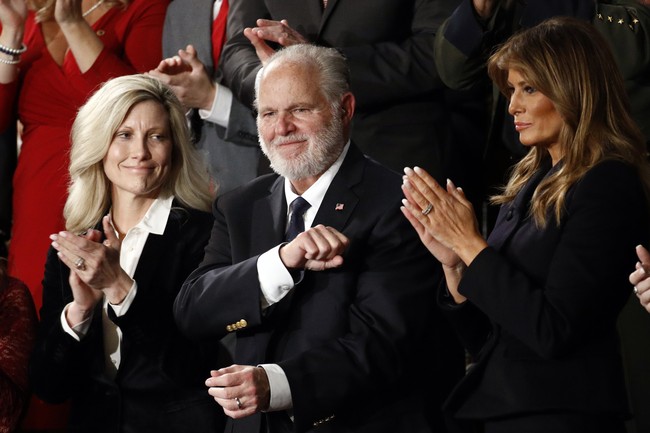
There was also a humane side to their relationship, visible when Trump surprised Rush at the State of the Union despite the host’s fragile health. That encounter was a reminder that politics has room for personal gestures that transcend headlines and talking points. Public honors like the Presidential Medal of Freedom were a statement that conservative voices count and that personal loyalty still matters.
It was an extremely poignant moment when, in 2020, Trump invited the seriously ill “King of Talk Radio” to his State of the Union address — where he surprised him with the Presidential Medal of Freedom. Millions of observers became verklempt:
Obituaries often settle too quickly on simple labels, but Rush’s legacy is broader than any single epithet. Critics tried to pin every extreme on him, yet millions who listened felt challenged and respected at the same time. He made conservatism not just an abstract doctrine but a daily conversation about common sense, liberty, and American exceptionalism.
The official Rush website also released an homage to “The Doctor of Democracy” on Tuesday:
For those who came to conservatism because of him, Rush’s influence runs deep: he taught people to question the drift of institutions and to speak up when they saw cultural decay. That practical encouragement—turning private doubt into public activism—is one of his enduring gifts. Even now, five years after his death, you can hear echoes of his phrases and the cadence of his logic in how many conservatives talk and think.
President Trump’s tribute felt personal and political at once, and that double valence is part of why Rush mattered. He helped build a movement ready to challenge complacency and to demand accountability. Remembering him now is about more than nostalgia; it’s about recognizing the role strong voices play in shaping public life.
Well, this is the 5th anniversary of the loss of a really great man, a great conservative, somebody that loved our country, loved his family, loved a lot of things…
He was a friend of mine, Rush Limbaugh. I had never met Rush when I announced that I was running. I’ll never forget, 2015. And I got a call, we’re all excited that Rush Limbaugh just endorsed you. I never met him. He liked my opening speech. He liked when I got up in June and I said, you know we got bad borders, we got bad crime, we got bad everything. And he liked it.
I came down the escalator with, now, our First Lady, and he thought it was great, and he endorsed me, and then I got to know him, and I realized what a great guy he was. But it’s five years that we miss Rush, as Sean Hannity would often say, “there will never be another Rush Limbaugh.”
So to his family, his great wife and family, I just want to say, we miss you all. We miss him, and there’ll never be anybody like him. Thank you very much.
He was, in many ways, a teacher for a generation that wanted honest debate rather than curated consent. Rush gave millions permission to think independently, and that’s a legacy that keeps pushing forward in the movement he helped shape. Rest in peace, Rush Limbaugh; your voice still rings for those who listen.

Add comment