
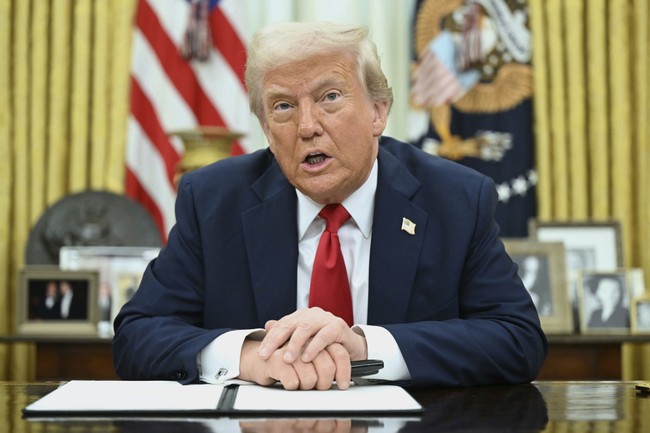
President Trump issued a new proclamation tightening entry rules for nationals from countries the administration deems high risk, expanding restrictions beyond the original list and tying policy to security, vetting failures, and cooperation with the United States.
Fixing immigration and securing our borders has been a central priority, and this proclamation builds on earlier actions to limit entry where screening and vetting are unreliable. The administration says data and country-specific analysis drove these decisions, and the move targets both longstanding trouble spots and nations newly flagged for security risks.
AMERICA FIRST SECURITY
President Donald J. Trump just signed a new Proclamation, STRENGTHENING our borders & national security with data-driven restrictions on high-risk countries with severe deficiencies in screening & vetting.
The Proclamation continues full restrictions & entry limitations of nationals from the original 12 high-risk countries established under Proclamation 10949: Afghanistan, Burma, Chad, Republic of the Congo, Equatorial Guinea, Eritrea, Haiti, Iran, Libya, Somalia, Sudan, & Yemen.
It adds full restrictions & entry limitations on 5 additional countries based on recent analysis: Burkina Faso, Mali, Niger, South Sudan, & Syria.
The proclamation continues the full restrictions that began under the earlier measure and adds five countries to the full-ban category based on recent intelligence and vetting assessments. It also extends limitations to holders of Palestinian-Authority-issued travel documents and tightens restrictions for some nations previously under partial measures. The administration frames these steps as practical responses to specific failures in document integrity and cooperation.
- The Proclamation continues the full restrictions and entry limitations of nationals from the original 12 high-risk countries established under Proclamation 10949: Afghanistan, Burma, Chad, Republic of the Congo, Equatorial Guinea, Eritrea, Haiti, Iran, Libya, Somalia, Sudan, and Yemen.
- It adds full restrictions and entry limitations on 5 additional countries based on recent analysis: Burkina Faso, Mali, Niger, South Sudan, and Syria.
- It also adds full restrictions and entry limitations on individuals holding Palestinian-Authority-issued travel documents.
- It imposes full restrictions and entry limitations on 2 countries that were previously subject to partial restrictions: Laos and Sierra Leone.
- The Proclamation continues partial restrictions of nationals from 4 of the 7 original high-risk countries: Burundi, Cuba, Togo, and Venezuela.
- Because Turkmenistan has engaged productively with the United States and demonstrated significant progress since the previous Proclamation, this new Proclamation lifts the ban on its nonimmigrant visas, while maintaining the suspension of entry for Turkmen nationals as immigrants.
- It adds partial restrictions and entry limitations on 15 additional countries: Angola, Antigua and Barbuda, Benin, Cote d’Ivoire, Dominica, Gabon, The Gambia, Malawi, Mauritania, Nigeria, Senegal, Tanzania, Tonga, Zambia, and Zimbabwe.
- The Proclamation includes exceptions for lawful permanent residents, existing visa holders, certain visa categories like athletes and diplomats, and individuals whose entry serves U.S. national interests.
- The Proclamation narrows broad family-based immigrant visa carve-outs that carry demonstrated fraud risks, while preserving case-by-case waivers.
The White House fact sheet tied these country-specific actions to systemic problems: corruption, unreliable civil records, nonexistent birth-registration systems, and fraud that make vetting impossible in practice. Where governments refuse to accept returnees or cannot provide reliable documentation, the proclamation restricts entry to protect public safety. Those practical thresholds are framed as incentives for cooperation rather than arbitrary punishment.
Proclamations are country-specific to reflect different circumstances and to encourage the subject nations to fix the underlying problems that prevent safe, verifiable travel. The administration notes that some nations have shown improvement, which led to a selective easing for certain visa categories while keeping other suspensions in place. The message is clear: show progress, and restrictions can be revisited.
- After consulting with cabinet officials and in light of the original report pursuant to Executive Order 14161, Proclamation 10949, and country-specific information gathered since, President Trump has determined that the entry of nationals from additional countries must be restricted or limited to protect U.S. national security and public safety interests.
- The restrictions are country-specific in order to encourage cooperation with the subject countries in recognition of each country’s unique circumstances.
- Many of the restricted countries suffer from widespread corruption, fraudulent or unreliable civil documents and criminal records, and nonexistent birth-registration systems—systemically preventing accurate vetting.
Practical details in the proclamation include protections for lawful permanent residents and existing visa holders, and carve-outs for diplomats, athletes, and other categories where entry serves U.S. interests. It also tightens some family-based visa exceptions where fraud risk has been documented, while keeping case-by-case waivers available for genuine humanitarian or security reasons. Those choices reflect a balance between safety and legitimate travel needs.
Expect pushback from critics who will frame the action as overly harsh or politically motivated, but from the administration’s perspective the changes are a rational response to measurable failures in partner countries. The Republican view here emphasizes sovereignty and security: the United States controls its borders and will act to protect its citizens when other governments fail to do their part.

Add comment