
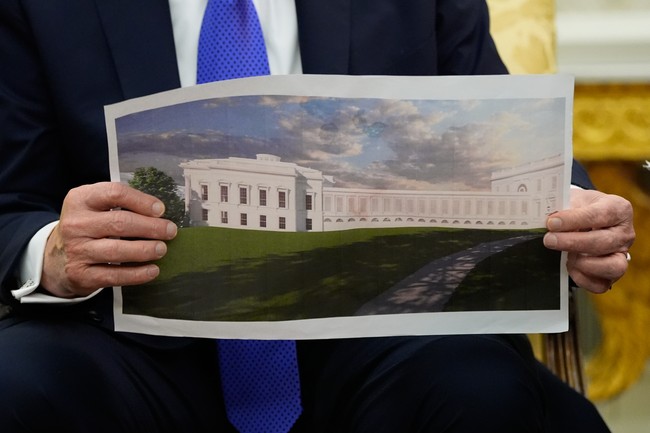
I will explain the controversy over the White House ballroom project, report the judge’s ruling and Trump’s reaction, outline the security rationale the administration gives, and note how this fight fits into the broader pattern of legal and political opposition in Washington.
Trump Blasts Ballroom Judge, Reiterates Project Was Always About So Much More Than a Banquet Hall
President Trump laid out a blunt response after a D.C. judge ordered that aboveground work on the White House ballroom stop, even as subterranean construction may continue. He framed the dispute as political obstruction rather than a genuine preservation concern and accused the judge of undermining national security. The exchange is the latest episode in a long-running legal fight over the privately funded project.
The judge’s ruling centered on a procedural point: the court said the aboveground construction lacked explicit congressional approval, so it should halt. The decision came after months of litigation and competing interpretations of what counts as a security exception. Critics argue this is just another example of judges stepping into political terrain, while the administration says the opposite.
Trump took the ruling personally and sharply. He called the jurist “a man who has gone out of his way to undermine National Security” and accused him of political motives that ignore public notice and prior opportunities to object. The president insists the plan was transparent and that opponents had time to challenge it earlier.
The president also stressed that the project is not merely a social venue but a major security investment for the presidency and visiting world leaders. His statement described a fortified, all-hazards facility designed to protect leaders during large events and emergencies. That argument has been central to the administration’s attempt to justify construction without the kind of congressional signoff the court emphasized.
If somebody, especially one with no standing, had a complaint — Why wasn’t it filed many months earlier, long before Construction was started? The Public Record was open for all to see. Everybody knew that it was planned, and going to be built. This highly political Judge, and his illegal overreach, is out of control, and costing our Nation greatly. This is a mockery to our Court System!
The administration highlights features it says make the ballroom essential to continuity and safety: shelters, medical facilities, protective partitioning, missile-resistant steel, and other hardened components. Trump argued those elements are vital for protecting the president at events, inaugurations, and international summits. He said the space is on budget and ahead of schedule and insisted it’s needed now.
…[He is] attempting to prevent future Presidents and World Leaders from having a safe and secure large scale Meeting Place, or Ballroom, one with Bomb Shelters, a State of the Art Hospital and Medical Facilities, Protective Partitioning, Top Secret Military Installations, Structures, and Equipment, Protective Missile Resistant Steel, Columns, Roofs, and Beams, Drone Proof Ceilings and Roofs, Military Grade Venting, and Bullet, Ballistic, and Blast Proof Glass —which all means that no future President, living in the White House without this Ballroom, can ever be Safe and Secure at Events, Future Inaugurations, or Global Summits. This Magnificent Space will allow them to carry out their vital duties as the Leader of our Nation. Furthermore, the Ballroom, which is being constructed on budget and ahead of schedule, is needed now.
Opponents, including preservation groups and some legal actors, say historic protections and statutory procedures matter and that ad hoc security claims should not override law. They view the judge’s order as a necessary check on executive actions taken without explicit congressional authorization. That legal line of attack has produced a string of rulings and appeals in recent months.
The White House has already appealed the decision, so the dispute will move up the judicial chain and likely return to full courtroom fights over standing, scope, and the reach of national security exceptions. For now, aboveground work is paused, and both sides are digging in. The contest feels emblematic of how big policy projects, even privately funded ones, can become courtroom battlegrounds in today’s polarized environment.
Whether the ballroom ultimately stands or falls will depend on appellate rulings and, possibly, congressional clarity. The administration is betting the project’s security case will prevail, while opponents are banking on procedural protections and preservation law to slow or stop construction. Either way, this case will be watched as a test of how far courts will let national security claims reshape domestic planning and historic preservation rules.


Add comment