
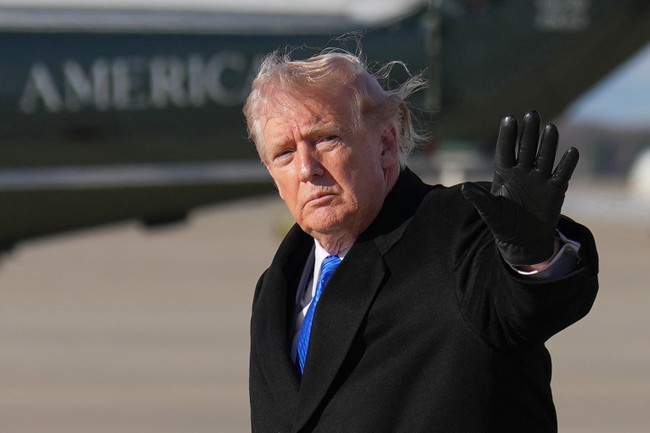
President Trump announced he would cancel a planned strike on Iran after regional allies urged de-escalation and requested time to negotiate terms, while still keeping leverage and the threat of force in play. The move combines firm military readiness with a diplomatic opening tied to concrete demands like ending Iran’s nuclear program and reopening the Strait of Hormuz. Republicans will see this as a mix of strength and smart restraint designed to protect American interests and avoid an unnecessary, unpopular war. This article lays out the sequence, the diplomatic pressures, the polling backdrop, and the political calculations behind the decision.
Trump’s public statement made clear the United States remained prepared to act with overwhelming force if diplomacy failed. “The USA is locked and loaded and ready to go against the Islamic Republic of Iran, at levels of Military Terror, Strength, and Power not seen since World War II,” Trump said. That kind of language signals to allies, adversaries, and domestic audiences that the option of force is real and credible.
“Despite this, we have just been asked by Iran, and other Middle Eastern Countries, to hold off any attack in that the perimeters of a deal has been agreed to.” That request set the terms for a pause: time to try to lock in enforceable commitments rather than rush into open conflict. From a Republican perspective, accepting a pause only if it secures hard demands is consistent with a results-oriented security policy.
The president tied any meaningful deal to strict conditions, including the reopening of the Strait of Hormuz and the dismantling of Iran’s nuclear weapons program. Those are not vague talking points; they are concrete national-security objectives that address both freedom of navigation and proliferation risks. Republicans can argue these are baseline goals that preserve U.S. credibility and regional stability if achieved.
https://x.com/WhiteHouse/status/2083736721586368904
Regional leaders applied unusual and public pressure on Washington to avoid immediate escalation. Reports indicate Saudi Arabia and other Gulf states urged de-escalation, worried about a wider conflagration that would destabilize the energy markets and the entire region. Their intervention illustrates how allies prioritize stability and how U.S. strategy must account for partner concerns even while maintaining military options.
Domestically, the timing of a potential war matters for the political landscape as much as for national security. Polling showed substantial public skepticism about a sustained war with Iran, with only a minority of Americans favoring continued military action. For Republicans running strong on national security, that presents a challenge: defend force as necessary while acknowledging voter fatigue with prolonged overseas engagements.
Within the Republican coalition, opinions are divided along ideological lines and loyalty to the president. A significant share of activists and voters aligned with Trump favor a robust posture, while others prefer restraint if the costs are high. The administration’s move to make a strike conditional on a deal attempts to thread that needle: preserve muscle memory while offering an off-ramp if tangible concessions are secured.
Strategically, pausing for talks can be advantageous if it produces verifiable outcomes and preserves options. If Tehran abandons nuclear pursuits and allows unrestricted passage through Hormuz, the U.S. secures major wins without open war. But if Iran uses the pause to rebuild capabilities or stall, the United States must be ready to resume pressure quickly and decisively.
Operationally, the president emphasized readiness and speed: canceling an attack is not the same as removing the capability to strike. That keeps Iran guessing and encourages rapid diplomacy under the shadow of force. It also forces regional actors to put up or shut up: if they asked for a pause, they now carry responsibility to help produce results.
Critics will say a pause rewards bad behavior or signals weakness, but supporters argue that extracting concrete concessions is the point. The Republican view here prioritizes outcomes over theatrical displays: power is useful only when it secures lasting American advantage. A deal that prevents nuclearization and guarantees maritime freedom would meet that test.
Practically speaking, any agreement will have to include verification measures and timelines to be credible. Republicans will press for inspection regimes, snap-back penalties, and clear benchmarks to ensure Iran cannot game the system. Without those safeguards, a pause risks becoming a pause in name only.
The political calculus ahead of the November cycle also matters. An unpopular, open-ended war would damage GOP prospects and strain the country’s economic resilience, which voters care about deeply. Steering toward a measured, enforceable solution is in line with conservative priorities: secure the homeland, protect the economy, and avoid unnecessary entanglements.
For now, the administration’s approach blends pressure with conditional diplomacy, keeping an eye on both national-security imperatives and political realities. The coming days will reveal whether Tehran and the regional players can translate this breathing room into a verifiable deal. If they do not, the United States has already signaled it will revert to the alternative: overwhelming force held in reserve.


Any deal with IRGC is worthless. Bomb the hell out of them til they are all dead.
I quote this imperative flaw that will not ever change; “the alternative: overwhelming force!”
That madman absolutely evil Islamist regime is HELLBENT and meant it every time they uttered Death to America, because they meant it 100% and those Evil to their core IRGC, Mullahs and any Ayatollahs in Iran SERVE Satan and everything about them is antithetical to Christianity, America and God Almighty! There can never be any peace or honest bullet proof negotiations made with them! The only solution is they all must GO, as in disappear by force or any other means, as in “if God Himself would wipe them off the face of the earth!”
All officials and the President have to accept that reality and wake-up to the fact that for nearly 50 years they’ve been out for blood, “American blood” and didn’t let up in any way, shape or form! Annihilate them! Trump got a top ringleader back in 2020 and that same type of action can be done many more times to destroy those devils where they lay or stand!
“On 3 January 2020, Qasem Soleimani, an Iranian major general, was assassinated by an American drone strike ordered by U.S. president Donald Trump near Baghdad International Airport in Iraq, while traveling to meet Iraqi prime minister Adil Abdul-Mahdi. Soleimani was commander of the Quds Force, one of five branches of Iran’s Islamic Revolutionary Guard Corps, which is designated as a terrorist organization by both the United States and European Parliament.” Wikipedia
Get it done!
God bless, in Jesus’ name.
Amen.