
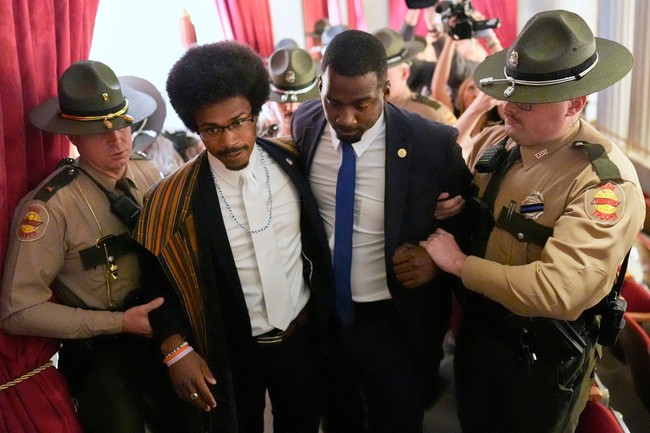
The viral photo of Tennessee state Rep. Justin Pearson standing before the Sergeant at Arms during a redistricting session sparked a flurry of online outrage, but a closer look shows the picture and the narrative around it do not line up with the facts. This piece lays out what happened, who amplified the image, and why the reaction says more about politics than reality. Read on for a clear account of the events, the mischaracterizations, and the political motive behind the spectacle.
The image that set off the storm was shared widely and framed as a dramatic example of racial exclusion. Prominent figures used charged language to paint the scene as evidence of systemic insult and erasure, but that framing ignored important details about the setting and the actors involved. When political theater replaces context, the public gets a distorted story designed to inflame rather than inform.
First, the photograph captured a moment at a state Senate committee meeting, not on the floor of the Tennessee House. That distinction matters because Pearson is a member of the House, not the Senate, so the optics of being “barred” from the chamber are misleading. The scene was dramatic, sure, but it was not the constitutional or procedural crisis many online commentators treated it as.
Second, the photo was amplified with a false narrative about Pearson being stripped of office or denied representation. He is running for the 9th Congressional District, not serving as its congressman, and the new map would likely complicate his path to victory. Political opponents and supporters can argue about the implications, but spinning the image into a story of official removal is inaccurate and dishonest.
Third, the portrayal of the moment as a singular instance of racial exclusion overlooks the full composition of the Tennessee General Assembly. There are multiple Black lawmakers serving in both chambers, and several representatives were active in the debate. Casting one staged moment as evidence of a statewide racial conspiracy simplifies a much messier political debate.
Influencers and media outlets piled on, sharing the photo with evocative captions and historical comparisons. One outlet wrote, “All of her photos from this past week share a visceral quality that harkens back to some of the iconic imagery from the civil rights movement,” elevating the image into symbolism. That kind of language turns a political dispute into a moral spectacle and encourages people to react emotionally rather than check the record.
Many of the most viral shares treated the image as if it proved a broader indictment of Tennessee or southern politics, invoking loaded phrases and sweeping claims. Those hot takes were then echoed by activists and politicians seeking to use the moment as leverage in a larger fight over redistricting. The communication strategy was obvious: dramatize, amplify, and let the outrage spread.
The photo showed Pearson positioned near the Sergeant at Arms, and viewers quickly supplied a narrative of exclusion and offense. That narrative fit neatly into talking points about voter suppression and racial bias, so it spread fast across social platforms. But context, including the actual venue and the procedural reality, was absent from most reposts.
Some accounts went further, suggesting Pearson had been ousted or that the event represented a unique attack on Black representation. Those claims collapsed under simple fact-checking: he was not removed from office, he does not represent the congressional district at issue, and the moment occurred in the Senate wing, not the House floor. Those basic points should have tempered the online reaction.
Pearson himself helped amplify the image by sharing it, knowing full well that the broader description did not match the facts. For those who study modern political communications, this is familiar territory. The performance and the headline matter more to some politicians than accuracy, and in a polarized environment, a compelling image can be more valuable than a careful account.
The broader redistricting fight is real and consequential, and honest debate about maps and representation is necessary. But when actors intentionally blur context for political gain, they degrade public trust and fuel cynicism. That tactic weakens real arguments and wastes energy that could be spent on substantive challenges to proposed maps.
These kinds of theatrics also have political consequences at the ballot box. Voters—especially those tired of performative politics—are noticing when spectacle replaces substance. Shifting allegiances among Black and Hispanic voters are driven by a complex mix of issues, but repeated displays that rely on manipulation and misdirection push some people away from the parties that stage them.
Political theater may rally a base in the short term, but it risks alienating persuadable voters who expect honesty and accountability. Lawmakers who choose optics over facts are playing a dangerous game: they win quick headlines but erode credibility over time. Meanwhile, the real work of debating redistricting, representation, and public policy gets sidelined.
Editor’s Note: The 2026 Midterms will determine the fate of President Trump’s America First agenda. Republicans must maintain control of both chambers of Congress.
When the smoke clears, what remains is a lesson about media literacy and motives. Viral images can be powerful, but they are not substitutes for context. Citizens and reporters alike would do well to demand clarity before amplifying divisive narratives.



Add comment