
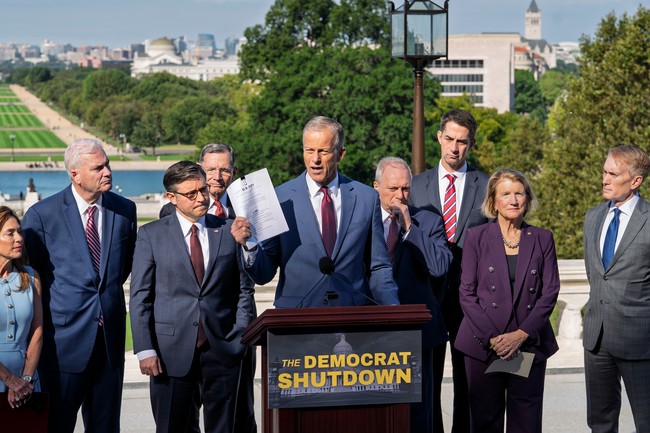
I’ll explain the new Senate move, quote the floor exchange exactly as reported, assess why withholding pay during a shutdown matters, connect it to broader Republican priorities, and note practical hurdles the bill faces. This piece focuses on the policy and politics around Senator John Thune’s proposal to stop senator pay during a federal shutdown.
Senate Majority Leader John Thune has pushed forward a resolution that would suspend senators’ pay if a government shutdown occurs. The proposal cleared a procedural step on Monday and now faces the Senate’s 60-vote threshold for cloture, making its path uncertain. The move is straightforward: hold elected officials financially accountable when they fail to fund the government.
Politically, the idea lands well with voters tired of Washington dysfunction. Conservatives have long argued that consequences should follow failures to perform core duties, and withholding pay during a shutdown is a blunt, visible consequence. It signals seriousness about budget discipline and accountability to taxpayers who suffer when essential services are interrupted.
Practically, the resolution faces predictable obstacles inside the Senate. Doctrinal and procedural hurdles, plus partisan calculations, mean that securing the 60 votes for cloture is a heavy lift. Some senators will worry about precedents for withholding compensation or about the political optics if funding disputes deepen; others will see it as a needed correction to a system that lets representatives avoid the fallout of their own gridlock.
Here’s a key point: voting to keep one’s own pay during a shutdown looks bad to voters, regardless of the legal complexity. The public generally accepts that elected officials should share accountability when their chambers let the government lapse. For Republicans, pressing this issue ties into a broader message about competence, fairness, and consequence-driven governance that resonates in swing states and with disaffected independents.
Here’s what was said:
Clerk / Presiding Officer: Calendar number 296, I should say. S. Res. 526. The clerk will report.
Clerk: Calendar Number 296, S. Res. 572 (sic). A resolution withholding the pay of senators if a government shutdown occurs.
Senator John Thune: Mr. President, I send a cloture motion to the desk.
Clerk: Clerk will report the cloture motion.
Clerk (reading the motion): Cloture motion. We, the undersigned senators, in accordance with the provisions of Rule 22 of the standing rules of the Senate, do hereby move to bring to a close debate on the motion to proceed to Calendar Number 296, S. Res. 526, a resolution withholding the pay of senators if a government shutdown occurs. Signed by 17 senators as follows…
Senator John Thune: Mr. President, I ask consent that the reading of the names be waived.
Presiding Officer: Without objection.
Senator John Thune: Thank you, Mr. President. Mr. President, I yield the floor.
Accountability mechanics aside, the principle is simple: if lawmakers fail at the essential duty of keeping the government open, they should face a tangible consequence. Voters do not separate politicians from policy when bureaucrats stop getting paid or when national services are disrupted. Holding senators financially accountable is a clear message that the people’s business matters more than political gamesmanship.
There are legitimate constitutional and statutory questions about pay and whether the 27th Amendment or other provisions come into play. Still, the political reality often outweighs technicalities; if the public demands action, lawmakers will find legal workarounds. Conservatives should press the point while staying honest about the need for coherent, conservative fiscal policy rather than mere political stunts.
This proposal also offers strategic value ahead of elections. Republicans can frame it as a commitment to responsible governance contrasted with opponents who favor indefinite bargaining that acts as a perpetual invitation to chaos. In closely contested races, demonstrating a commitment to accountability makes a difference with swing voters who care more about competence than party lines.
Opponents will argue that withholding pay could worsen stalemate by raising the stakes and making compromise harder. That argument has merit in some cases, but it also underestimates voters’ appetite for consequences and the deterrent effect of public scrutiny. For many conservatives, the risk is worth it if it discourages habitual shutdown threats and forces sincere negotiations.
If this measure gains momentum, its fate will depend on internal GOP unity and the willingness of some senators to put principle over personal comfort. For Republican leaders, the calculus is balancing boldness with pragmatism: push accountability, but be ready to navigate the messy realities of Senate procedure. Either way, the debate over this simple idea—no pay during shutdowns—will test who in Washington is serious about governing and who prefers the status quo.
Not paying senators during a shutdown is a long-overdue proposal that fits a conservative appetite for consequence-based governance. The question now is whether Senate Republicans can translate frustration into votes and whether the electorate rewards those who force the issue. Either way, the debate is a clear moment to make the case for accountability in a city that often resists it.



Add comment