
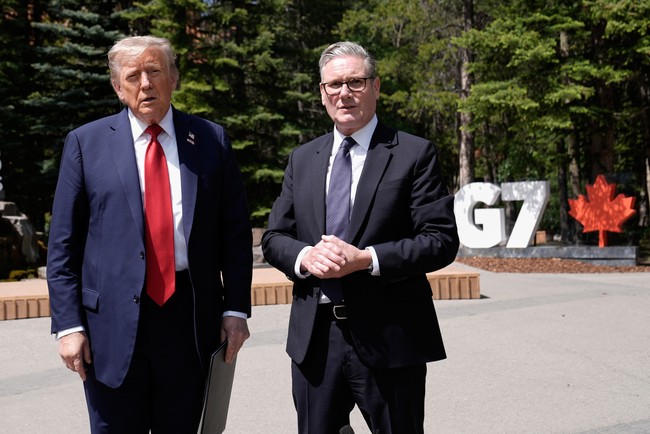
Keir Starmer reached out to Donald Trump after a sharp public rebuke over Britain’s initial refusal to back U.S. action on Iran; the Whitehall readout stresses condolences and cooperation while critics, including Tony Blair, say Britain should have backed America from the start.
UK Prime Minister Keir Starmer tried to smooth relations with President Donald Trump following an exchange over Britain’s stance at the outset of the recent Iran conflict. The official statement emphasized ongoing military cooperation and expressed condolences for the loss of six U.S. service members.
Starmer’s office : “The leaders began by discussing the latest situation in the Middle East and the military cooperation between the UK and US through the use of RAF bases in support of the collective self-defence of partners in the region. ” “The Prime Minister also shared his heartfelt condolences with President Trump and the American people following the deaths of six US soldiers. ” “They looked forward to speaking again soon”
At the start of Operation Epic Fury, Starmer reportedly refused U.S. requests to use British airbases, a choice that quickly shifted as U.S. and Israeli forces moved to degrade Iran’s military capabilities. The UK Ministry of Defense later put one of its aircraft carriers on advanced readiness and readied a destroyer for movement toward the region, signaling a reversal in posture.
That reversal did not stop President Trump from publicly underscoring his view that late support is hardly the same as standing together from the beginning. Trump’s message was blunt: “That’s OK, Prime Minister Starmer, we don’t need them any longer — But we will remember. We don’t need people that join Wars after we’ve already won! President DONALD J. TRUMP”
The timing of the call itself drew attention: Starmer’s team announced the conversation, while Trump’s office had not posted its own acknowledgment as of publication. That asymmetry fed the narrative among critics that Starmer was on the defensive, attempting to repair damage after an awkward early stance.
Inside Westminster, pressure mounted on Starmer from political figures who argue the Atlantic alliance must come first, especially during crises. Former Prime Minister Tony Blair was particularly pointed, telling colleagues that Britain should have offered support to the U.S. “from the very beginning.”
Blair said: “I am not saying anything that I haven’t already said to the government… I think we should have backed America from the very beginning.” “We have got to be very clear about this as a country. We’re depending on the American alliance for our country. They are not just an ally, they are an indispensable ally, right?”
He continued: “Every single time you test an alliance you never test it when things are easy. You test it when it’s hard. They were asking to use our bases to refuel… it’s not like it was in Vietnam… not like the Iraq campaign where we had thousands of British troops.” “The American relationship matters. It matters particularly today. It’s not a question of whether it’s this president or that president. If they are your ally and they are an indispensable cornerstone for your security… you had better show up”.
Critics on the right were quick to cast Starmer’s initial hesitation as evidence of weakness or of being swayed by domestic political factions that lean against firm alignment with Washington. Those critics argue that in geopolitics, reliability matters more than symbolic gestures, and allies notice who is present when it counts.
Supporters of Starmer counter that the prime minister had to balance cabinet politics, legal considerations, and public opinion in Britain when making an early decision about base access. The rapid developments on the ground, they say, made a later commitment inevitable once the operational picture changed and coalition needs became clear.
Whatever the internal debates, the episode has highlighted the strategic value the U.S.-UK relationship still holds and the political risks for leaders who appear slow to back their closest ally. Trump dismissed comparisons meant to flatter Starmer, quipping earlier this week, “He’s no Winston Churchill.”
Editor’s Note: For decades, former presidents have been all talk and no action. Now, Donald Trump is eliminating the threat from Iran once and for all.
It’s worth watching whether this phone call marks a genuine thaw or merely a short-term damage-control move. The optics matter: allies watch each other closely, and voters in both countries will remember who stood firm when tensions rose.
The obvious schlep Keir Starmer certainly isn’t even miles away from being as Trump correctly stated; “He’s no Winston Churchill.”
No comparison whatsoever!