
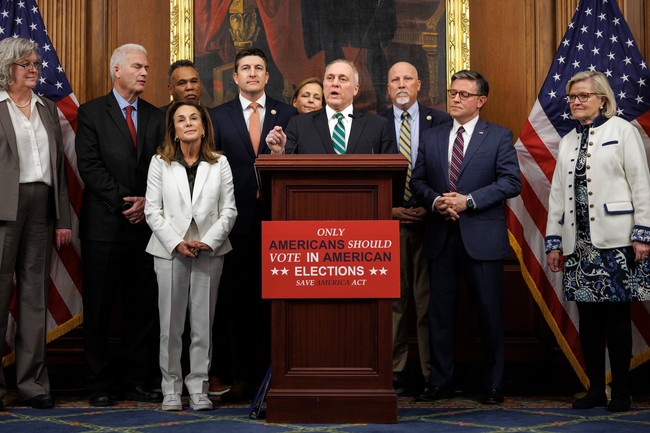
The Senate has voted to begin floor debate on the SAVE America Act, a high-profile voting reform pushed by former President Trump, and that move sets up a weekend and likely weeklong fight over proof-of-citizenship registration and voter ID requirements. Expect a contentious, partisan battle as Republican leaders press the bill to the floor while Democrats prepare a full-court press of criticism and amendment tactics. This piece walks through how the vote unfolded, why leaders chose a prolonged debate instead of a talking filibuster, and what to watch for next as the Senate navigates the issue.
The motion to proceed passed narrowly, and that slim margin tells you everything about the political dynamics in play. This vote only opens the door to debate — it does not pass the legislation — but it does let Trump-aligned senators frame the discussion and rally support for measures they see as restoring confidence in elections. With the chamber split and party-line tensions high, the next several days will be a test of messaging and stamina for both sides.
The Senate voted Tuesday to begin a long and contentious debate over the SAVE America Act, a bill that would require people to show documented proof of citizenship when registering to vote and a photo ID when casting a ballot.
President Trump has called the measure his No. 1 legislative priority.
The Senate voted 51-48 to proceed to the bill, advancing the measure despite the opposition of Sen. Lisa Murkowski (R-Alaska).
Sen. Thom Tillis (R-N.C.), who said last week he would vote against proceeding to the bill, missed the vote. Sen. Mitch McConnell (Ky.), who has told GOP colleagues that he doesn’t support the bill, voted to begin debate as a courtesy to the Senate Republican leadership.
Some Republican senators who have reservations still voted to proceed to debate out of deference to Senate process or party unity, and that illustrates how tactical this moment is. A single absence or a single defection can flip outcomes in a 51-49 Senate, so leadership often permits debate to let senators make their case publicly. For Republicans, the goal is to make the case that registration with proof of citizenship and ID checks will protect election integrity without disenfranchising eligible voters.
Opponents are already primed to label the measure suppressive and to flood the debate with amendments, rhetorical attacks, and procedural maneuvers. Expect Democratic strategists to mix substantive objections with cultural-political arguments designed to frame the bill as an attack on communities of color and urban voters. That messaging will be loud, and Republican supporters will have to maintain discipline while highlighting concrete reforms they say limit fraud.
The vote sets the stage for Trump’s Senate allies to hold an extensive debate over the next week in an effort to build political momentum for the House-passed legislation, which Trump says will be critical to Republicans keeping control of Congress in the midterm election.
Sen. Mike Lee (R-Utah), a leading proponent of the bill, has argued that a prolonged floor debate on the measure could build political support for the bill, similar to how senators mustered support for the 1964 Civil Rights Act during a two-month Senate floor debate.
Senator proponents are leaning on history and optics: a long, public debate can shift public opinion and place pressure on wavering senators. Republican backers want to use the floor time to force Democrats to defend their current positions on voter eligibility and ID, turning the hearing into a referendum on election integrity. If done well, this strategy could clarify where each senator stands for voters ahead of crucial elections.
Some Republicans are skeptical of the bill’s political upside, but they still see value in the debate. The chair of the majority opted against a talking filibuster and instead plans a sustained calendar presence for the bill over the weekend and into next week. That choice was tactical: a talking filibuster would open the door to unfettered amendment offers that could derail the legislative vehicle or add poison-pill language.
Senate Majority Leader John Thune (R-S.D.) has declined to force Democrats to wage a talking filibuster, which would require continuous floor debate, to block the legislation. But he instead will keep the measure on the floor through the weekend and into next week to highlight Democratic opposition to its voting reforms.
“The talking filibuster has different sets of rules that apply. There are no rules of germaneness on amendments,” he said.
That approach lets Republicans spotlight Democratic resistance while limiting the ability to tack on unrelated amendments that could complicate the bill. Democrats will still try to use amended language and messaging to paint the legislation as exclusionary, and their attacks will focus on claims that the bill prevents certain groups from voting. Republicans need to counter those claims with clear examples of how ID and citizenship verification promote confidence in elections without blocking lawful participation.
The Senate debate will unfold over several days, and each exchange will be a chance for both sides to score political points. Watch for how amendments are managed, which senators break ranks, and whether public opinion shifts in the hours after the first speeches. This fight is about policy, yes, but it is also a test of political narrative control heading into the next major election cycle.
Editor’s Note: The Democrats are doing everything in their power to undermine the integrity of our elections.

I have to show a photo id when checking in at the doctor’s offic. Why in hell should voters not be expected to do the same. If this bill is exclusionary, I guess said people don’t go to doctors or the DMV. What a bunch of BS! Damn demoncrats.