
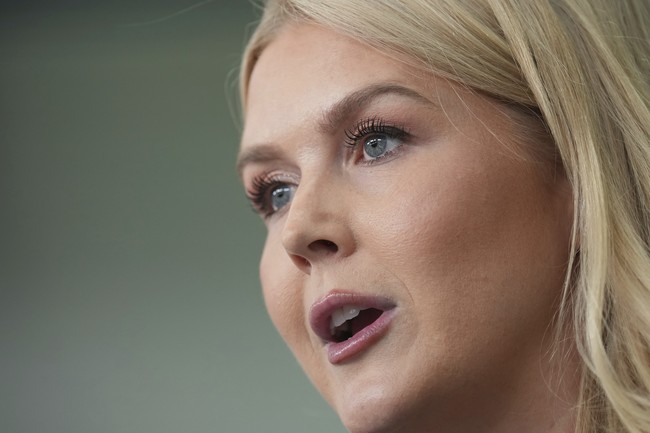
The White House press briefing this week delivered a blunt warning to Iran: private words will be tested, and failure to keep promises could meet military consequences. Press Secretary Karoline Leavitt framed talks as a real opportunity while reminding listeners that past Iranian leaders lied and faced severe outcomes. The administration portrays negotiations as part of a strategy that mixes diplomacy with the credible threat of force. Meanwhile, questions linger about who in Iran the President is actually talking to and whether those interlocutors can be trusted.
White House Press Sec Drops Bomb on Iran: Lie to Us and Get Hit
At Monday’s briefing, Karoline Leavitt answered a question about Operation Epic Fury with sharp, purposeful language aimed at Tehran. She stressed that private assurances will be evaluated and that the United States will hold Iran accountable if those assurances prove false. The message was straightforward: words matter, but actions matter more.
The President’s team is signaling that diplomacy is not naive or endless. Leavitt made it clear that promises given behind closed doors will be tested publicly, and there will be consequences if commitments are not honored. That posture blends an opening for negotiation with an explicit warning that military options remain on the table.
Embedded in the coverage is a reminder of how the administration frames past interactions with Iran. Leavitt contrasted current private discussions with prior dealings she described as filled with deception, noting that past deceit produced severe responses. That history is used to justify a tougher, less trusting approach to whatever assurances Iran makes now.
The briefing included language that left little doubt about the stakes. Leavitt said anything Iran tells the United States privately will be tested and that the President has spelled out military consequences for failures to follow through. That kind of statement is meant to be unambiguous: promises aren’t enough without verifiable action.
..will see if they don’t hold true to the words that we are hearing privately, behind the scenes.
She went on to emphasize testing and accountability, asserting that private conversations must align with concrete behavior. Leavitt framed the current interlocutors as more reasonable behind closed doors than some previous leaders, arguing past leaders “lied to the United States and they strung us along in negotiations.” That exact phrasing underscored a policy shaped by skepticism and deterrence.
Well, that’s part of the ongoing process that is taking place and the ongoing negotiations. Of course, anything they say to us privately will be tested, and we will ensure they are being held accountable to their word, and if they are not, the President has laid out the military consequences that the Iranian regime will see if they don’t hold true to the words we hear privately behind the scenes.
When the President says ‘more reasonable,’ again, these folks are appearing more reasonable behind the scenes privately in these conversations than perhaps some of the previous leaders who are now no longer on planet Earth, because they lied to the United States and they strung us along in negotiations, and that was unacceptable to the President, which is why many of the previous leaders were killed.
Reporting also surfaced a name: Mohammad Bagher Ghalibaf, the Iranian Parliament Speaker, has been mentioned as someone President Trump is supposedly speaking with. That revelation raises immediate skepticism because the revolutionary regime’s culture of deception stretches back to 1979. It’s fair to ask whether any figure from that system can credibly break with entrenched patterns.
Leavitt called this a historic opportunity for Iran to abandon nuclear ambitions and reach a enforceable deal with the administration. She warned that refusal would bring “grave consequences of the United States armed forces,” language intended to make clear the costs of failing to change course. Those words aim to steer Tehran toward verifiable concessions rather than delay tactics.
Yet Tehran’s playbook historically includes stalling, asymmetric attacks, and testing patience through repeated provocations. That pattern presents a persistent risk: if Iran can keep launching drones and irregular strikes, it may hope the West will eventually accept a compromised settlement. The administration’s insistence on verification and accountability is meant to deny Iran that escape hatch.
The situation leaves policymakers with limited, stark choices: press for verifiable, monitored change that removes the nuclear threat and excludes regime insiders from power, or accept a fragile ceasefire that leaves the core problem intact. Leavitt and the President are pushing for the former while making it plain that the latter will not be tolerated without a price.


Add comment