
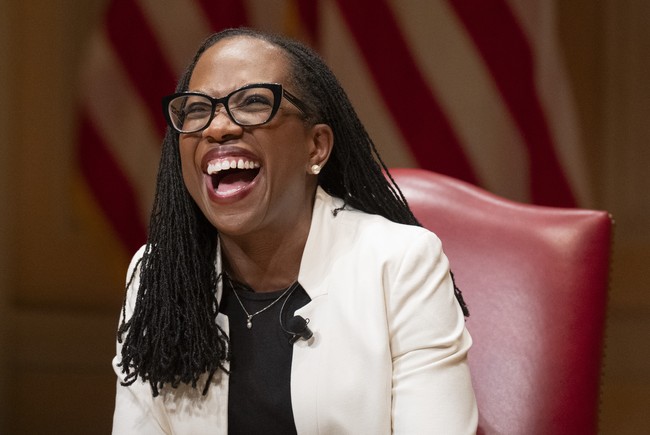
I’ll show how Justice Ketanji Brown Jackson’s podcast appearance clashes with calls for impartiality, recap reactions from fellow justices and the public, include her exact remarks on bias, present critical responses from social platforms, and highlight the tone of the episode without linking to outside sources.
Supreme Court Justice Ketanji Brown Jackson spoke about judicial neutrality while appearing on a high-profile podcast, and the optics are hard to ignore from a conservative perspective. Her message claimed a strict focus on avoiding partiality, but critics say her courtroom record and public persona do not match that claim. For Republicans watching, the disconnect between message and image looks striking and worth scrutiny.
Jackson has a reputation among many conservatives for emotive writing and for asking pointed, often lengthy questions during oral arguments. That style has drawn sharp rebukes from other justices, who have used blunt language to criticize her reasoning and rhetorical choices. Those exchanges are part of the backdrop Republicans use to question how committed she really is to a neutral, restrained approach on the bench.
Justice Amy Coney Barrett, for example, wrote that “We will not dwell on Justice Jackson’s argument, which is at odds with more than two centuries worth of precedent, not to mention the Constitution itself,” reflecting a strong institutional disagreement. Justice Clarence Thomas has objected to what he called a “race-infused world view,” and Justice Samuel Alito labeled one dissent “baseless and insulting” and said her rhetoric “lacks restraint.” These critiques are often cited by conservatives as evidence that Jackson leans toward advocacy rather than adjudication.
Given that context, her decision to appear on a podcast hosted by Michelle Obama — a leading figure of the Democratic establishment — raised immediate concerns about impartiality for critics. The episode’s title framed her as someone navigating “hard times,” a phrase some found oddly sympathetic for a sitting Supreme Court justice. For many on the right, being hosted by a major partisan figure while lecturing about neutrality just intensifies doubts rather than easing them.
How could a justice expect to convince skeptics of impartiality while sitting in a relaxed, conversational forum with a former first lady who remains a strong partisan symbol? That is exactly the question conservative commentators and activists posed after the episode aired. The issue isn’t simply the conversation itself, but the cumulative impression: high-profile appearances can blur the line between public engagement and political signaling.
https://x.com/RepLisaMcClain/status/2082906586847084777
During an appearance of more than an hour on the podcast, Jackson, a Biden appointee to the Supreme Court, stressed the importance of being unbiased, saying, “You really have to be focused on that.”
“There are lots of limits on what judges can do, and I try to be very, very mindful and scrupulous with respect to that because, as you say, our obligation is to be unbiased in our approach,” said Jackson.
“And, so, you have to then navigate all the sources that could make for an appearance of partiality, which you want to avoid.”
Those exact words are the heart of the matter for critics who see them as tone-deaf given Jackson’s record and affiliations. Saying “our obligation is to be unbiased” rings hollow to observers who point to cases and public commentary they view as ideologically tinted. Conservatives argue that impartiality is demonstrated in decisions and legal reasoning, not just stated on a podcast with a celebrity host.
The online reaction was swift and scathing, with social posts mocking the perceived mismatch between message and medium. Many posts highlighted the irony of preaching neutrality from a platform associated with a powerful Democratic figure, treating the episode as a public relations move rather than a sober discussion about judicial duty. That wave of criticism served to amplify partisan doubts about her fitness for a role that demands strict detachment from political influence.
Republicans also point to the confirmation dynamics that brought Jackson to the bench, arguing the selection was driven more by identity considerations than by a purely meritocratic judicial evaluation. Those concerns feed into the larger narrative that high court appointments today are as much political as they are judicial. In that view, every public appearance with partisan celebrities becomes more than an interview — it becomes evidence.
Additional commentary from commentators and aggregators piled on, emphasizing the disconnect between lofty statements about the dignity of the courts and the reality of partisan optics. For conservatives, the substance of judicial impartiality must be visible in both ruling patterns and selective public engagements. Without that consistency, assurances of neutrality sound like talking points.
Ultimately, the podcast episode did what public appearances often do: it revealed as much about perception as it did about intent. For Republicans watching the high court, the message was clear — rhetoric about impartiality will be judged against a justice’s record and associations, and any sign of partisanship will be seized on as validation of long-standing concerns.
The hour-long conversation will continue to be cited by critics as an example of how a justice can undermine her own credibility through celebrity platforms. Conservatives will keep pointing to the mismatch between word and deed as evidence that the debate over judicial impartiality remains unresolved. That debate is only likely to intensify as high court decisions touch on increasingly charged political questions.



Add comment