
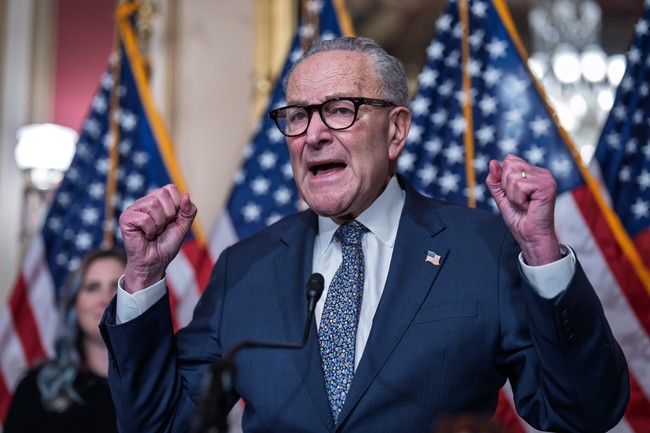
Senate Minority Leader Chuck Schumer went to the National Press Club to deliver a big anti-corruption talk and instead got interrupted by a protester who accused him of backing genocide, triggering an uncomfortable back-and-forth that exposed faults in Schumer’s handling of dissent and the broader Democratic infighting over foreign policy and party direction.
Chuck Schumer arrived expecting a controlled address aimed at attacking President Donald Trump, but the event quickly derailed when an audience member stood up and challenged him directly. The protester accused Schumer of hypocrisy on corruption given his record and his stance on Israel, and Schumer’s attempts to quiet the interruption only made the moment more awkward. The clash underscored how sensitive and fractious the debate is within the Democratic coalition.
The protester put it bluntly: “You talk about corruption, how can you talk about corruption when you back genocide? What can be more corrupt than genocide? This is part of the same con of you and Trump playing off of each other,” and he said Schumer had been “put on notice” by the Center for Constitutional Rights and other organizations for “aiding and abetting” genocide. Those exact words landed in front of a national audience and forced Schumer to respond on the spot. The room’s reaction showed that party messaging can collapse when internal tensions spill into public forums.
Schumer tried to move past the interruption with a dismissive line: “Thank you for your diatribe. Now let’s continue. Let’s continue.” That kind of brush-off is a classic political move, but it didn’t settle the crowd and it didn’t address the accusation. When leaders respond with dismissal instead of engagement, it makes them look either tone-deaf or defensive, neither of which helps the party politically.
https://x.com/cspan/status/2082837981887451238
He then escalated, telling the protester, “The people didn’t come to hear you,” and motioning for him to be removed. The protester pushed back with a harsher charge: “You should be questioned about your diabolical record,” and later shouted, “It’s amazing that you can show your genocidal face in public! Mr. Senator! Mr. Senator! Shame on Public Citizen for not allowing questions to this genocidal maniac.” Those lines echoed loudly, and Schumer’s aides faced the kind of disruption that leaves a leadership image bruised.
Schumer has long been a reliable supporter of Israel, and that posture puts him at odds with parts of the left flank that now demand tougher scrutiny of U.S. policy. The protest shows the fault line: establishment Democrats want to maintain traditional alliances, while the far left leverages moral language that can be politically devastating if opponents amplify it. Republicans see this as proof the Democratic coalition is fracturing under its own contradictions.
On top of policy fights, the episode highlights political strategy failures. For much of the last decade, Democrats have chosen confrontation—attacking President Donald Trump—as their default message, instead of offering clear policy solutions. Schumer’s focus on partisan attacks rather than addressing voter concerns about the economy, inflation, and national security leaves openings for Republicans to cast themselves as the pragmatic, steady alternative.
This public moment also matters for midterm politics. The Democrats’ internal disputes, combined with concerns about extremism, fundraising challenges, and redistricting, create vulnerabilities that Republicans can exploit. When party leaders stumble in public, it becomes an image problem that can influence undecided voters and energize the opposition.
Beyond immediate political consequences, the confrontation signals a possible future for Schumer within his own party. Pushed by activists and primary threats from the left, establishment figures risk being challenged if they can’t reconcile competing factions. For Republicans watching, this dynamic offers both tactical advantages and ammunition for messaging about Democratic disarray.
What happened at the National Press Club wasn’t just an awkward interruption; it was a window into the broader struggles consuming one major party. Schumer’s handling of the incident—attempting to shut down a critic, then deflecting—played into narratives about Democratic leadership weakness. For Republicans, that’s another reminder to emphasize competence and steadiness while the left continues to self-destruct in public.

Add comment