
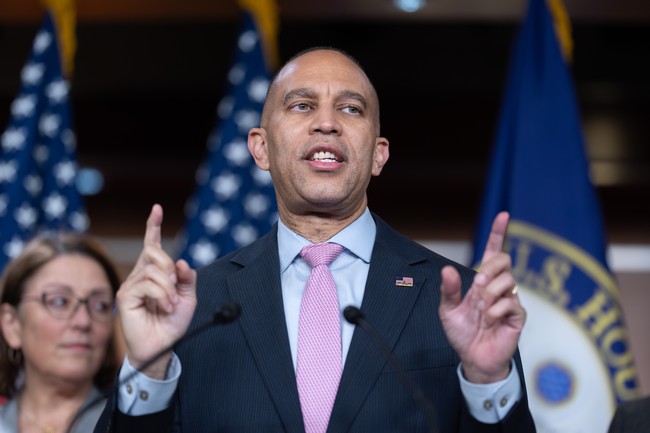
The Democratic Party is facing embarrassment in Texas after Maureen Galindo’s inflammatory social posts, and House Democratic Leader Hakeem Jeffries is attempting damage control while critics point to a pattern of extremist rhetoric among some left-wing figures nationwide. This article examines Galindo’s remarks, Jeffries’ response, related examples of troubling comments from other Democratic hopefuls, and why Republicans say the party’s leadership can’t or won’t fully address this strand of radicalism.
Texas Democrats are wrestling with fallout after Maureen Galindo’s disturbing social media statements surfaced and she still led the primary field. Voters pushed her to a runoff, and she now says her comments were mischaracterized, while fellow Democrats scramble to distance themselves. Republicans are seizing the moment to question the party’s judgment and the broader direction of its coalition.
The controversy centers on a social media post attributed to Galindo that was widely circulated and criticized. The content forced local and national Democrats to respond quickly, and opponents jumped in to highlight what they call dangerous rhetoric from within the party. This is playing out as the runoff approaches, and it has become a flashpoint in the 2026 election cycle.
In an Instagram post last week, Galindo wrote that she will “turn Karnes ICE Detention Center into a prison for American Zionists and former ICE officers for human trafficking. (It will also be a castration processing center for pedophiles which will probably be most of the Zionists).”
Hakeem Jeffries publicly denounced the comments and said she had been “roundly condemned by Democrats across the political spectrum.” He also claimed Republicans were helping boost her candidacy, which created a contentious back-and-forth. Conservatives argue that invoking GOP involvement is an attempt to deflect from the failure of Democratic voters and operatives to prevent extreme candidates from rising.
After Jeffries’ remarks, the story shifted to whether outside groups had a hand in promoting Galindo, with attention on metadata and donations used as evidence by some reporters. Republicans counter that the central issue is not who pushed her but why Democratic voters elevated a candidate with such inflammatory rhetoric. The debate is less about campaign mechanics and more about party priorities and tolerance for extreme views.
Asked about allegations that Republicans have backed Galindo, House Speaker Mike Johnson told reporters Wednesday: “Of course not. I didn’t even know this person existed.”
“I don’t know anything about it, except that these crazy comments surfaced yesterday, and a number of people sent it to me, and I thought this is a perfect example of where the Democratic Party is going,” he said. “We say all the time: This is not your father’s Democratic Party.”
Republicans point out that no known GOP figure endorsed Galindo or her statements, and that Johnson’s reaction highlights a perception problem for Democrats. The criticism frames the issue as symptomatic: even when overt extremism appears, party structures either fail to catch it or choose to look the other way. That’s the argument being pressed by conservative commentators and activists.
Beyond Texas, other recent incidents are being used to illustrate a pattern of unacceptable behavior among some Democrats. In Maine, a Senate candidate previously reported to have a Nazi tattoo and accused of making repulsive comments resurfaced in conservative coverage. Those examples are woven into a broader narrative that the party tolerates or overlooks fringe elements within its ranks.
Democratic leaders, for their part, insist they condemn hate and bigotry when it appears, but critics argue such statements are often reactive and insufficient. Republicans say the frequency of these scandals shows a deeper cultural shift within the party that leadership has not rooted out. The result is a persistent line of attacks portraying Democrats as unmoored from mainstream values.
For conservative observers, the lesson is straightforward: highlight these episodes and pressure Democrats to take responsibility for the people they nominate. That strategy is aimed at persuading swing voters who are uncomfortable with extremism of any stripe. Whether that approach changes the Democratic Party’s internal dynamics remains to be seen.
The Galindo controversy is a test case for both parties. Democrats must decide whether quick denunciations will satisfy voters and stem damage, or whether more active gatekeeping is required. Republicans will continue to press the narrative that these incidents reflect systemic problems, not isolated mistakes, and will use them in campaigns through November and beyond.


I quote; “extremist rhetoric among some left-wing figures nationwide.”
Jeffries is nothing but an extremist Islamist Enemy of America within and should already be in GITMO before a Military Tribunal for Sedition, Treason and other equally serious crimes!!!