
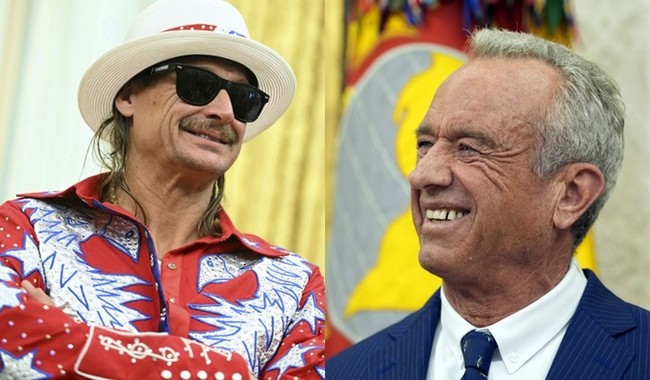
I’ll walk through why this pairing matters, what the video shows, how the message fits into a broader Republican view of health and personal responsibility, and why the spectacle actually advances a practical public-health point without sacrificing a sense of humor.
The scene was unexpected: RFK Jr. and Kid Rock working out together, shirtless at points, taking cold plunges, and promoting basic health habits. For many conservatives, surprises in the Trump era have become a theme, and this odd partnership is another example. It’s easy to mock the theatrics, but the core message here—eat better, stay active—lines up with long-standing Republican values of individual responsibility and strong families.
The short promotional piece stages a folksy, muscle-and-grit tableau rather than a polished government video. It mixes Americana imagery with gym-bro antics, which makes the whole thing feel intentionally over-the-top. That theatrical choice lowers the guard of viewers who might otherwise ignore a conventional health PSA and gets attention in a crowded media landscape.
Critics on the left and in legacy media immediately labeled it cringe or unhinged, but dissenting opinions don’t negate the point. When conservative policymakers talk about health, they typically stress prevention, local solutions, and personal agency—this video speaks that language in a loud, populist register. In practice, telling Americans to choose real food over processed products and to move more is common-sense advice that can reduce chronic disease and shrink healthcare costs over time.
Part of the value here is messaging that reaches nontraditional audiences. Pop culture figures like Kid Rock have cultural capital with working-class voters who might tune out a bland public service announcement. Pairing a public official with a recognizable entertainer creates a bridge to communities where obesity and poor diet are persistent problems. That kind of outreach is practical politics: persuade people to adopt healthier habits rather than lecture them from a podium.
Some moments in the video lean into absurdity to keep viewers entertained, such as the sauna bike and an unexpected cold plunge performed while still wearing jeans. Those choices are memorable and shareable, which is useful for public-health outreach in the social-media era. The stunt element doesn’t erase the underlying policy concern—too many Americans consume high-calorie, low-nutrition food—and it may even make the warning stick.
Set to the rocker’s “Bawitdaba” song, the one-minute, 30-second comical video, described as “Secretary Kennedy and Kid Rock’s Rock Out Workout,” opens with the pair posing shirtless next to what appeared to be a taxidermied bear wearing a hat, and then shows quick shots of the American flag, a shark, a military plane, bears and an eagle.
The two men are also seen preparing food in a kitchen, holding an American flag in front of an imitation Statue of Liberty and sitting in a convertible.
Beyond spectacle, the video surfaces a serious statistic that should alarm anyone who cares about national strength: a large percentage of Americans are overweight or obese. That impacts labor force participation, military readiness, and long-term fiscal health. Republicans who prioritize national resilience should welcome any frank conversation that leads to healthier citizens and a more sustainable healthcare system.
Kennedy rides a stationary bike in the sauna wearing jeans while Kid Rock can be seen doing push-ups in the background. The pair then switch places.
After the sauna workout, Kennedy jumps into a cold-plunge tub while still wearing his jeans.
After getting out of the cold plunge, Kennedy wonders, “Where’s Kid?” and he finds the rocker relaxing in a heated swimming pool.
Politically, this kind of unconventional outreach underscores a broader Republican strategy: speak plainly, use cultural messengers, and emphasize practical outcomes. Health policy debates often get lost in bureaucratic jargon, but telling people to prioritize whole foods and daily activity is a message anyone can grasp. It also dovetails with conservative ideas about decentralizing care, empowering families, and preventing disease at home.
The video’s critics will continue to gripe about tone rather than substance, and partisan media will spin it however they please. But from a conservative angle, this partnership works because it reframes government messaging in a way that respects personal freedom while nudging citizens toward healthier choices. If that’s what it takes to get people moving and eating better, a little theatricality is a reasonable price to pay.
To conclude with a light note: anyone who can make a health point while also being a little silly is doing more than a press release ever will. The core ask is straightforward—choose real food and stay active—so if an offbeat video helps deliver that, it earns a place in the modern public-health playbook.


Add comment